Discover Ace Frehley of KISS: his story, gear, technique and the Les Paul tone that helped shape hard rock at full voltage.
16 min read
··By Luciano Bastos / Luciano Bastos Guitar
01
Basic Data
Field
Information
Full name
Paul Daniel Frehley
Stage name
Ace Frehley
Date of birth
April 27, 1951
Date of death
October 16, 2025
Birthplace
The Bronx, New York, USA
Nationality
American
Genres
Hard rock, heavy metal, glam rock
Instrument
Guitar, vocals
Nicknames
Ace, Space Ace, The Spaceman
02
Introduction
Ace Frehley belongs to that rare class of guitarists whose identity comes through almost instantly. He was never primarily celebrated as a clinical technician or an ultra-precise shredder. He was celebrated for something harder to teach: instant character. A few notes were enough. The vibrato sounded vocal, the bends felt physical, and the solos behaved like mini-choruses embedded inside the song itself.
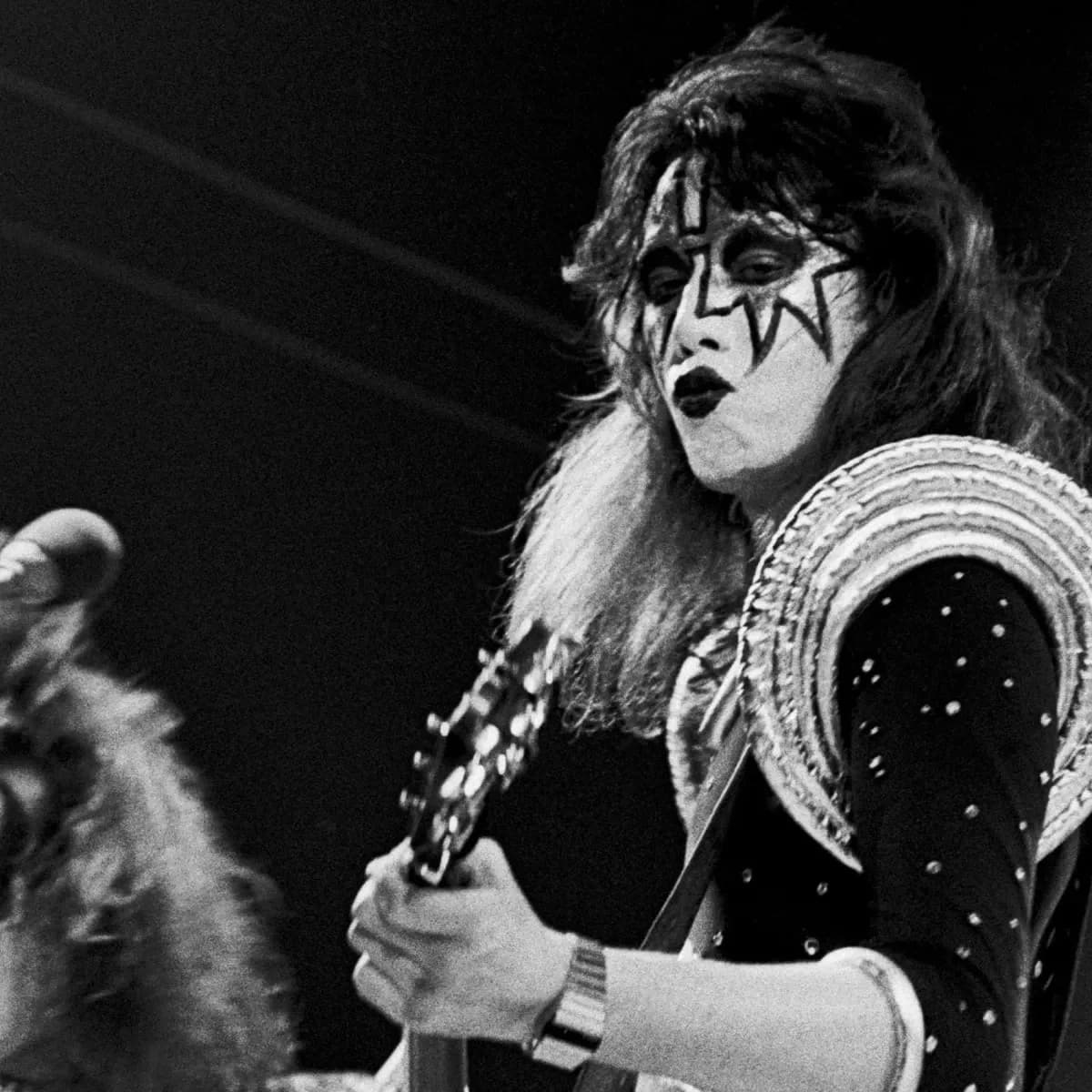
As KISS’s original lead guitarist, Frehley helped shape both the sound and the imagery of one of rock’s most important arena bands. The Spaceman persona, the smoke- and rocket-equipped Les Pauls, the direct blues-based phrasing and the raw electric swagger all fused into one complete artistic statement. Inside KISS, he was the melodic engine, the wild card and the player who often pushed the band toward its heaviest guitar moments.
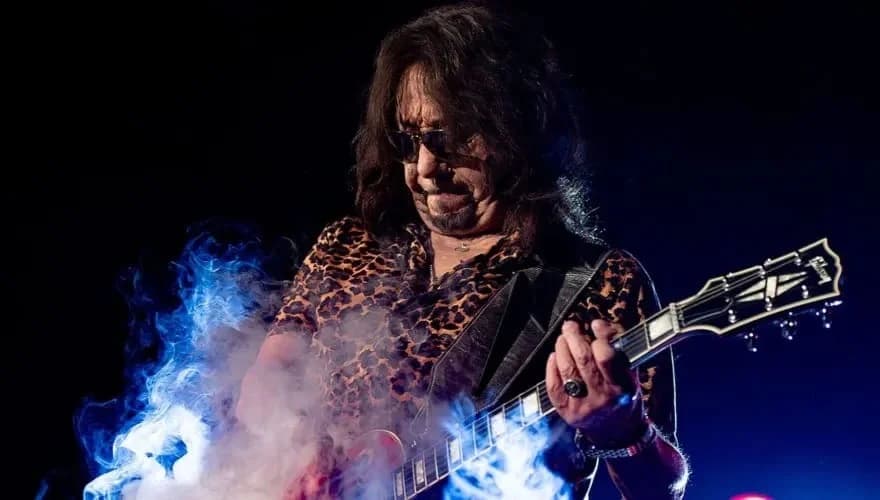
For anyone searching Ace Frehley gear, Ace Frehley guitar tone, or how to sound like Ace Frehley, the answer still starts in the same place: a Les Paul, a Marshall-style amp, enough gain to let sustained notes sing, and a right hand that attacks with conviction. After that, it becomes a matter of feel, attitude and the unmistakable sense of danger that made the Spaceman one of hard rock’s most influential guitar heroes.
03
First Steps
Paul Daniel Frehley was born in the Bronx into a musical family. Piano, acoustic guitar and a general respect for music were part of the household atmosphere, so music never felt remote or exotic. Once he received his first electric guitar as a teenager, he dove into it obsessively. Frehley often emphasized that he never went to music school and never took formal guitar lessons; he learned by listening to records, copying phrases, making mistakes and slowly turning instinct into style.
That self-taught route explains a great deal about his playing. Instead of approaching the guitar as a technical exercise, he approached it as impact. The goal was to make one note count for three, not to play thirty notes to prove a point. That is how the teenage kid from the Bronx absorbed Hendrix, Jeff Beck, Buddy Guy, B.B. King, Led Zeppelin, the Stones and the rebellious spirit of late-’60s British and American rock.
Before fame, he passed through local groups such as The Outrage, Four Roses, King Kong, Honey, The Magic People, Molimo and Cathedral. In 1973, he answered Paul Stanley and Gene Simmons’ famous ad seeking a lead guitarist. Legend says he showed up wearing one red sneaker and one orange sneaker; what matters is that once he played, the reaction was immediate. His image, stage presence and tone completed exactly what the future KISS needed.
04
Musical Influences
Jimi Hendrix
The Jimi Hendrix Experience / Solo
Frehley cited Hendrix as a defining influence not only because of the music, but because of the attitude. The lesson was in the incendiary phrasing, expressive feedback and the idea that a guitar could sound dangerous, sexual and futuristic at the same time. The barely controlled edge of Ace’s work on songs like Strange Ways traces straight back to Hendrix.
Jeff Beck
The Yardbirds / Jeff Beck Group
From Beck came the understanding that one sustained note, bent and vibrated correctly, can say more than a long flurry of notes. Ace’s cutting tone and his willingness to privilege personality over geometric perfection clearly belong to that tradition.
Buddy Guy
Chicago Blues / Solo
Ace’s rougher blues side owes a lot to Buddy Guy. Many of his best solos rely on hard bends, dramatic pauses and simple, almost spoken resolutions. Even within a bombastic band like KISS, the core of his phrasing vocabulary remained electric blues.
B.B. King
Solo
B.B. King reinforced the idea of the singable guitar solo. Frehley was never a guitarist of excess; much of his finest work comes from choosing very few notes and delivering them with enormous instinct. That is deeply connected to B.B.’s school of melodic economy.
Jimmy Page
Led Zeppelin
Page showed him that riff-writing and spectacle could coexist. The way Ace built songs such as Cold Gin and Parasite owes a great deal to heavy British hard rock, where blues roots and proto-metal weight live side by side. His taste for dirty textures and spontaneous-feeling solos also comes from that lineage.
The Rolling Stones and The Who
British rock
These bands helped shape the dry, physical directness in Ace’s playing. The street-level groove, controlled messiness and sense that rock should still feel dangerous all surface repeatedly in the first KISS records.
05
Bands and Projects
Band / Project
Period
Notable Albums
KISS
1973–1982, 1996–2002
Kiss (1974), Alive! (1975), Destroyer (1976), Love Gun (1977), Alive II (1977), Psycho Circus (1998)
Ace Frehley (solo album from the KISS solo project)
Ace joined KISS while the band was still becoming itself. The group already had ambition, concept and appetite for excess, but it needed the right kind of creative chaos. He supplied that in the form of riffs, solos, stage ideas and even visual input: the first sketch of the classic KISS logo came from him before Paul Stanley refined it.
In the 1970s, his role was far bigger than quick overviews sometimes suggest. Songs such as Cold Gin, Parasite, Shock Me and Rocket Ride are not footnotes in the KISS story; they are part of the hard-rock core of the catalog. Whenever the band wanted to sound dirtier, meaner or more guitar-driven, Frehley was often the one nudging the music in that direction.
After his first departure, his artistic rebuild took shape with Frehley’s Comet. The project showed a more sober, more self-aware Ace who still knew how to write massive riffs. Rock Soldiers became the anthem of that phase. From 2009 onward, another strong run of solo records restored his name as an active creative force, culminating in Space Invader and 10,000 Volts, albums that proved the Spaceman could still deliver hooks, riffs and solos with identity.
06
Instruments and Equipment
🎸Guitars
1973 Gibson Les Paul Deluxe Tobacco Sunburst
The Les Paul that defined early KISS. Ace bought it at Manny’s Music in New York and swapped the original mini-humbuckers for DiMarzio pickups to get more gain, stronger mids and a more aggressive attack.
1976 Gibson Les Paul Custom Cherry Sunburst 'Budokan'
Probably the Les Paul most associated with his classic image. He added a non-functioning middle pickup for the look and used DiMarzio Super Distortions for a hotter, fiercer sound.
Black Les Paul Custom 'The Smoker'
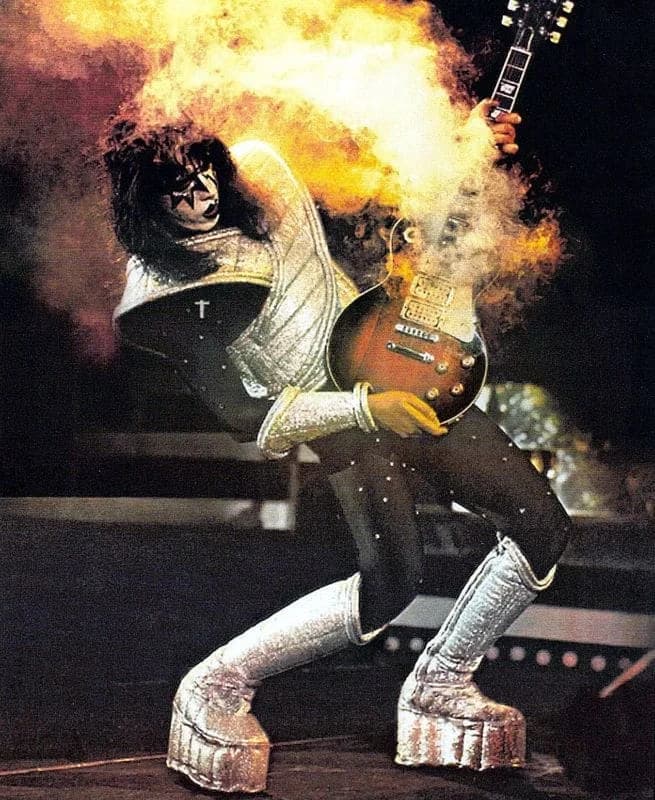
The smoking guitar from KISS’s classic era. More than a gimmick, it summarizes the way Frehley fused showmanship with instrumental identity.
TV Yellow Les Paul Special 'New York Groove Guitar'
The illuminated guitar used for 'New York Groove'. It was modified with hundreds of bulbs to turn the solo spotlight moment into total spectacle.
1957 Les Paul Black Beauty 'Rocket-Shooting Guitar'
The legendary rocket-launching Les Paul. It was outrageous, undeniably KISS, and a perfect symbol of how Ace treated the guitar as an extension of character.
🔊Amplifiers
Marshall 100-watt stacks / Super Lead
The heart of classic Ace tone. Frehley himself reduced the formula to a Les Paul and a Marshall on 10. The result is open, rude, mid-forward overdrive with vocal sustain.
Custom Marshall touring cabinets
On major KISS tours, Marshall produced special stacks for the band. The combination of big volume and aggressive response helped turn solos like 'Shock Me' and 'Deuce' into walls of sound.
⚡Pickups and effects
DiMarzio Super Distortion / Dual Sound
Vital to the hotter, more compressed side of his ’70s tone. These pickups helped him push Marshall amps into a heavier, more defined zone.
Pickup selector setup with unused pickups effectively out of the way
Ace explained that live he mostly relied on the bridge pickup and often disconnected the others so the quick toggle-switch effect would work without losing impact.
Selective wah and flange use
Ace was not known for a complicated pedalboard, but he used effects surgically. 'Rocket Ride' is the best example: flange in the riff and wah in the solo for extra color without sacrificing his core voice.
The great secret behind Ace Frehley’s tone was never complexity. He preferred a short, effective chain. Historically, that also makes his setup highly relevant for gear-oriented readers: anyone chasing his sound usually starts with three replicable pillars — a Les Paul with a strong humbucker, a Plexi/Marshall-style amp, and a heavy pick attack with wide vibrato. It is simpler than it looks, but it demands a convincing right hand and a real ear for sustain.
07
Main Techniques
01
Wide, Vocal Vibrato
Ace’s vibrato is one of his defining signatures. He does not use it merely as decoration; he uses it to turn the note into a refrain. It is wide, intense and breathing, the kind of motion that makes the guitar feel almost human. Listen to the way notes finish in Shock Me, Rip It Out and later solo material: the note does not simply end, it keeps speaking.
02
Aggressive Blues Bends
Frehley attacked bends as if he were pulling the note by force. The target was never sterile textbook accuracy for its own sake, but urgency and attitude. In Cold Gin, Parasite and Rock Soldiers, the bends feel like expressive blows, much closer to Buddy Guy and Hendrix than to shred-school neatness.
03
Singable Solos: 'A Song Within the Song'
Ace often argued that the best solo is "a song within a song." That explains why so many of his leads can be sung back from memory. He repeats motifs, develops small melodic cells and chooses phrases the listener remembers after the chorus is over. Shock Me and New York Groove are textbook examples of that philosophy.
04
Spontaneity, Feedback and Physical Attack
Part of Ace’s magnetism lies in how close he can sound to the edge without losing the plot. In Strange Ways and in the ending solo of Deuce on Alive!, he lets amp and guitar interact, uses feedback as an extension of phrasing and turns the performance into a physical event. It is less academic than most guitar instruction language, but it is absolutely central to understanding his style.
On December 12, 1976, during a concert in Lakeland, Ace suffered a serious electric shock after touching an ungrounded metal structure. The show was delayed and the accident could have ended in tragedy. Instead, it became the spark for Shock Me, the song that also marked his first lead vocal in KISS.
He worked as a Jimi Hendrix roadie for a day
As a teenager, Ace managed to get backstage at Hendrix’s last New York show on Randall’s Island. Rather than being thrown out immediately, he was put to work helping the stage crew and Mitch Mitchell’s drums. It is the kind of story that sounds too wild to be real, which is precisely why it feels so perfectly Ace.
The classic KISS logo began with his sketch
Ace drew the first version of the KISS logo with the lightning-bolt S letters. The design would later be refined, but the original visual spark came from him. It is an important reminder that his contribution to the band’s identity extended well beyond the guitar.
His 1978 solo album won the internal KISS contest
When all four KISS members released solo albums at the same time in 1978, Ace’s was the one that made the strongest commercial and cultural impact. New York Groove became a hit, and the album eventually went platinum. For many fans, it confirmed that the band’s wildest guitarist could also be its most naturally inspired solo artist.
Dimebag Darrell carried Ace on his chest
Dimebag never hid the size of his admiration: he tattooed Frehley’s Spaceman face on his chest. That alone says a lot about Ace’s reach. He may not have been the most technical guitarist of his era, but he was one of the musicians most responsible for making future guitarists pick up the instrument in the first place.
Tom Morello called him his first guitar hero
Tom Morello publicly said more than once that Ace Frehley was his first guitar hero. That helps measure the Spaceman’s legacy: his influence crosses hard rock, metal, grunge and alternative rock. Even players who sound nothing like him still acknowledge the initial shock his playing created.
His tone philosophy was brutally simple
Ace never pretended he needed a laboratory to sound like Ace Frehley. In an interview, he summed up the formula with total bluntness: nothing comes close to a Les Paul, and all you need is a Les Paul and a Marshall on 10. Very few guitarists have explained their sonic identity so clearly in so few words.
10
Legacy and Influence
Ace Frehley’s legacy is larger than the kind of “greatest guitarist” lists that rely almost entirely on technical yardsticks. He belongs to another category: the players who reshape the mythology of the instrument. Ace helped teach whole generations that the electric guitar is not only a vehicle for skill; it is also a machine for identity, character, tone and collective memory. That is much rarer.
In hard rock and heavy metal, his shadow is enormous. Slash’s melodic pentatonic instincts, Dimebag Darrell’s explicit devotion, the admiration of John 5, Mike McCready and Tom Morello — all point to the same truth. When KISS exploded, thousands of teenagers looked at the Spaceman and understood that playing guitar could be dangerous, fun and cinematic at the same time.
There is also a visual and performative inheritance that cannot be separated from the music. The smoke, rocket and light-equipped Les Pauls turned the guitar into a centerpiece of the show without reducing its musical importance. In the post-KISS world, countless artists began treating the instrument not merely as a tool, but as a symbol.
Ace died in 2025, but his mark remains every time someone chases a simple perfect riff, a solo that behaves like a chorus, or that unmistakable Les Paul into Marshall sound that feels too big for the room. The Spaceman may be gone, but the kind of rock he helped build is still here: loud, excessive, melodic and impossible to resist.