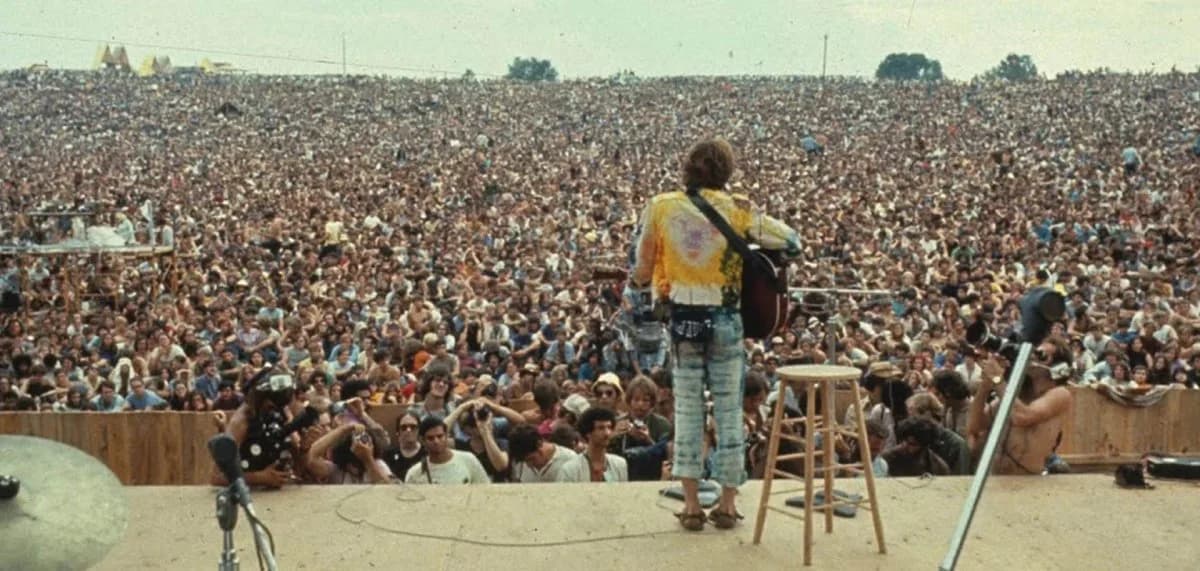
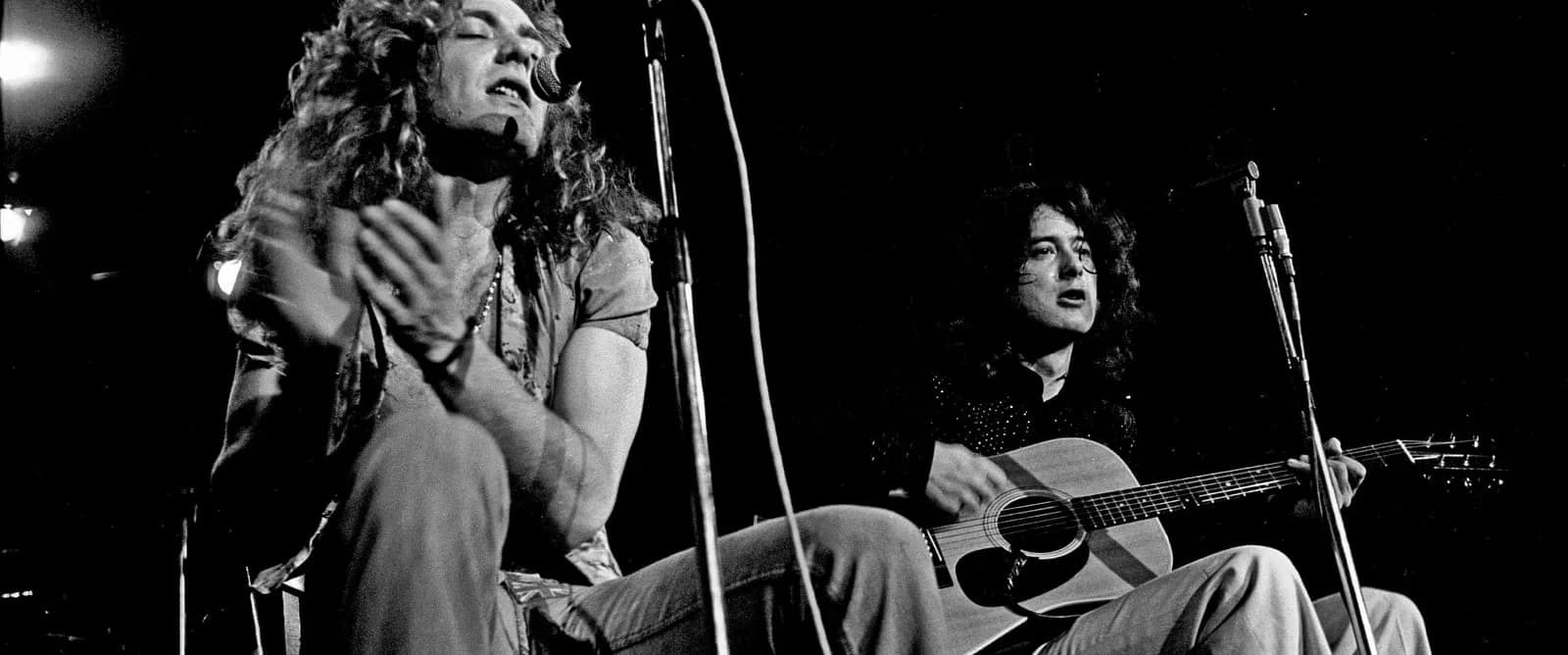
But talking about Led Zeppelin is never only talking about music. Around the band there are stories of destroyed hotel rooms, private jets, drugs, groupies, violence, obsession with the occult, mysterious symbols, rumors, tragedies, and exaggerations that have crossed decades.
That is an important part of the legend, but it needs to be treated as part of a broader historical mosaic. Not everything told about Led Zeppelin is proven fact. Some stories are documented, others come from conflicting memories, others came from backstage books, and many grew because 1970s rock was the perfect environment for mixing reality, marketing, excess, and fantasy.
Led Zeppelin was one of the greatest bands of all time. It was also a band surrounded by contrasts: musically sophisticated, emotionally intense, spiritually curious, commercially enormous, and at the same time connected to an extreme lifestyle typical of a particular era of arena rock.
Led Zeppelin em Cena
 1 / 5
1 / 5Before Zeppelin: Jimmy Page's experience
The chemistry was immediate. Page brought production vision, riffs, dynamics, and aesthetic direction. Plant brought voice, presence, and an almost shamanic energy. Jones added musical, harmonic, and structural depth. Bonham brought weight, swing, and a rhythmic force that would change rock drumming forever.
The blues as a starting point
Songs like "You Shook Me," "I Can't Quit You Baby," "Whole Lotta Love," and "Since I've Been Loving You" show this direct connection with the blues. But Led Zeppelin did not play blues like a traditional band. They turned blues into something larger, more theatrical, and more physical.
The invention of a giant sound
This mixture appears throughout the discography: the raw weight of "Communication Breakdown," the hypnotic riff of "Whole Lotta Love," the epic construction of "Stairway to Heaven," the grand Eastern atmosphere of "Kashmir," the suffering blues of "Since I've Been Loving You," and the almost tribal force of "When the Levee Breaks."
Led Zeppelin helped define what a rock band could be in the 1970s: not merely a group playing songs, but a complete sonic entity, with visual identity, mystery, live intensity, and albums designed as experiences.
The band critics took time to understand
At first, some music critics did not understand Led Zeppelin. Some saw the band as exaggerated, noisy, or too derivative of American blues. But the public heard something different.
While critics debated whether it was good taste or excess, the shows grew, the records sold, and the band became larger and larger. Led Zeppelin was one of those bands that did not need early press approval to become a phenomenon.
The audience wanted to feel that force live. And live, Zeppelin was an unpredictable machine. Songs could change length, gain long improvisations, extended solos, acoustic passages, and drum explosions.
That freedom is one of the band's signatures. Led Zeppelin did not sound like a reproduction of the record. It sounded like an experience happening in the moment.
The birth of arena rock
This growth changed the scale of rock. What had once been connected to clubs, theaters, and smaller circuits now occupied stadiums, large arenas, and million-dollar international tours.
Led Zeppelin helped create the model of the rock band as a business power: artistic control, major contracts, self-contained production, a large crew, and an image surrounded by exclusivity. They did not release singles in the traditional way just to please the market. The focus was the album, the show, and the construction of an aura.
But the larger the structure became, the greater the isolation became as well. The band lived in a bubble: hotels, limousines, dressing rooms, planes, security guards, drugs, alcohol, fans, managers, and a constant cycle of adrenaline and exhaustion.
Excess: when the legend leaves the stage
Led Zeppelin's reputation for excess became almost as famous as its music. Stories about destroyed rooms, drinking, drugs, fights, parties, and wild behavior became part of the band's mythology.
This kind of narrative was common in 1970s rock, but with Zeppelin it reached enormous proportions. Part of it came from the band's own behavior and touring circle. Part came from books, journalists, managers, roadies, and people who lived around the group. Part of it also grew over time.
Those accounts help explain the environment in which the band moved. Arena rock in the 1970s brought together sudden fame, money, constant travel, large crews, easy access to alcohol and drugs, and an intense relationship between musicians, fans, press, and backstage life.
Led Zeppelin created extraordinary music and, at the same time, became associated with an imagery of excess that became inseparable from its public narrative. To understand the band, it is useful to look at both the records and the cultural context in which those stories circulated.
Groupies: desire, fame, and backstage life
In Led Zeppelin's case, the stories involving groupies became especially famous. Some are described in biographies, documentaries, and backstage memoirs. Others circulate as road legends, often with different versions and details that are hard to verify.
That world brought together world-famous musicians, tour crews, managers, journalists, security staff, fans, and people moving through hotels and dressing rooms. It was an environment where fame, alcohol, drugs, desire, curiosity, and the search for proximity to idols all mixed together.
For a long time, this subject was told mainly as part of the road adventure of major bands. In Led Zeppelin's history, groupie culture appears as a portrait of the relationship between fame, youth, desire, and backstage life at the height of 1970s rock.
The fish incident: legend, scandal, and backstage lore
One of the most widely discussed and controversial stories associated with Led Zeppelin is the so-called "fish incident," frequently mentioned in books and articles about the band's backstage life.
The story involves an alleged sexual situation with a groupie during a tour. Over the years, it has been repeated, modified, and turned into one of the most cited episodes when discussing the culture of rock excess.
The most important thing here is not to explore the episode in detail. For a historical article, the point is different: the story shows how Led Zeppelin became a magnet for extreme narratives. Some may have a real basis, others may have been exaggerated, but all helped feed the image of the band as dangerous, mysterious, and outside ordinary life.
It also shows how music journalism, rock biographies, and road stories helped turn backstage episodes into folklore, repeating versions that are not always easy to confirm in every detail.
Jimmy Page and the interest in the occult
Here, it is useful to separate documented fact, interpretation, and rumor. Page's interest in the occult is documented. The presence of mysterious symbols in the band's aesthetic is also real. The idea that Led Zeppelin was a "satanic band," however, belongs much more to popular readings and theories that grew around the group.
Occultism in Zeppelin functioned more as atmosphere, symbolism, and Page's personal fascination than as an explicit doctrine of the entire band.
Aleister Crowley and the phrase 'Do what thou wilt'
The phrase "Do what thou wilt" is often interpreted as permission to do anything without consequence, but within Crowley's system the idea was more complex: to discover and follow one's true will.
Even so, in the context of rock, the phrase gained another weight. For a generation surrounded by sexual freedom, drugs, rebellion, and rejection of traditional norms, Crowley seemed like the perfect figure: dangerous, mysterious, anti-establishment, and scandalous.
Jimmy Page did not need to explain much. His aesthetic, reserved posture, symbols, and association with Crowley were enough for the public imagination to complete the rest.
The four symbols of the fourth album
That detail increased the mystery. The symbols seemed ancient, magical, and undecipherable. For many fans, they were clues to something hidden. For others, they were simply a bold form of visual identity.
The decision to use symbols instead of names reinforced a central idea of Zeppelin: the band did not want to look ordinary. It wanted to sound and appear larger than real life.
"Stairway to Heaven" is one of the most famous songs in rock history. It is also one of the songs most surrounded by mystical interpretations.
For decades, mentions circulated that the song contained satanic messages when played backward. That kind of theory became common especially in public debates about rock, youth, and religion.
Those mentions never became established fact. They belong to a period in which rock was frequently associated, by religious and conservative groups, with rebellion, youth, sexuality, and alternative spirituality.
"Stairway to Heaven" works because it mixes folk, symbolic poetry, gradual growth, a memorable solo, and a final explosion. The lyrics are open, full of spiritual and ambiguous imagery, but ambiguity is not proof of a secret message. Often, mystery is exactly what allows a song to cross generations.
Occultism as rock aesthetics
Rock has always had a strong relationship with images of transgression. Inverted crosses, pentagrams, demons, witches, magic, night, roads, death, and pacts appear in many phases of popular music.
In Led Zeppelin, occultism does not appear the way it would later appear in heavy metal, explicitly and theatrically. It appears in a more elegant and nebulous way: symbols, covers, enigmatic lyrics, medieval atmosphere, fantastic references, and Jimmy Page's reserved aura.
That subtlety may have made it even more powerful. Zeppelin rarely explained too much. The band left room for the public to imagine.
And when the public imagines, the legend grows.
The connection with Tolkien, mythology, and fantasy
That influence appears in songs such as "Ramble On" and "The Battle of Evermore," which evoke journeys, battles, ancient landscapes, and almost mythical characters.
This side helped separate Zeppelin from other blues rock bands. They were not interested only in singing about love, the road, and desire. They also wanted to create worlds.
That is why the band became so important to the imagination of hard rock and metal. Long before many bands explored castles, runes, dragons, and epic themes, Led Zeppelin was already mixing electric weight with fantasy and spirituality.
The shadow of tragedy
Led Zeppelin's story is also marked by tragedy. In 1975, Robert Plant suffered a serious car accident in Greece, interrupting touring plans and affecting the band's rhythm.
In 1977, during a tour in the United States, Plant received the news of the death of his young son Karac. The episode devastated the singer and deeply shook the continuity of the group.
In 1980, John Bonham died after a period of excessive alcohol consumption. Without Bonham, the members decided to end Led Zeppelin. The decision was meaningful: they understood that the band was not replaceable. Led Zeppelin depended on that specific lineup.
Bonham's death was not only the end of an extraordinary drummer. It was the end of a musical entity.
The myth cannot swallow the music
There is a risk when we talk about Led Zeppelin: allowing the stories of excess, groupies, and occultism to swallow the music. That would be unfair to the band's artistic greatness.
Zeppelin was much more than scandal. It was a band of exceptional musicians, with a rare sense of dynamics, production, arrangement, and live presence.
Jimmy Page was not just a riff guitarist. He was an architect of sound. Robert Plant was not just a high-pitched singer. He was an interpreter with physical and theatrical presence. John Paul Jones was not just the quiet bassist. He was a sophisticated musician who supported the harmony and depth of the arrangements. John Bonham was not just a loud drummer. He was a master of weight, timing, and groove.
The myth helps explain the aura. But the music is what sustains everything.
What beginner guitarists can learn from Led Zeppelin
For anyone starting on guitar, Led Zeppelin is a huge school. But it is important to study the band the right way.
Do not begin by trying to play everything fast or loud. Start by listening to how the parts fit together.
Some essential lessons are:
- simple riffs can sound huge when played with intention;
- dynamics are as important as distortion;
- pauses create impact;
- blues and heavy rock are deeply connected;
- a good riff needs to talk to the drums;
- acoustic playing is also part of rock language;
- tone comes not only from gear, but from the hands;
- a song can grow gradually until it explodes.
To study Led Zeppelin on guitar, some songs are excellent starting points:
| Song | What to study |
|---|---|
| "Whole Lotta Love" | Riff, groove, and attitude |
| "Black Dog" | Broken phrasing and band interaction |
| "Rock and Roll" | Rock energy based on blues language |
| "Good Times Bad Times" | Riff, precision, and creative drumming |
| "Since I've Been Loving You" | Slow blues, bends, and expression |
| "Stairway to Heaven" | Gradual construction, fingerpicking, and melodic soloing |
| "Kashmir" | Modal riff, atmosphere, and hypnotic repetition |
| "Ramble On" | Contrast between acoustic passages and electric explosion |
A brief Led Zeppelin timeline
| Year | What happened |
|---|---|
| 1968 | Jimmy Page forms the band after the end of The Yardbirds. The group initially performs as The New Yardbirds. |
| 1969 | The first two albums are released, establishing the band's heavy, bluesy, explosive sound. |
| 1970 | Led Zeppelin III reveals a more acoustic, folk-oriented, and dynamic side. |
| 1971 | The fourth album consolidates the legend, with "Stairway to Heaven" and the members' individual symbols. |
| 1973 | Houses of the Holy expands the band's sonic palette. |
| 1975 | Physical Graffiti confirms the group's epic ambition and includes "Kashmir." |
| 1975 | Robert Plant suffers a serious car accident in Greece. |
| 1977 | The death of Robert Plant's son deeply shakes the band. |
| 1979 | In Through the Out Door shows a stronger presence of keyboards and new sonic directions. |
| 1980 | John Bonham dies, and Led Zeppelin decides to end its activities. |
| 2007 | The surviving members reunite for a special show with Jason Bonham on drums. |
Essential albums to understand the band
If you want to start listening to Led Zeppelin carefully, some albums are essential:
- Led Zeppelin I — the birth of the sound: heavy blues, riffs, and raw energy.
- Led Zeppelin II — more direct, heavier, and closer to classic hard rock.
- Led Zeppelin III — reveals the band's acoustic, folk, and experimental side.
- Led Zeppelin IV — the most mythical album, balancing weight, mysticism, and grandeur.
- Houses of the Holy — expands the sound with funk, reggae, progressive elements, and different textures.
- Physical Graffiti — a double album, ambitious, diverse, and one of the band's greatest artistic statements.
These albums show that Led Zeppelin was not a one-formula band. They could be heavy, delicate, dark, sensual, acoustic, epic, and experimental.
Conclusion: between the riff and the legend
Led Zeppelin remains fascinating because it exists in two dimensions at once.
On one side, there is the real band: four British musicians, deeply influenced by the blues, who created some of the most important riffs, albums, and concerts in rock history.
On the other, there is the mythical band: surrounded by stories of excess, groupies, occultism, symbols, tragedies, and rumors that seem to belong more to an ancient legend than to a musical group.
The two dimensions mix together. But the best way to understand Led Zeppelin is to fall into neither blind idol worship nor simplistic condemnation.
The band was brilliant. It was excessive. It was innovative. It was surrounded by legends. It was human. And that is precisely why it remains so powerful.
In the end, what survives above all is the sound: Jimmy Page's guitar, Robert Plant's voice, John Paul Jones's bass and keyboards, John Bonham's drums, and that rare feeling that a band could sound like storm, ritual, road, and explosion at the same time.