
The Gallagher reunion reignited something that had been dormant, but never dead. Oasis had split in 2009 after years of public tension, provocation, arguments and internal exhaustion. Even so, their songs kept working as a shared language: songs for pubs, stadiums, teenage bedrooms, beginner guitarists and nostalgia-heavy playlists.
What happened with the Oasis comeback was not only nostalgia. It was a rare combination of emotional memory, cultural identity, fraternal charisma, popular songwriting and a contemporary gap: few recent rock bands generate the same feeling of anthem, belonging and collective release.
That is why the Gallagher reunion did not revive only the Oasis name. It revived the question of what Britpop represented, why it marked the 1990s so deeply and why, decades later, there is still an audience ready to sing those songs as if they were happening now.
Oasis, Britpop and the Gallagher Return
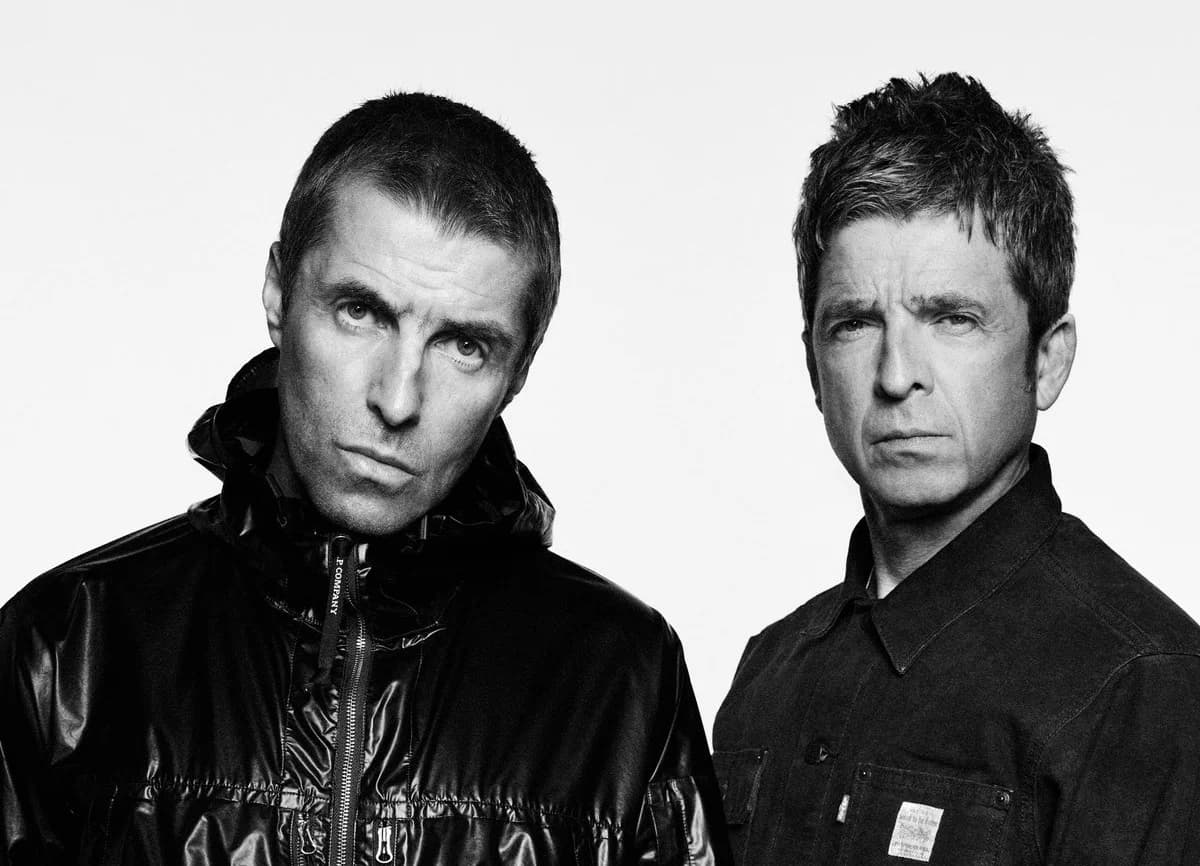 1 / 5
1 / 5The comeback that once seemed impossible
The return of Oasis carried a different weight from other classic rock reunions. It was not only about schedules, money or nostalgia. The emotional core of the story was always the relationship between Liam and Noel Gallagher. Oasis ended in 2009 before a show in Paris, after a rupture that cemented the brothers as two almost incompatible poles of the same creative force.
For years, a reunion seemed unlikely because the split was never presented as a graceful hiatus. It was a public wound. Liam and Noel followed separate paths, traded insults in interviews and online, and kept alive a soap opera that became part of the band's myth.
The comeback was built as a global event: the United Kingdom, Ireland, North America, Asia, Oceania and South America. The São Paulo dates at MorumBIS also reinforced that Oasis was never only a British phenomenon. The band has always had international appeal, especially in countries where guitar rock kept a loyal audience even after the genre's commercial decline.
Why Oasis never fully disappeared
Oasis left the stage as a band, but they never vanished from popular culture. That is the central point in understanding the scale of the reunion. Even without new albums or joint tours, the catalogue kept circulating with force.
“Wonderwall”, “Don't Look Back in Anger”, “Live Forever”, “Supersonic”, “Champagne Supernova”, “Cigarettes & Alcohol” and “Slide Away” remained songs of collective use. They work in stadiums, bars, parties, internet videos, acoustic singalongs and moments of public release.
Few bands manage to turn so many songs into independent cultural objects. Some songs detach from their original album and begin to live as social memory. With Oasis, this happened intensely. Many people who did not live through the 1990s discovered the band through streaming, memes, parents, friends or the aura of rivalry between the brothers.
Oasis also remained relevant because their sound is direct. It does not require a manual. Open guitars, frontal vocals, huge choruses, solid drums and lyrics that mix arrogance, hope, melancholy and escape. That apparent simplicity makes the band highly accessible, and it also explains part of their permanence.
What Britpop was
Britpop was more than a closed musical genre. It was a British cultural moment of the 1990s, linked to a renewed focus on local references after a decade in which American alternative rock, especially grunge, had dominated much of the global imagination.
Britpop conversed with the Beatles, the Kinks, Small Faces, the Jam, glam rock, punk, new wave, Madchester and indie rock. It was guitar music, but it was also an aesthetic: parkas, the Union Jack, magazine covers, rivalries, clubs, football, urban youth and an almost insolent confidence that British culture was once again exporting style.
Oasis became the most popular and massive face of that movement. While Blur represented a more art-school, ironic and observational intelligence, Oasis seemed to come from somewhere else: less conceptual, more frontal, more working-class in public image, more oriented toward anthems and communal release.
Manchester, working-class identity and belonging
The symbolic power of Oasis passes through Manchester. The city had already produced fundamental moments in British music, from Joy Division and New Order to the Smiths, Happy Mondays and the Stone Roses. When Oasis appeared, they carried part of that inheritance: guitars, attitude, urban culture, long nights and an intense connection between music and local belonging.
For the Gallaghers, the origin story was always important. Two brothers from Burnage, far from London glamour, reached the top with songs that sounded built for crowds. That trajectory helped listeners see Oasis as a band of affirmation, not just entertainment.
Britpop was often read through class tensions, especially in the rivalry between Oasis and Blur. That reading can simplify the story, but it helps explain why Oasis was perceived as a popular voice. Liam sang as if he did not ask permission. Noel wrote songs that turned ordinary ambition into emotional grandeur.
That combination explains why the reunion revived not only affection for the band, but also a memory of identity. For many fans, Oasis represents youth, city, friendship, pride, excess, football, pubs, radio, cassette tapes, CDs, music television and a time when guitar bands still seemed to occupy the center of the world.
The Gallaghers as dramatic engine
The relationship between Liam and Noel was always central to the fascination around Oasis. Musically, they formed a rare mechanism. Noel was the main songwriter, harmonic architect and central guitarist. Liam was the voice, the stance, the face and the physical energy that turned those melodies into statements.
Separately, each maintained a career and an audience. Together, however, they produce another kind of electricity. Oasis depended on that tension: Noel's song found in Liam's voice a mixture of mockery, vulnerability and youthful arrogance. Liam seemed to sing every line like a challenge. Noel wrote as if every chorus had to survive an entire terrace singing it back.
That dynamic also had a cost. The same friction that generated public magnetism fed internal instability. The public followed the band not only for the songs, but for the permanent question: how long can these two remain on the same stage?
The reunion reactivates that drama. Part of the interest comes precisely from the risk. The audience wants to hear the songs, but it also wants to see whether the brothers can occupy the same space after so much time. In rock, few narratives are more powerful than the partial reconciliation of a creative pair marked by real conflict.
The songs that kept the flame alive
The Gallagher reunion has this force because the repertoire sustains the myth. Oasis did not return only with a famous brand. They returned with a songbook already embedded in popular culture.
Why the comeback reignited Britpop
The Oasis comeback reignited Britpop because the movement always depended on memory, image and narrative as much as sound. Britpop was a musical scene, but also a story people told about themselves: British youth, local pride, guitars, magazines, rivalry, fashion and the feeling that a generation had found its soundtrack.
When Liam and Noel return to the same stage, that narrative is reactivated. Not because the 1990s can be reproduced exactly, but because their symbols remain recognizable. Liam's parka, the open chords, Noel's choruses, the crowd singing “Don't Look Back in Anger” and the Manchester aesthetic still communicate immediately.
There is also a reaction to the present. In an era dominated by solo artists, digital production, fast viral cycles and fragmented consumption, Oasis offers an almost opposite experience: a guitar band, with quarrelling brothers, a stadium repertoire and songs that demand a human chorus. That creates a sense of rarity.
Britpop returns to the conversation because Oasis is its most massive memory. Other bands were more sophisticated in certain ways; some were more experimental, more critical or more elegant. But none condensed the movement's popular, loud and anthemic side so completely.
Nostalgia or real relevance?
Every classic band reunion raises the same question: are we seeing artistic relevance or well-managed nostalgia? In the case of Oasis, the most honest answer is that both coexist.
There is nostalgia, unquestionably. Many fans want to recover a feeling of youth, a time when discovering a band could reorganize clothing, posture, friendships and the records on the shelf. But reducing everything to nostalgia would ignore the fact that the songs keep finding new listeners.
Oasis's real relevance lies in the functional permanence of the songs. They are still playable, singable and recognizable. They work on streaming, in stadiums, on acoustic guitar and in collective memory. For a generation used to disposable singles, that kind of repertoire carries its own weight.
Oasis may not be returning to invent the future of rock. The band's management has already indicated that the reunion does not need to mean new music. But the comeback shows that the past, when supported by strong songs, can become present without pretending to be modern.
The impact on guitarists and new bands
For guitar players, the Oasis return is also a lesson. The band never depended on extreme technical virtuosity. Its impact came from the combination of simple chords, full tone, steady strumming, memorable melodies and a sense of collective construction.
Noel Gallagher showed that rhythm guitar can be as important as lead guitar. Many Oasis riffs and progressions are relatively accessible, but they sound huge because they serve the song. There is an important lesson there: playing well does not always mean playing more; often it means finding the right part, at the right moment, with the right energy.
For new bands, Oasis also leaves a provocation. In an age of highly edited production, the band reminds us of the strength of a clear identity: recognizable voice, recognizable aesthetic, recognizable attitude and choruses the audience can sing after a single listen.
The reunion may not create a new Britpop, but it can stimulate renewed curiosity about guitar bands. Sometimes the role of a historic return is not to launch a scene, but to remind people that collective rock still has power when repertoire, narrative and audience meet.
A brief timeline
| Year | What happened |
|---|---|
| 1991 | Oasis forms in Manchester, with Liam Gallagher in the early lineup and Noel joining shortly after as songwriter and guitarist. |
| 1994 | Definitely Maybe turns the band into a symbol of a new generation of British rock. |
| 1995 | (What's the Story) Morning Glory? takes Oasis to global heights and establishes Britpop as a mass phenomenon. |
| 1996 | The Knebworth shows become a landmark of 1990s British culture. |
| 1997 | Be Here Now arrives with enormous expectations and symbolizes both the peak and the excess of the era. |
| 2000 | Standing on the Shoulder of Giants marks a period of internal and aesthetic change. |
| 2009 | The band splits after tension between Liam and Noel before a show in Paris. |
| 2024 | Oasis announces the Oasis Live ’25 tour, reigniting global conversation about the band and Britpop. |
| 2025 | The reunion reaches the stage with a worldwide stadium tour. |
| 2026 | The reunion cycle continues through documentary projects, official records and renewed cultural circulation of the catalogue. |
What to hear to understand the phenomenon
To understand why the reunion had such impact, the best path is to return to the records and hear the myth being built in nearly chronological order.
- Definitely Maybe — the opening manifesto: loud guitars, youth, urgency and self-belief.
- (What's the Story) Morning Glory? — the album that turns the band into a global phenomenon.
- The Masterplan — proof that even the B-sides could carry enormous songs.
- Be Here Now — the portrait of excess, grandeur and the contradictions of the peak.
- Standing on the Shoulder of Giants — the sound of a band trying to continue after the earthquake of the 1990s.
- Don't Believe the Truth — a more balanced phase, with greater contribution from other members.
- Dig Out Your Soul — the final album before the split, heavier and more psychedelic in atmosphere.
The point is not to hear only the hits. Oasis is better understood when you notice how the band built a language: simple chords treated like monuments, lyrics open enough to fit the listener's life and a voice that seemed to turn vulnerability into defiance.
Conclusion: Britpop as living memory
The return of Oasis shows that some bands do not survive only because they were famous. They survive because they managed to turn an era into sound. Britpop could have remained trapped in the 1990s, but the Gallagher reunion revealed that its language still has emotional force.
Oasis came back in a different world: a different music market, a different internet, a different way of consuming music, a different relationship between audience and artist. Even so, the reaction was immediate because the band carries something that cannot be easily manufactured: popular repertoire, human narrative, real conflict, visual identity and a rare sense of communion.
Britpop may not return as a historical movement. There will be no perfect repetition of 1995, the magazine covers, the Oasis versus Blur battle or the euphoria of Cool Britannia. But the spirit of that period can return as active memory: guitars, choruses, accent, attitude, direct melodies and the belief that a band can still gather many people around a song.
In the end, the Gallagher reunion reignited Britpop because Oasis was always more than a successful band. It was an idea of rock: simple, arrogant, emotional, imperfect, popular and made to be sung loudly. When that idea returned to the stage, many people realized it had never completely disappeared.