
Basic Data
| Field | Information |
|---|---|
| Full name | BOSS CS-3 Compression Sustainer |
| Brand | BOSS — Roland Corporation |
| Category | Compressor/sustainer pedal |
| Release year | 1986 |
| Status | In production |
| Dimensions | 73 mm x 129 mm x 59 mm |
| Weight | 380 g |
| Power | 9 V 6F22/6LR61 battery or BOSS PSA adaptor, sold separately |
| Price range | New: around US$ 120 / R$ 1,019; used: roughly US$ 50–100, depending on condition and market |
Overview
The BOSS CS-3 Compression Sustainer is one of the most recognizable compact compressor pedals ever made. In continuous production since 1986, it sits in a specific and useful place: it is not a transparent boutique compressor, and it does not try to emulate an optical studio unit. Its purpose is more direct and functional: tame peaks, increase sustain, even out string response, and add presence to the guitar signal in the classic rugged BOSS format.
It appeals to players who need a reliable pedal for clean rhythm parts, arpeggios, funk, country, pop rock, singing leads, and passages where the guitar needs to remain more even in the mix. It is also a very practical first compressor, because its four controls make the relationship between sustain, attack, tone, and output level easy to understand.
The CS-3 remains relevant because it balances accessibility, durability, and character. It does not completely disappear from the signal; when set aggressively, it delivers the audible squash many guitarists associate with classic pedal compressors. With moderate settings, it can work as an always-on tone shaper that adds polish, body, and touch consistency.
Construction and Design
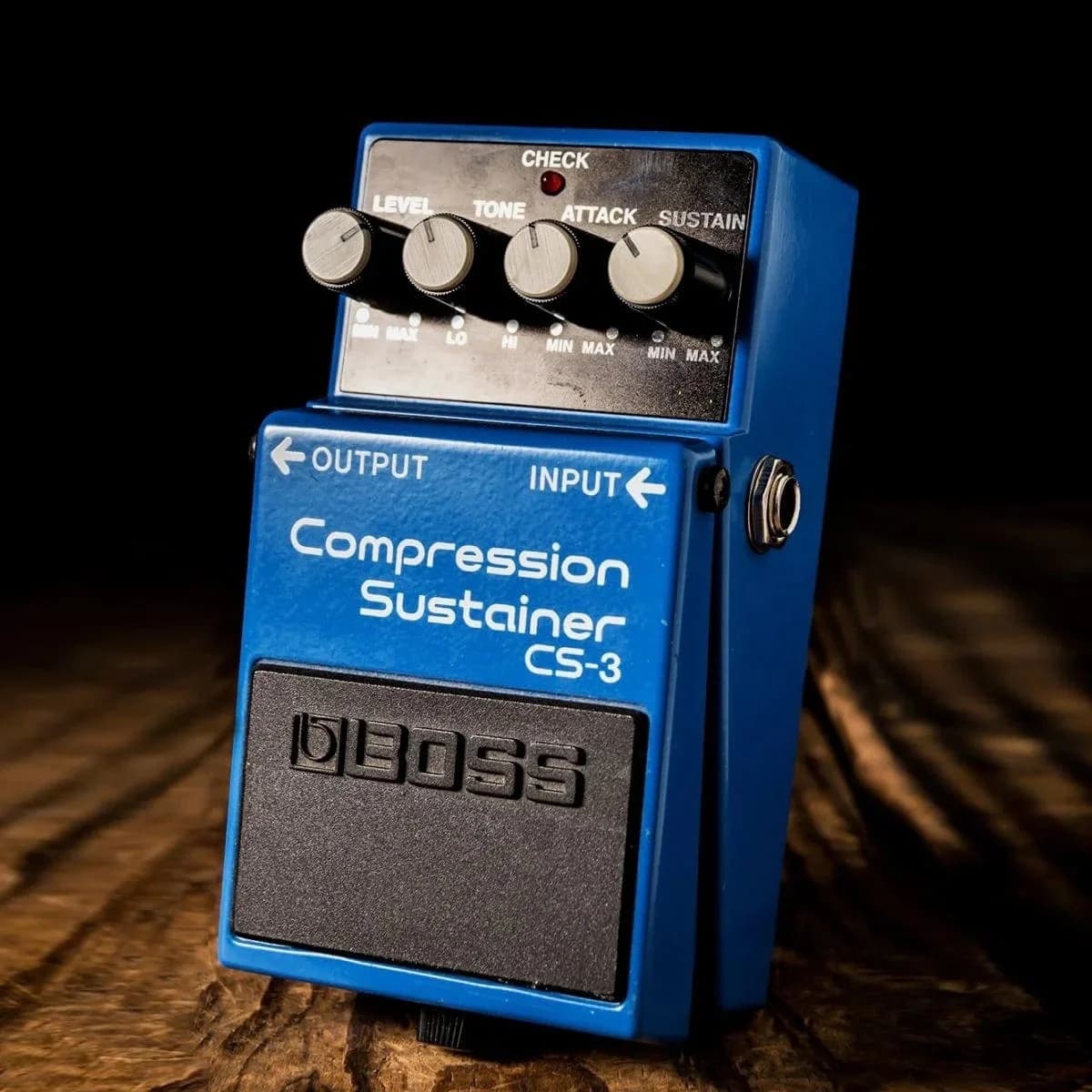
The CS-3 follows the standard BOSS compact pedal format: metal chassis, wide pressure-switch pedal, non-slip rubber top, battery compartment accessed through the front thumbscrew, and side-mounted jacks. It is a stage-ready design built for frequent transport and long-term use, with the familiar ergonomics that made BOSS compact pedals an industry reference.
Its metallic blue finish sets it apart on a pedalboard and immediately identifies its role in the BOSS family. The four-knob layout — Level, Tone, Attack, and Sustain — is simple but more flexible than two-knob compressors such as the traditional MXR Dyna Comp. That matters: the CS-3 lets the player adjust not only compression amount and output volume, but also attack response and the tonal color of the compressed signal.
In practical terms, it is portable, dense, and sturdy. At 380 g, it feels solid without becoming inconvenient on compact boards. Like modern compact BOSS pedals, it uses buffered bypass, which can be beneficial in long pedal chains, even though it may not satisfy players who want true bypass at every point in the signal path.
Technical Specifications
| Specification | Value |
|---|---|
| Effect type | Compressor / Sustainer |
| Circuit | Analog compressor with VCA circuit |
| Nominal input level | -20 dBu |
| Input impedance | 1 M ohm |
| Nominal output level | -20 dBu |
| Output impedance | 1 k ohm |
| Recommended load impedance | 10 k ohms or greater |
| Bypass | Buffered bypass |
| Controls | Sustain, Attack, Tone, Level, pedal switch |
| Indicator | Check LED, also battery check indicator |
| Connectors | 1/4" input, 1/4" output, DC In |
| Power supply | 9 V 6F22 carbon-zinc battery, 9 V 6LR61 alkaline battery, or PSA adaptor |
| Current draw | 20 mA |
| Estimated battery life | Carbon: approx. 10.5 h; alkaline: approx. 26 h |
| Included accessories | Safety/information leaflet and 9 V battery |
| Recommended adaptor | BOSS PSA Series, sold separately |
| Dimensions | 73 mm width, 129 mm depth, 59 mm height |
| Weight | 380 g |
BOSS CS-3
 1 / 3
Features and Functions
The Sustain control sets the amount of compression and the length of the note sustain. At lower settings, the pedal simply catches peaks and makes the sound more even. As the knob rises, the CS-3 pushes weaker notes forward, extends decay, and makes the tone more compressed, especially on clean picking, fingerstyle parts, and melodic lines.
The Attack control changes how the circuit reacts to the pick transient. Turned clockwise, it preserves more of the string’s initial attack, producing a snappier and more percussive sound. At lower settings, the pedal clamps down faster on transients, softening the initial hit and reinforcing the sense of continuous sustain. This makes the CS-3 useful both for crisp rhythm work and more sustained lead lines.
Tone is a crucial feature. Compressors can change the perceived brightness and body of a guitar signal, and the CS-3 lets the player compensate directly on the pedal. Higher settings emphasize treble and help the guitar cut through the mix; lower settings soften the high end and keep single-coils from becoming too sharp. Level sets the final output volume and can be used either to match bypass level or slightly push the next stage in the chain.
Sound and Performance
The CS-3 sounds clear, firm, and unmistakably like a pedal compressor. It can deliver moderate, musical compression, but its character becomes more obvious when Sustain moves past noon: the guitar gains body, note decay stretches out, and natural dynamics become more controlled. For clean rhythm parts, funk, arpeggios, and pop lines, that may be exactly the final polish the part needs.
Touch response depends heavily on the Attack setting. With more attack preserved, the pedal keeps pick definition and works well for clean riffs, alternate picking, and parts that need articulation. With a faster clamp and higher Sustain, it becomes more obvious: notes jump forward, hand noise and pickup noise become more audible, and the tone can feel heavily compressed.
Noise is the critical point. Like every compressor, the CS-3 raises the quieter parts of the signal, and that includes single-coil hum, drive hiss, and poor power-supply noise. With moderate settings and good power, it is usable and musical. With high Sustain, high Level, and noisy gain chains, it can become noisy.
The position of the CS-3 in the pedal chain changes the result considerably. The most traditional setup is to place it early in the signal path, usually after the tuner and before overdrives, distortions, modulation, delay, and reverb. In that position, it compresses the guitar’s natural dynamics before the signal is saturated, making arpeggios, clean rhythm parts, funk grooves, country lines, and pop-rock figures more even, with controlled attack and steadier sustain.
Some guitarists, however, prefer placing the compressor after overdrives or distortions. In that case, the CS-3 works on a signal that is already saturated, helping level volume, extend lead sustain, and make solos feel more homogeneous. This approach can work very well for rock and hard-rock tones, but it requires care: because the compressor raises quieter parts of the signal, it can also bring forward noise, hiss, and hum generated by the drive pedals.
It is also possible to place it after modulation or closer to the end of the chain, where it behaves almost like a general pedalboard leveler. That can create a more polished and controlled sound, but it may also reduce the natural dynamics of the effects and pull delay repeats or reverb tails forward. For that reason, the CS-3 is most predictable before drives, more expressive after them, and more experimental when used near the end of the chain.
Artists Who Use It
The CS-3 is associated with Noel Gallagher’s pedalboard during the Knebworth 1996 period, when Oasis were at the height of britpop and relied on large, steady rhythm guitars with strong presence. In that context, the compressor helps explain the search for consistency in open chords, clean strumming, and parts where the guitar needs to fill space without losing definition.
The CS-3 has been listed among the outboard pedals used in The Edge’s rig during the 360° Tour, according to gear information linked to his technician Dallas Schoo. In a setup known for rhythmic delays, crystalline arpeggios, and dynamic precision, a compressor such as the CS-3 makes sense as a tool for controlling attack, leveling repetitions, and keeping clean notes present inside complex textures.
The CS-3 appears in pedalboard records associated with Johnny Marr, a guitarist whose language combines arpeggios, clean rhythm work, melodic riffs, and careful dynamic control. For that kind of approach, the pedal can work as a pick-leveling and sustain tool, helping clean parts stay defined without completely transforming the guitar’s voice.
Synyster Gates has mentioned using a BOSS CS-3 compressor in a gear-interview context, describing the effect as something that naturally thickens the sound. In modern hard rock and metal, that kind of compression can help reinforce consistency, sustain, and presence in lead parts, especially when the signal already runs through high-gain amplifiers and drive stages.
Who It Is For
The CS-3 makes sense for guitarists who want a rugged, easy-to-find compressor with enough controls to learn and adjust compression in a practical way. It is especially useful for clean rhythm, funk, pop rock, country, indie, modern blues, clean sustaining leads, and pedalboards that benefit from a reliable buffer early in the chain.
It is not the best choice for players seeking fully transparent compression, dry/compressed blend, or studio-style compressor behavior. It may also frustrate musicians using noisy single-coils, lots of gain, or low-quality power supplies, because intense Sustain settings tend to reveal noise that already exists in the rig. For those players, pedals with blend, threshold control, or quieter circuits may be better options.
Pros and Cons
| Pros | Cons |
|---|---|
| Very rugged BOSS construction, suitable for stage and daily use | Can produce noticeable noise at high Sustain settings or in already noisy rigs |
| Four practical controls, including Attack and Tone, offer more flexibility than simple two-knob compressors | No blend control for mixing dry and compressed signal |
| Excellent for increasing clean sustain, leveling arpeggios, and adding presence to rhythm parts | Not the most transparent compressor; the pedal’s character appears easily |
| In continuous production since 1986, with wide availability new and used | Can flatten natural dynamics when used aggressively |
| Buffered bypass can help preserve signal in long pedal chains | No threshold, ratio, or visual metering found on more advanced compressors |
| Can also work with bass and electric-acoustic guitar when used with moderate settings | PSA adaptor is not included |
Final Verdict
The BOSS CS-3 Compression Sustainer is worth considering for players who want a classic, rugged, direct compressor pedal capable of adding clean sustain, dynamic leveling, and presence without a heavy learning curve. It is especially strong when the guitar needs to sound more consistent: clean rhythm, arpeggios, funk parts, pop lines, and solos that need notes to last longer.
At the same time, the CS-3 should not be bought with the expectation of total invisibility. It has personality, can compress very obviously, and requires attention to noise, chain placement, and Sustain level. For players who want a modern compressor with blend, greater transparency, and finer control, alternatives such as the Keeley Compressor Plus, Wampler Ego, BOSS CP-1X, or optical-style units may be more appropriate. But as a rugged, accessible, historically important compression tool, the CS-3 remains one of BOSS’s essential pedals.