
Basic Data
| Field | Information |
|---|---|
| Full name | BOSS DS-1 Distortion |
| Brand | BOSS |
| Category | Guitar distortion pedal |
| Line/series | BOSS Compact Pedal Series |
| Launch year | 1978 |
| Country of manufacture | Not specified on the current official product page; it may vary by era and production batch |
| Approximate price range | USA: around US$70; Europe: around €75–€80; Brazil: generally between R$720 and R$800 in national stores |
| Status | In production |
| Official page | https://www.boss.info/us/products/ds-1/ |
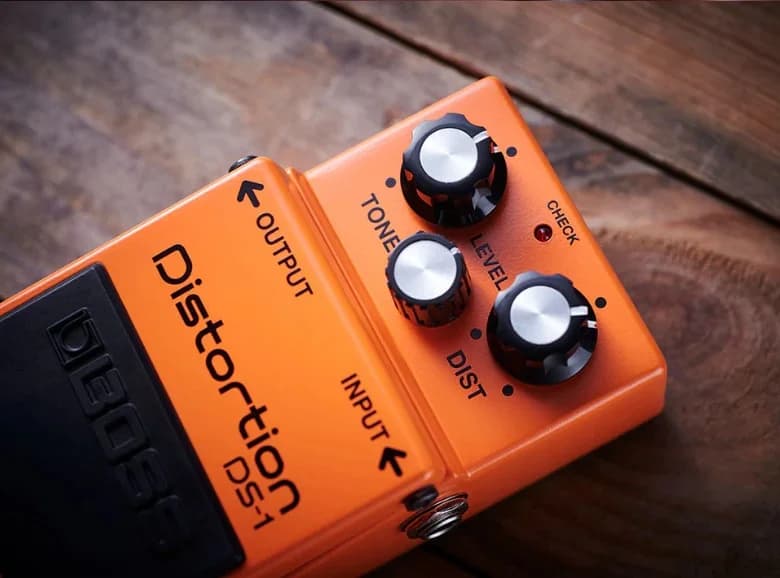
The BOSS DS-1 Distortion is the most emblematic compact distortion pedal in the BOSS catalog and one of the most recognizable drive pedals in electric guitar history. Its visual identity is immediate: orange enclosure, three controls, a large footswitch, and a straightforward rock distortion mission.
This review focuses on the standard DS-1 currently in production. Anniversary, Waza Craft, and related versions are mentioned where they help explain the family, but the editorial focus is the classic three-knob pedal.
Overview
The DS-1 has a special place because it does not try to behave like a transparent overdrive or a modern preamp pedal. It is a distortion pedal with its own personality: firm attack, present highs, a somewhat scooped lower-mid character, and enough sustain for dirty rhythm parts, riffs, and cutting leads.
Introduced in 1978, it arrived when many gain pedals still leaned closer to fuzz than to defined distortion. BOSS developed a hard-clipping circuit using transistor and op-amp gain stages, giving players a more controlled, aggressive, and practical distortion at realistic volumes. That balance helped the pedal survive across punk, grunge, hard rock, fusion, instrumental rock, and alternative styles.
The DS-1’s success also comes from accessibility. It is affordable by international standards, easy to find, runs from a BOSS PSA-style adapter or a 9V battery, and fits almost any pedalboard. For many guitarists, it is the first “real” distortion pedal. For others, it remains a specific tool: that direct, slightly raw orange sound that helps a guitar jump out of a mix.
Construction and Design
The construction follows the classic BOSS compact pedal format: metal chassis, large rubberized footswitch, front screw battery compartment, and side-mounted jacks. This format became a benchmark because it is rugged, easy to operate, and reliable on stage.
The layout is direct. TONE sits on the left, LEVEL in the center, and DIST on the right. The controls are easy to read, and the CHECK LED indicates both effect status and battery condition. The pedal does not offer modern features such as MIDI, presets, USB, an app, or cabinet simulation. Its concept is deliberately analog and immediate.
The orange finish is part of the DS-1 identity. It is more than a visual choice: it makes the pedal easy to identify on a board and has become visual shorthand for “BOSS distortion.” Its compact size works for small boards, home setups, and larger rigs with multiple drives.
Technical Specifications
| Specification | Value |
|---|---|
| Effect type | Distortion |
| Controls | TONE, LEVEL, DIST |
| Switching | BOSS compact pedal switch |
| Indicator | CHECK LED |
| Input | 1/4" phone type |
| Output | 1/4" phone type |
| Power input | DC IN |
| Nominal input level | -20 dBu |
| Input impedance | 1 MΩ |
| Nominal output level | -20 dBu |
| Output impedance | 1 kΩ |
| Recommended load impedance | 10 kΩ or greater |
| Power supply | 9V 6F22/6LR61 battery or BOSS PSA adapter sold separately |
| Current draw | 10 mA |
| Estimated battery life | Approx. 50h with carbon-zinc battery; approx. 80h with alkaline battery |
| Dimensions | 73 mm W x 129 mm D x 59 mm H |
| Weight | 360 g including battery |
| Included accessories | 9V carbon-zinc battery and safety/information leaflets, according to official specification |
BOSS DS-1
 1 / 3
1 / 3Features and Functionality
The DS-1 is a single-purpose pedal. It has no channels, modes, presets, IRs, USB interface, app, effects loop, tuner, MIDI, or Bluetooth. That absence is not a flaw; it is part of the product philosophy.
The DIST control adjusts gain amount and sustain length. At low settings, the pedal can work as a dirty boost or a push for an already slightly driven amp. Around the middle, it reaches classic rock territory with defined riffs and moderate compression. Near maximum, it delivers denser distortion, stronger attack, and more sustain, although it also exposes more noise and harshness depending on the amplifier.
LEVEL controls the output volume. It can match the bypassed signal or push an amp input harder. TONE is one of the most important parts of the DS-1: clockwise adds brightness and attack while reducing low-end body; counterclockwise makes the sound fuller and less cutting. Small TONE adjustments make a large difference.
In a signal chain, the DS-1 usually works best early, after a tuner and before modulation, delay, and reverb. It can also be boosted by an overdrive before it for more midrange leads or used to push another drive, but that depends heavily on the amp and the overall EQ.
Sound and Performance
The DS-1 sound is immediate: hard-edged distortion, obvious brightness, and a grain that does not try to be overly polished. It is not the ideal pedal for transparent overdrive, smooth amp-like breakup, or creamy traditional blues compression. The DS-1 is more direct, more angular, and more rock-oriented.
With Stratocaster, Telecaster, and other single-coil guitars, it can sound aggressive and very present. TONE needs careful adjustment because bright amps can make the pedal sharp. With humbuckers, especially Les Paul, SG, and Superstrat-style guitars, the pedal gains more body and sustain while retaining the high-end cut that helps solos and power chords stand out.
The amp interaction is decisive. Into very clean, scooped amps, the DS-1 can sound thin or harsh if TONE is set too high. Into amps with strong mids, such as British-style combos, Marshall stacks, or amps already near breakup, the pedal tends to sit better, adding attack and saturation without completely masking the guitar.
At home, it is useful because it provides distortion at low volume. In the studio, it works when the goal is recognizable, raw distortion with character. In rehearsal and live use, it needs careful EQ so it does not disappear in the mids or overdo the treble. Noise is manageable at moderate settings, but naturally increases with high gain, noisy pickups, or poor power supplies.
Artists Who Use It
The DS-1 is strongly associated with Nirvana’s early sound. Bleach producer Jack Endino identified the DS-1 as a key part of Cobain’s 1989 tone. This association is especially important for understanding the pedal’s raw, direct, aggressive side in grunge before Cobain also moved to the BOSS DS-2 Turbo Distortion.
Satriani used the DS-1 live after the success of Surfing with the Alien, when he needed a practical way to get consistent distortion without relying on vintage stacks during smaller tours. In that context, the DS-1 becomes an instrumental rock lead tool: sustain, attack, and definition in a simple box.
Steve Vai is one of the most cited names in DS-1 history. His tech Thomas Nordegg reported that from the late 1990s onward, the DS-1 was a main pedal in Vai’s rig. The association matters because it shows the DS-1 not merely as a beginner pedal, but as a high-gain voice in the hands of an extremely technical player.
George Lynch described the DS-1 as his default overdrive/distortion pedal since the 1980s. In his case, the pedal is linked to hard rock and melodic metal, generally serving as a dependable source of gain and attack in high-performance rigs.
John Frusciante is associated with both the DS-1 and DS-2, with both pedals listed among recording gear connected to the Stadium Arcadium era. This use should be understood as part of a wider pedal-and-amp system, not as the only source of his sound.
Who It Is For
The DS-1 makes strong sense for beginners who want a first distortion pedal that is reliable, simple, and relatively affordable. It also suits intermediate players looking for a classic drive voice for punk, grunge, alternative rock, hard rock, instrumental rock, and cutting leads.
It is a good choice for home practice, band rehearsals, and players who need an easy-to-replace pedal for touring. It also pairs well with setups where the amp already has strong mids or mild breakup. For recording, it works best when the goal is a distinctive sound rather than generic polished distortion.
It is not the best choice for transparent overdrive, very organic vintage blues, extremely tight modern metal, high-gain sounds with controlled lows, or broad EQ flexibility. Players using very bright amps should test before buying because the DS-1 can become too cutting when poorly set.
Comparison with Competitors
| Alternative | Best at | Main difference from the BOSS DS-1 |
|---|---|---|
| ProCo RAT 2 | Versatility between distortion and fuzz | More mid-forward and thicker in texture; often better for punk, indie, and dirtier near-fuzz sounds |
| BOSS DS-2 Turbo Distortion | Leads with more presence | A direct relative of the DS-1 with Turbo modes; Turbo II adds more mids and solo focus |
| BOSS DS-1W Waza Craft | Premium refinement and versatility | Keeps the DS-1 idea but adds a Custom mode with more body, mids, and output gain; costs more |
| MXR M75 Super Badass Distortion | EQ control | Adds a three-band EQ and more flexibility for shaping lows, mids, and highs; less iconic but more adjustable |
| BOSS SD-1 Super OverDrive | Pushing tube amps | Not a direct distortion competitor; it is more mid-focused, softer, and amp-like, ideal for boost and classic overdrive |
The DS-1 wins on simplicity, availability, and identity. The RAT 2 is more flexible when a guitarist wants to cross distortion and fuzz. The DS-2 is stronger when more midrange presence is needed for solos. The DS-1W is for players who love the DS-1 concept but want a more refined version. The MXR M75 is more practical for players who need detailed EQ.
Pros and Cons
| Pros | Cons |
|---|---|
| Historic guitar distortion icon | Can sound harsh into very bright amps |
| Rugged, reliable BOSS compact construction | Simple EQ with no dedicated mid control |
| Affordable in many markets | Not ideal for very tight modern metal |
| Works as main distortion or dirty boost | Can sound thin into scooped clean amps |
| Easy to use and easy to find | No modern features such as presets, MIDI, USB, or simulations |
| Strong association with rock, grunge, and hard rock | Noise naturally increases at high gain |
The DS-1’s strength is also its limitation: it has character. Players who like that character quickly understand why it became a classic. Those expecting a neutral, transparent, highly moldable pedal will likely be happier with modern alternatives.
Final Verdict
The BOSS DS-1 is still worth it because it delivers classic, affordable, historically important distortion without complicating the guitarist’s life. It is not the most refined, versatile, or quietest pedal on the market, but it remains one of the most direct ways to enter rock territory with a reliable stompbox.
It shines on rock riffs, grunge rhythm parts, aggressive leads, simple rigs, and amps that already have some midrange body. For beginners, it is a safe buy as long as the player understands that TONE settings and amp choice change everything. For experienced guitarists, it is a specific tool: a classic sound that may be exactly what the track needs.
If you want modern distortion, extremely controlled lows, adjustable mids, or a more amp-like feel, alternatives such as the MXR M75, BOSS DS-1W, DS-2, or ProCo RAT 2 may make more sense. But if the goal is to own the orange pedal that helped define generations of guitarists, the DS-1 remains an essential piece of rock history in compact form.