
Basic Data
| Field | Information |
|---|---|
| Full name | D'Addario NS Capo Lite PW-CP-07 |
| Brand | D'Addario |
| Category | Accessory / guitar capo |
| Line/series | D'Addario Accessories / NS Series / Capo Lite |
| Design | Ned Steinberger design |
| Country of manufacture | Not officially specified by the manufacturer |
| Approximate price range | Around US$10.99–12.99 in the United States; about €13–14 in Europe; local pricing varies by market and availability |
| Status | Current international-market product, with availability varying by country |
| Official page | daddario.com/products/guitar-capo-lite |
Overview
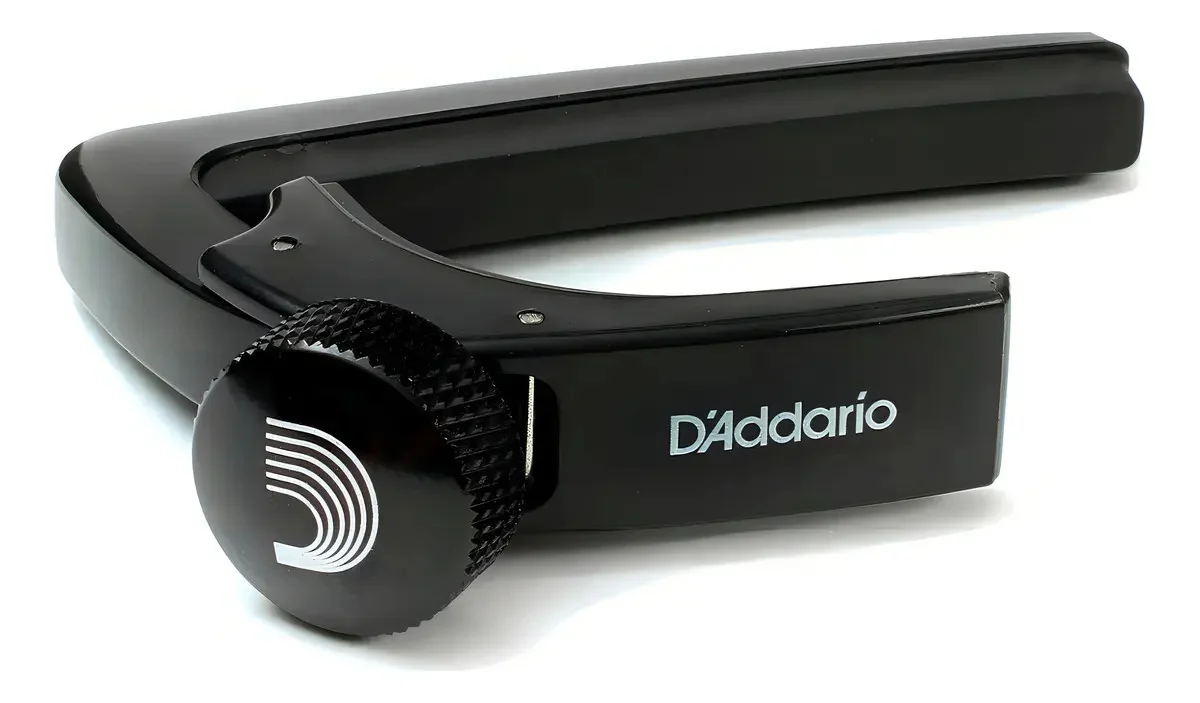
The D'Addario NS Capo Lite PW-CP-07 is a simple accessory with a very clear purpose: give players precise capo tension in a lightweight, affordable, easy-to-carry format. It belongs to D'Addario's NS capo family, associated with Ned Steinberger's design work, and sits near the entry point of the range: less premium than the aluminum models, but far more controlled than generic fixed-pressure capos.
Its core idea is to solve a common problem with inexpensive spring capos. Too much pressure can pull the strings sharp; too little pressure causes buzz and dead notes. The NS Lite uses a screw-style micrometer adjustment so the player can dial in the minimum pressure required for a specific guitar, string gauge and fret position.
This is not a flashy accessory. Its value is practical. It is inexpensive, light, compact and useful for six-string acoustic and electric guitars with radiused fingerboards. For players working with pop, folk, worship, acoustic rock, blues-based arrangements or songs that require transposition, it is the kind of small piece of gear that makes the whole setup easier.
Construction and Design
The NS Capo Lite is made from high-strength molded ABS thermoplastic. That material choice defines much of the product's character: it is very light, cost-effective and unobtrusive on the neck. The trade-off is that it does not feel as premium as a machined aluminum or nickel-plated steel capo.
Its shape is slim and fairly discreet. The string-contact surface follows the radius commonly found on steel-string acoustics and electric guitars, and the PW-CP-07 version is aimed at six-string instruments with radiused fingerboards. For classical guitars with flat fingerboards, D'Addario offers dedicated classical versions, so the models should not be mixed up.
The main control is the knurled tension knob on the side. It lets the player adjust pressure in small increments. The capo can be positioned with one hand, although it is not quite as instant as a spring-loaded Kyser-style capo. The reward is better control over how much force is being applied to the strings.
The construction is robust enough for practice, rehearsals, moderate stage use and regular home or studio work. The main caution is that ABS, while durable, does not have the same abuse tolerance as metal. For heavy touring, repeated fast changes and long-term professional use, an aluminum model may be the more appropriate choice.
Technical Specifications
| Specification | Information |
|---|---|
| Model | PW-CP-07 |
| Commercial name | D'Addario NS Capo Lite / D'Addario Capo Lite |
| Type | Screw-style capo with adjustable tension |
| Recommended instruments | Six-string acoustic and electric guitars with radiused fingerboards |
| Not recommended for | Twelve-string guitars; flat classical fingerboards require the dedicated classical version |
| Body material | High-strength molded ABS thermoplastic |
| Finish | Black |
| Adjustment | Side micrometer tension knob |
| Operation | One-hand positioning |
| Associated designer | Ned Steinberger |
| Intended use | Guitar, practice, live and studio use |
D'Addario NS Lite Capo
 1 / 3
1 / 3Features and Functionality
The key feature of the NS Lite is micrometer tension adjustment. In practical terms, the player places the capo just behind the fret and turns the knob until all strings ring cleanly, without buzz and without excessive clamping pressure. This is especially useful on low-action guitars, light-gauge strings and electric guitars, where too much capo pressure can easily make the instrument sound sharp.
Because this is a purely mechanical accessory, there are no channels, presets, effects, USB, Bluetooth, MIDI, app control, audio interface features, loop functions or power requirements. The entire performance depends on physical contact with the instrument. Better placement and more accurate pressure produce better results.
The light body makes it easy to keep in a case, gig bag or pocket. It can also be clipped to the headstock between songs, although players should avoid unnecessary pressure on delicate finishes. For home practice, church sets, small gigs and basic recording, the combination of low weight and adjustable pressure is the main attraction.
The limitation is speed. A conventional spring capo can be moved more quickly from one fret to another. The NS Lite may require minor readjustment as the neck gets wider or narrower, especially when moving from the first few frets to the middle of the neck. That is the trade-off for precision.
Sound and Performance
A capo does not create tone in the way a pedal or amplifier does, but it has a direct impact on clarity, tuning, sustain and playing comfort. The D'Addario NS Lite performs well when used with care: placed just behind the fret and adjusted with the minimum required pressure, it produces clean open-position chords, clear arpeggios and transpositions that do not feel overly clamped.
On steel-string acoustic guitars, it works well for pop, folk, worship, country, acoustic blues and rock rhythm parts. The adjustable pressure helps reduce the slightly sharp sound often caused by fixed-pressure spring capos. On electric guitar, especially with .009 or .010 strings and low action, this control becomes even more important because only a small amount of extra pressure can affect perceived tuning.
The instrument's natural dynamics remain intact when the capo is properly adjusted. Open strings still have clear attack, and the fretting hand can use familiar chord shapes in different keys. It is also useful in home recording, where small tuning deviations become obvious once multiple acoustic tracks are layered.
The weak point is absolute speed. Since the guitar neck changes thickness along the fretboard, the knob may need to be adjusted when the capo changes position. On stage, that is manageable with a planned setlist, but it may bother players who need to move the capo between songs with only a few seconds to spare.
Artists Who Use It
There is no strong public evidence that major rock or blues artists use the D'Addario NS Capo Lite PW-CP-07 specifically as a central part of their rig. For that reason, this section does not present false endorsements. The more accurate editorial approach is to highlight artists for whom capo use is musically relevant, showing the kind of context in which an adjustable capo like the NS Lite makes sense.
Richards is a key reference for capo use in classic rock, especially when paired with open tunings such as Open G. This is a musical-context association, not a claim that he uses this specific model. Still, his approach shows why stable pressure and tuning accuracy matter when a capo becomes part of the arrangement.
Oasis' acoustic-driven repertoire helped make capo-based open-chord transposition familiar to a generation of rock guitarists. There is no public confirmation that Gallagher uses the NS Lite, but his style demonstrates why a simple, reliable capo is useful for vocal-friendly keys and ringing chord shapes.
Taylor is one of the clearest examples of a player who uses a capo as an arranging and vocal-range tool. His music sits closer to folk and singer-songwriter traditions than blues rock, but tuning accuracy is critical in his clean, articulate acoustic style. The link here is conceptual rather than model-specific.
Mayer's vocabulary moves through blues, pop and soul, and parts of his acoustic repertoire use capo placement for key and color. There is no confirmed public association with the NS Lite specifically. Even so, for players who move between acoustic and electric guitar, a lightweight adjustable capo fits the same practical territory.
Who Is It For?
The D'Addario NS Lite is a strong choice for beginners who have already discovered that very cheap capos can cause tuning issues. It also suits intermediate players who need a simple capo for practice, acoustic sets, church, home recording, lessons, casual jams and small performances.
It makes sense for steel-string acoustic players, six-string electric guitarists, open-chord repertoire, singers who change keys, and styles such as folk, pop rock, worship, acoustic blues, country and classic rock. It is especially useful for light strings and instruments that react poorly to excessive pressure.
It is not the best choice for players who need instant capo changes in the middle of a performance. It is also not ideal for musicians who want premium metal construction, a high-end look or maximum durability for heavy touring. For classical guitars with flat fingerboards, the correct option is the NS Lite Classical, not the PW-CP-07 version for radiused fretboards.
Comparison with Competitors
| Model | Best for | Analysis |
|---|---|---|
| D'Addario NS Capo Lite PW-CP-07 | Value and inexpensive fine adjustment | Best when the goal is adjustable tension without paying for a metal capo. Light, simple and effective, but less premium. |
| D'Addario NS Capo Pro | Same concept with better construction | Keeps the screw-adjustment idea but uses aluminum construction. More expensive, more durable and better suited to heavier use. |
| Kyser Quick-Change | Fast stage changes | Very fast and practical live, but its fixed spring pressure can pull some guitars sharp. |
| Shubb C1 | Classic precision and build quality | Strong reputation, more professional feel and dependable adjustment. Costs more and is not as instantly movable as a spring capo. |
| G7th Nashville | Convenience with modern design | A popular fast-change alternative for acoustic and electric use. Easier for quick repositioning, but not the same fine-tension concept as the NS Lite. |
The NS Lite wins when low price and tension control are the priorities. Kyser wins for speed. Shubb wins for build feel and classic reliability. The NS Capo Pro is the natural upgrade for players who like the NS Lite idea but want a metal body. For most students and home or semi-professional musicians, the NS Lite delivers the essentials very sensibly.
Pros and Cons
| Pros | Cons |
|---|---|
| Micrometer adjustment helps reduce tuning problems | Not as fast as a spring capo for instant changes |
| Very light and easy to carry | ABS body does not feel as premium as metal |
| Strong value for money | May require readjustment when moved along the neck |
| Works well on six-string acoustic and electric guitars with radiused fingerboards | Not recommended for twelve-string guitars |
| Discreet, functional design | Not the right model for flat classical fingerboards |
| Good for practice, home recording and moderate stage use | Less suited to heavy touring or extreme professional use |
Final Verdict
The D'Addario NS Capo Lite PW-CP-07 is worth buying if you want a light, affordable capo that is more precise than generic fixed-pressure models. It shines when the goal is clean open chords, fewer tuning problems caused by excess pressure and a dependable accessory for six-string acoustic and electric guitars.
It is not the most luxurious, fastest or toughest capo on the market. That is not its mission. Its strength is the balance between price, fine adjustment and simplicity. For beginners, it is a smart buy. For intermediate players, it is an excellent everyday or backup capo. For professionals who play a lot of live shows, the NS Capo Pro, a Shubb or a more robust G7th model may be better choices.
As an editorial conclusion, the NS Lite is a small, honest and functional accessory. It will not transform the sound of your instrument, but it helps preserve what matters when using a capo: stable tuning, clean strings and the freedom to play in different keys without overcomplication.