
Basic Data
| Field | Information |
|---|---|
| Full name | Dunlop Cry Baby® Standard Wah GCB95 |
| Brand | Dunlop / Jim Dunlop |
| Category | Analog wah-wah pedal for guitar |
| Line/series | Cry Baby |
| Country of manufacture | United States, as commonly listed by specialist retailers for the GCB95 |
| Approximate price range | USA: around US$99.99 new; Brazil: usually around R$900 to R$1,400 new, depending on import costs, inventory, and taxes |
| Status | In production |
| Official page | jimdunlop.com/cry-baby-standard-wah/ |
Overview
The Dunlop Cry Baby Wah is one of those pedals that moved beyond being just an effect and became a language. Instead of changing frequencies in a static way, it lets the player control a filter with the foot in real time, creating the vocal sweep that made wah essential in rock, blues, funk, hard rock, and classic metal.
The GCB95 has a clear purpose: to be the most direct, recognizable, and accessible Cry Baby in the line. It does not offer a Q control, range selector, boost, officially promoted true bypass, app, MIDI, or presets. Its strength lies in the opposite direction: a rugged chassis, an aggressive sweep, traditional mechanical switching, and a tone that cuts through a mix easily.
That simplicity explains its relevance. For guitarists who want to understand wah without immediately moving into more expensive and configurable versions, the GCB95 is a natural starting point. It is expressive enough for singing solos, aggressive enough for gain-heavy riffs, and percussive enough for funk rhythm parts when paired with precise picking.
It is also a pedal that demands interpretation. Unlike an overdrive that can stay on all the time, a wah responds directly to foot movement, pick attack, amplifier volume, and its position in the signal chain. That is why the Cry Baby is not merely an effect. It is a performance tool.
Build and Design
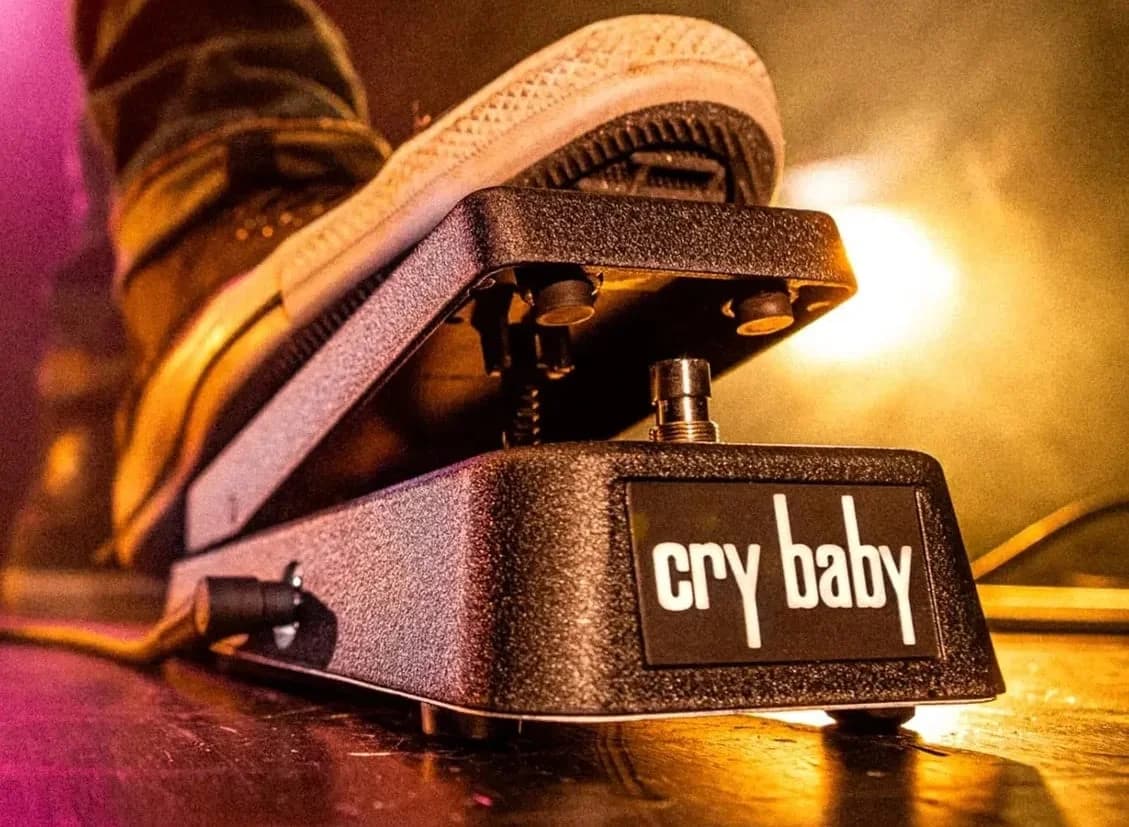
The GCB95 follows the classic rocker-pedal format: a heavy metal base, a rubberized treadle, and a switch underneath the toe. To turn it on or off, the player presses the front of the pedal until it clicks. After that, rocking the pedal back and forth controls the tonal sweep.
The enclosure is heavy-duty die-cast metal with a textured black finish and a minimalist look. Its visual identity is one of the most recognizable in the pedal world: black body, ribbed rubber tread, and the white “cry baby” logo on the front. There are no side knobs, displays, or visible controls. Everything happens through the physical motion of the pedal.
The feel underfoot is firm. The travel has enough resistance to prevent accidental movement, but not so much that it becomes tiring in normal use. On stage, the base feels stable. On compact pedalboards, however, the traditional size can be inconvenient and may require planning so it remains accessible.
The toe switch is reliable, but the classic system has a learning curve. Beginners sometimes leave the pedal on without realizing it or press too hard to engage it. That is part of the traditional design rather than a defect, but it matters if you prefer auto-return or optical wah pedals.
Technical Specifications
| Specification | Information |
|---|---|
| Model | GCB95 |
| Effect type | Analog wah-wah |
| Inductor | Red Fasel® inductor in the modern GCB95 version |
| Potentiometer | Hot Potz, tested by Dunlop for one million cycles |
| External controls | Rocker pedal with toe switch |
| Inputs | 1 Instrument input |
| Outputs | 1 Amplifier output |
| Input impedance | 800 kΩ |
| Output impedance | 10 kΩ |
| Filter parameter — Low Pass | 350 Hz to 450 Hz |
| Filter parameter — High Pass | 1.5 kHz to 2.5 kHz |
| Maximum input level | -8.0 dBV |
| Maximum output level | +10 dBV |
| Maximum gain — heel down | +19.5 dB |
| Maximum gain — toe down | +19 dB |
| Signal-to-noise ratio — heel down | 98 dBV, A-weighted |
| Signal-to-noise ratio — toe down | 89 dBV, A-weighted |
| Current draw | 900 µA |
| Power | 9V battery, Dunlop ECB003 9V adapter, or compatible Dunlop/MXR power supplies |
| Bypass | Traditional mechanical switching; the official GCB95 page does not present true bypass as a main feature |
| Chassis | Heavy-duty die-cast metal |
| Digital features | None |
| MIDI / USB / Bluetooth | None |
Dunlop Cry Baby Wah
 1 / 3
Features and Functions
The GCB95 is a single-purpose pedal. It does not try to be an effects hub or a programmable wah. Its job is to sweep a frequency range in real time to create the familiar vocal wah effect.
In practice, it has three main uses. The first is moving wah, where the guitarist synchronizes foot motion with phrases, bends, vibrato, and pick attack. This is the most expressive use, common in blues rock, hard rock, and psychedelic solos. The second is rhythmic use, with repetitive, percussive motion, strongly associated with funk and clean or lightly driven grooves. The third is fixed-filter use: the player leaves the treadle in one position to emphasize mids, create a nasal tone, or push a certain frequency area for solos.
Connectivity is basic: guitar into the Instrument input, Amplifier output to the amp or the rest of the signal chain. Power can come from a 9V battery or a compatible 9V adapter. As with many battery-powered pedals, unplugging the input cable when the pedal is not in use helps avoid unnecessary battery drain.
There are no presets, tuner, effects loop, cabinet simulation, USB interface, Bluetooth, MIDI, or app. That is not an accidental limitation. It is part of the concept. A GCB95 buyer is choosing a mechanical, direct wah pedal, not a configuration platform.
Tone and Performance
The Cry Baby GCB95 sounds direct, cutting, and immediately recognizable. Its sweep focuses on mids and highs, with enough attack to make notes stand out in a band. Compared with darker, more vintage-style wahs, the modern GCB95 tends to sound more aggressive, with a more obvious top end and strong presence at the start of phrases and bends.
With overdrive or distortion, it produces the nasal scream that helps solos come forward without relying only on volume. On riffs, it can add motion and tension, especially in short passages. On clean rhythm parts, it works well for rhythmic patterns, but it requires precision: if the foot motion does not connect with the picking hand, the effect can become cartoonish quickly.
Its dynamics depend heavily on the player. The pedal does not hide the performance; it magnifies intention. Small differences in foot position change articulation. Parked in the middle of the sweep, it can work as a useful mid-focused filter. Toe-down can be bright and even harsh depending on the guitar, pickups, and amp. Heel-down is darker and more compressed, useful for contrast.
At home, the GCB95 is fun, but it may feel exaggerated at low volume if used with heavy gain and little musical context. In the studio, it works well when a part needs real expression, especially solos or focused overdubs. In rehearsal and on stage, its main strength becomes obvious: it cuts through the mix. That same quality can become excessive if the amp is already bright.
In the pedal chain, the most common position is before drives, fuzzes, and distortions. That preserves the classic behavior: the wah shapes the guitar signal before gain. Placing it after drives can create a more dramatic filtered effect, sometimes useful, but usually less natural for traditional rock and blues. With vintage-style fuzzes, interaction can be sensitive; depending on the circuit, buffers and impedance can change response and noise.
Artists Who Use It
Hendrix is one of the most important historical associations with wah tone. Dunlop offers a Jimi Hendrix Cry Baby model designed to reproduce the wah tone heard on tracks such as “Voodoo Child (Slight Return).” The timeline matters: Hendrix did not use the modern GCB95 reviewed here, but his approach helped define the vocabulary that the Cry Baby line preserves.
Clapton is among the guitarists cited by Dunlop in the Cry Baby story as part of the wah’s consolidation in rock. His late-1960s use helped turn the effect into an expressive lead tool for blues rock. This is a historical and stylistic association rather than a specific endorsement of the modern GCB95.
Slash has Dunlop Cry Baby signature models, confirming the direct connection between his lead tone and the Cry Baby aesthetic. In his context, wah works as an extension of bends, wide vibrato, and Marshall-style gain, helping hard-rock solos take on a more vocal focus.
Tom Morello has a signature Cry Baby and uses wah as a core part of his language of texture, noise, and rhythmic phrasing. Rather than treating it only as a solo color, he turns it into a performance tool integrated into riffs and sound effects.
Buddy Guy is presented by Dunlop as an important figure in bringing wah into the blues vocabulary. His signature model reinforces the effect’s use in expressive phrasing, vocal attacks, and guitar tones that react directly to hand dynamics and foot movement.
Who It Is For
The Dunlop Cry Baby GCB95 makes strong sense for guitarists who want a classic wah, rugged and uncomplicated. For beginners, it is an excellent school of expression: it forces the player to coordinate phrasing, timing, picking, and foot movement. For intermediate players, it is a practical tool for solos, riffs, and stage tones. For advanced musicians, it remains useful when the priority is reliability and direct response rather than programming.
It fits especially well with classic rock, blues rock, hard rock, funk, psychedelia, and traditional metal. It can also work in pop, worship, and modern soundtrack contexts when used with restraint. In apartments and home studios, remember that wah is a very obvious effect: it can sound excessive if used on every phrase. Its best use is usually intentional and selective.
It is not the best choice for players who need multiple wah voices, Q control, boost, true bypass promoted as a key feature, a mini format, or automatic switching. It may also disappoint guitarists who prefer darker, smoother, more vintage wah sounds. For those players, the Cry Baby Classic GCB95F, Cry Baby 535Q, Vox V847A, or Xotic XW-1 may be better fits.
Comparison with Competitors
| Model | Best for | Main difference from the GCB95 |
|---|---|---|
| Vox V847A Wah | Vintage tone and the classic British/Italian wah tradition | Often perceived as more classic and smoother; the GCB95 is generally more aggressive and focused in the upper mids |
| Boss PW-3 Wah | Compact pedalboards and Boss-style reliability | Offers voicing modes and a smaller format; the GCB95 delivers the traditional Cry Baby feel and a larger treadle |
| Cry Baby 535Q Multi-Wah | Players who want range, Q, and boost controls | Far more adjustable; the GCB95 is cheaper, simpler, and more immediate |
| Xotic XW-1 Wah | Demanding players who want fine control | More controls and a boutique-style feature set; the GCB95 is more accessible and direct |
| Morley 20/20 Bad Horsie Wah | Stage use with automatic switching | Optical system and auto-return favor quick effect entry and exit; the GCB95 keeps the classic mechanical click |
Against more modern alternatives, the Cry Baby Standard does not win on features. It wins on identity, price, and familiarity. It is the pedal many guitarists choose when they want “a real wah” without learning menus, switches, or calibration.
The most important comparison inside the Cry Baby line is with the 535Q. The 535Q is more flexible and can suit studio players, cover bands, and guitarists who want to adapt the wah to different guitars. The GCB95 is better when simplicity, cost, and immediate classic response matter most.
Pros and Cons
| Pros | Cons |
|---|---|
| Classic, aggressive, recognizable wah tone | No Q, range, or boost controls |
| Rugged metal chassis | Traditional size takes pedalboard space |
| Excellent for rock, blues rock, and hard-rock solos | Can sound too bright or nasal in already bright rigs |
| Simple operation with no menus | Click switching takes some getting used to |
| Strong value within the category | Official page does not position true bypass as a standard-model feature |
| Cuts through a live mix well | Less versatile than the 535Q, XW-1, and multi-mode wahs |
The GCB95’s strongest point is the combination of price, identity, and ruggedness. Its weakest point is the lack of adjustment. It delivers a specific sound — and delivers it well — but it does not try to cover every possible wah variation.
Final Verdict
The Dunlop Cry Baby Wah GCB95 still makes sense because it fulfills a clear promise: classic Cry Baby tone in a simple, rugged, musical pedal. It is not the most sophisticated wah, the most compact, the quietest in every rig, or the most flexible in the category. But it remains one of the strongest entry points for understanding why wah became essential to electric guitar.
For players in rock, blues, hard rock, funk, or classic metal who want an expressive pedal for solos, riffs, and rhythmic textures, the GCB95 is a safe choice. It shines especially in a band context, where its mid and high-frequency focus helps the guitar come forward without relying only on volume.
A competitor may be better if you need fine adjustment, a more vintage voice, a smaller format, or automatic switching. In that case, look at the Cry Baby 535Q, Vox V847A, Boss PW-3, Xotic XW-1, or Morley Bad Horsie. But if the question is “which classic wah should I buy first?”, the Cry Baby Standard is still one of the strongest answers — not because of nostalgia, but because its simplicity still works.