
Basic Data
| Field | Information |
|---|---|
| Full name | Epiphone Les Paul Standard, including the current Standard 50s and Standard 60s variants |
| Brand | Epiphone |
| Group | Epiphone is part of Gibson Brands; Gibson acquired Epiphone in 1957 and the brand now lives inside the Gibson/Epiphone ecosystem |
| Category | Solid body single-cut electric guitar |
| Line/series | Inspired by Gibson Collection; Les Paul family |
| Related models | Les Paul Studio, Les Paul Modern, Les Paul Custom, Les Paul Prophecy, Les Paul Special, Les Paul Junior and signature models |
| Country of manufacture | Varies by period and line; current high-volume models are generally made in Asia, mainly China and Indonesia depending on batch and distribution |
| Approximate price range | US: around $599 to $899 for many core models; Brazil: commonly around R$ 3,500 to R$ 9,000 depending on version, exchange rate, availability and retailer |
| Status | In production, with periodic updates to finishes, specs and special editions |
| Official page | gibson.com, Epiphone Les Paul section |
Overview
The Epiphone Les Paul is one of the most important entry points into the Les Paul world. It is designed to deliver the classic Gibson architecture — single-cut solid body, short scale, Tune-O-Matic bridge, dual humbuckers and four independent controls — at a far more accessible price. That makes it a strategic guitar for serious beginners, advancing intermediate players and experienced musicians who want a dependable Les Paul without the cost of a Gibson USA model.
The key point is that "Epiphone Les Paul" is not one guitar. It is a family. The Standard 50s leans into a more vintage feel, with a fuller neck and moderate-output ProBuckers. The Standard 60s usually has a slimmer neck and a slightly more direct response. The Studio simplifies the look to reduce cost and weight. The Modern adds comfort contours, weight relief and more flexible electronics. The Custom emphasizes the deluxe visual language. The Prophecy takes the shape into high-performance metal territory with Fishman Fluence pickups and 24 frets. The Special and Junior are rawer, more direct instruments built around P-90 attitude.
This review uses the Epiphone Les Paul Standard as the central reference because it represents the classic core of the line. At the same time, it compares the key models in the family so you can choose the right Les Paul for your sound.
Construction and Design
The visual recipe is instantly recognizable: a single-cut body with a carved top, 24.75-inch scale length, trapezoid inlays, upper-bout pickup selector and four lower-body knobs. An Epiphone Les Paul Standard feels substantial in the hands. It does not try to be a light, ergonomic superstrat; it keeps the more traditional Les Paul posture, with a denser body, a centered mass and natural sustain.
On current Standard models, the typical construction combines a mahogany body with a maple cap, a glued-in mahogany neck and an Indian laurel or, in some recent/specific series, rosewood fingerboard. The set-neck construction is part of the Les Paul DNA because it contributes to a solid attack, long sustain and a more continuous feel between neck and body. The maple top helps add definition to the thick mahogany low end.
Ergonomics require honesty. A Les Paul can be more tiring than a Stratocaster, Telecaster or SG during long shows, especially if the individual guitar is heavy. Upper-fret access is also less open than on modern double-cut designs. On the other hand, that physical mass is part of what many players want: dense notes, authoritative chords and the sense of holding a serious instrument.
Finishes vary widely by model. The Standard goes for the classic look with binding, traditional knobs and sunburst or goldtop finishes. The Custom adds multi-ply binding, gold hardware and a darker fingerboard, usually ebony on current models. The Studio removes some visual luxury to focus on value. The Modern and Prophecy are more contemporary, adding comfort features, weight relief and expanded electronics.
Technical Specifications
The table below uses the current Epiphone Les Paul Standard 50s/60s as the main reference, with notes for other versions where relevant.
| Specification | Epiphone Les Paul Standard — main reference |
|---|---|
| Body | Mahogany, generally with maple cap |
| Shape | Les Paul single-cut solid body |
| Neck | Glued-in mahogany neck |
| Neck profile | Standard 50s: Rounded Medium C/fuller feel; Standard 60s: SlimTaper/slimmer feel, depending on version |
| Scale length | 24.75" / approximately 628.65 mm |
| Fingerboard radius | 12" / approximately 304.8 mm |
| Fingerboard wood | Indian laurel on many versions; rosewood on selected/recent series; ebony on Custom, Modern and Prophecy depending on model |
| Frets | 22 medium jumbo on most Standards; 24 jumbo on Prophecy |
| Pickups | Standard 50s: ProBucker 1 and ProBucker 2; Standard 60s: ProBucker 2 and ProBucker 3; Studio: often Alnico Classic PRO; Prophecy: Fishman Fluence |
| Controls | 2 volumes, 2 tones and 3-way pickup selector |
| Pots | CTS on several current Inspired by Gibson models |
| Bridge | LockTone Tune-O-Matic / Stop Bar or equivalent model-specific variants |
| Tuners | Grover, Epiphone Vintage Deluxe or Grover locking, depending on model |
| Nut | Graph Tech NuBone on several current models |
| Output | Standard 1/4" jack |
| Finish | Gloss, satin, worn or special finishes depending on version |
| Typical factory strings | .010–.046 on many models |
| Case/bag | Varies by version; some include premium gig bag or hard case, others do not |
Epiphone Les Paul Standard
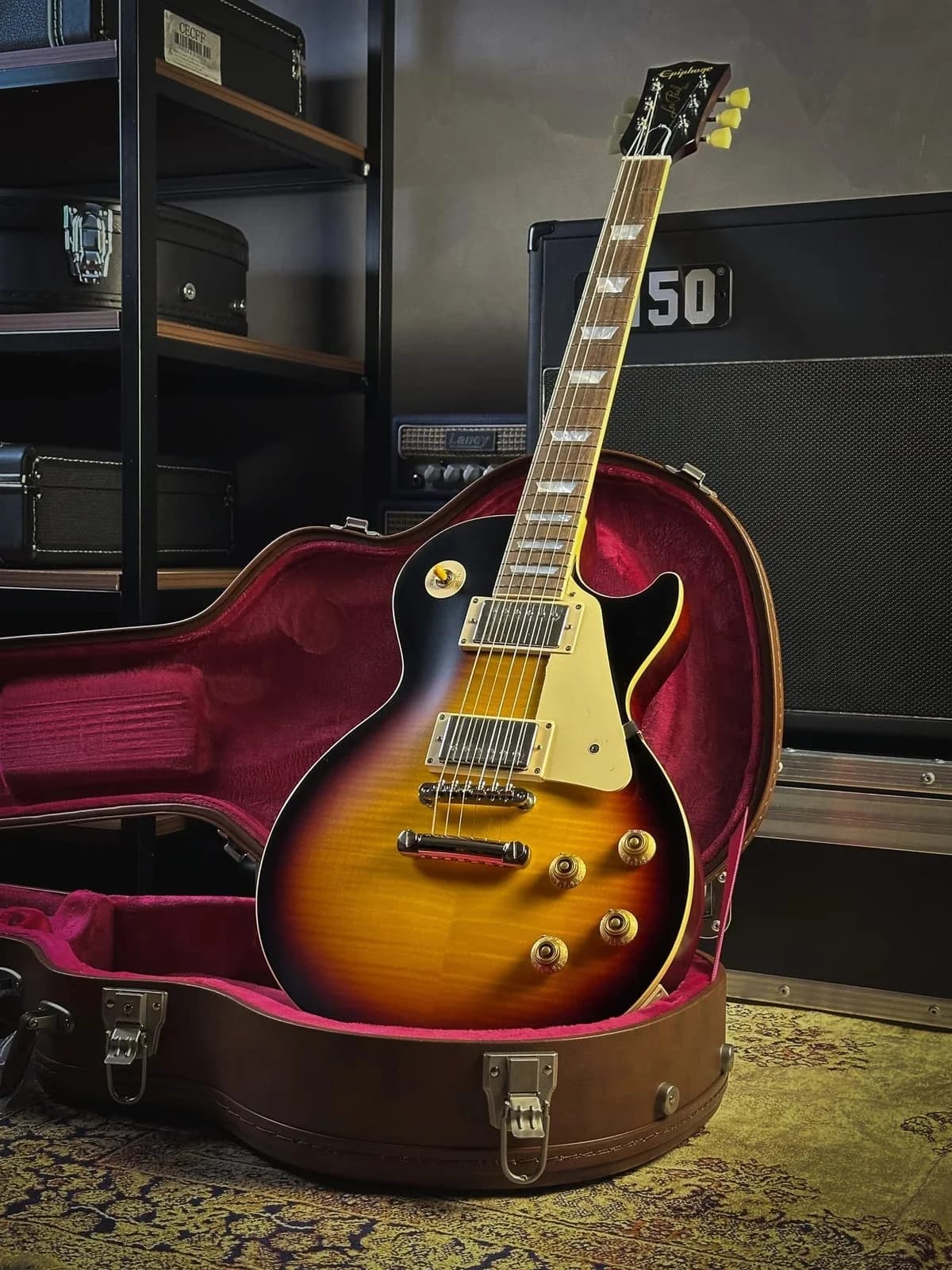 1 / 3
1 / 3Features and Functionality
The Epiphone Les Paul Standard is a traditional guitar, not a digital platform. There is no USB, Bluetooth, presets, MIDI, built-in tuner or battery. Its real feature set is the mechanical and electrical interaction between wood, set neck, fixed bridge, humbuckers and passive controls.
On the Standard, the two-volume/two-tone layout is more powerful than it looks. A player can set the bridge pickup hotter for riffs and solos, roll the neck pickup volume down for cleaner rhythm parts, and switch between them from the three-way toggle. With a tube amp or a good modeler, lowering the guitar volume cleans up overdrive in a musical way, especially on ProBucker-equipped models with CTS pots.
The Les Paul Studio is often more practical: Les Paul tone with fewer visual extras. Some versions offer push/pull coil split on the volume knobs, broadening the palette into more open sounds, even though they will not become true Stratocaster tones. The Modern develops that flexibility further with improved upper-fret access, weight relief and more versatile electronics. The Prophecy heads in another direction: active Fishman Fluence pickups, multiple voices and a more compressed, precise modern response.
The Special and Junior deserve separate attention. They are not just "cheap Les Pauls"; they have their own voice. P-90 pickups deliver raw attack, aggressive mids and excellent dynamics for blues, garage rock, punk, slide and classic rock. If you do not need the thick low end of humbuckers, a Special can feel more alive and immediate than a Standard.
Sound and Performance
A good Epiphone Les Paul Standard sounds thick, mid-forward, sustaining and familiar. The bridge pickup delivers full-bodied riffs, controlled highs and enough attack for classic rock, hard rock, blues rock and heavier pop. The neck pickup is rounder, with full lows and softer highs, working well for singing leads, slow blues, jazz-rock and warm clean rhythm parts.
Dynamics depend heavily on the amp and setup. With ProBuckers, the response is more vintage than extreme: there is natural compression, but still enough sensitivity to pick attack. It works well with classic overdrives, fuzzes, boosters and pushed British or American amps. Under high gain, the bridge has weight, but modern metal players may prefer the Prophecy, which offers more definition and aggressive pickup voicing.
At home, the Les Paul Standard works well with interfaces, plugins and small practice amps, but it reveals one practical detail: full humbuckers can become muddy if the patch or amp has too much bass. Reducing low end and emphasizing mids usually solves the problem. In the studio, it is reliable for double-tracked rhythm guitars, melodic solos and thick guitar layers. At rehearsals and on stage, the fixed bridge and sustain help, but the weight matters during long sets.
Playability is classic. The short scale makes bends and vibrato easier, especially with .010 strings. The 50s neck suits players who like a fuller grip for blues; the 60s neck helps smaller hands and faster phrases. Tuning stability is usually good when the nut is properly cut, but factory guitars may benefit from a proper setup: nut, intonation and pickup height. That is common in intermediate guitars and should be part of the buying plan.
Artists Who Use It
Joe Bonamassa is one of the strongest links between modern blues rock and Epiphone Les Paul instruments. Epiphone has released several signature guitars connected to his collection and the Les Paul universe, including vintage-inspired models. The point is not that he plays Epiphone exclusively on every stage; it is that he helped validate the idea of a serious, more affordable Les Paul with strong specs, vintage styling and credible pickups.
Slash is historically tied to hard-rock Les Paul tone, and Epiphone offers Slash Les Paul Standard models within the Inspired by Gibson range. This matters for players chasing thick humbuckers, long sustain and singing mids without paying Gibson signature prices.
Jared James Nichols has a direct relationship with Epiphone Les Paul signature models, including single-pickup, P-90-based Les Paul Custom-style instruments. His context is raw blues rock with minimal effects, aggressive picking and strong dynamics. That association proves the Epiphone Les Paul platform can work outside the standard dual-humbucker recipe.
Matt Heafy is important for the modern Epiphone Les Paul Custom side. His signature models place the Les Paul shape in a contemporary metal context, emphasizing stability, high gain and stage performance. For players considering the Prophecy or modern Customs, he is a strong reference for heavier professional use.
Jerry Cantrell has Epiphone signature models inspired by his language of dense riffs, lower tunings and dark hard rock. The connection matters because it reinforces one of the Les Paul's natural territories: strong mids, sustain and rhythmic weight without losing definition.
Who Is It For
The Epiphone Les Paul Standard is ideal for players who want to enter Les Paul territory seriously. For beginners, it can be an excellent first guitar if the budget allows and if the student already knows they like rock, blues and humbuckers. For intermediate players, it is probably the most balanced point in the line: convincing construction, classic tone, solid playability and room for future upgrades.
It shines in blues rock, classic rock, hard rock, worship with thick drive, pop rock and home-studio recording. It works well with traditional pedals such as Tube Screamer, Blues Driver, Klon-style drives, classic fuzzes, analog delays and amps or modelers from Marshall, Vox, Fender, Orange, Boss Katana, Positive Grid Spark, Line 6, Neural DSP and similar platforms.
For gigging musicians, the Standard is fully usable once properly set up. For studio work, it is a reliable tool for double-tracked rhythm guitars and lead lines. For apartment use, it works well with a small amp or interface, though it has no special silent-practice advantage beyond humbuckers naturally rejecting more noise than single coils.
It is not the best choice for players who want an ultra-light guitar, open upper-fret access, tremolo bridge, authentic single-coil sparkle or highly compressed modern metal sounds. In those cases, a superstrat, SG, PRS SE or the Les Paul Prophecy may make more sense.
Comparison With Competitors
| Model | Best for | Main advantage | Limitation against Epiphone Les Paul Standard |
|---|---|---|---|
| Gibson Les Paul Studio | Players who want a simpler Gibson USA | American build, brand prestige and stronger resale value | Much higher price; not always a proportional improvement for every player |
| PRS SE McCarty 594 Singlecut | Modern versatility with vintage inspiration | Excellent finish, refined playability and usable coil split | Less traditional Les Paul feel and attack |
| ESP LTD EC-256 / EC-1000 | Modern rock and metal | More modern ergonomics, higher-output pickup options and fast necks | Less focused on vintage Les Paul tone; more aggressive styling |
| Cort CR250 / CR300 | Single-cut value | Good build for the money and convincing tone | Weaker brand pull and no direct Gibson/Epiphone legacy |
| Epiphone Les Paul Studio | Value within the Epiphone line | Cheaper, more direct and often lighter | Less classic ornamentation and, in some versions, less refined pickups than ProBuckers |
The most natural comparison is the Gibson Les Paul Studio. The Gibson brings prestige, USA construction and stronger resale value, but the Epiphone Standard can be the rational buy for players who want much of the practical experience at a fraction of the price. Against PRS SE and LTD, Epiphone wins in traditional Les Paul authenticity. Against Cort and other single cuts, it benefits from the direct connection to the Gibson group and the strength of the Epiphone name.
Pros and Cons
| Pros | Cons |
|---|---|
| Classic Les Paul tone at a much lower price than Gibson | Weight can be tiring during long rehearsals or gigs |
| Convincing ProBuckers on Standard 50s/60s models | Traditional ergonomics limit upper-fret access |
| Set-neck build and fixed bridge favor sustain | May need an initial setup for nut, intonation and pickup height |
| Wide model range: Studio, Standard, Modern, Custom, Prophecy, Special and Junior | Differences between versions can confuse first-time buyers |
| Strong link to the Gibson universe, since Epiphone is part of Gibson Brands | Does not fully replace a Gibson USA in finish detail, selected woods and resale value |
| Excellent for rock, blues and hard rock | Not the most versatile option for funk, country or crystalline single-coil tones |
The Epiphone Les Paul Standard is honest: it delivers a lot, but it is not magic. Buyers should expect a solid, musical and inspiring instrument, not a low-cost Gibson with every detail of an American premium guitar. Differences still exist in wood selection, fine finishing, hardware, quality control and market value. Still, musically, a well-set-up Epiphone can record and perform live with excellent results.
Final Verdict
The Epiphone Les Paul Standard is absolutely worth considering if you want the sound, look and core experience of a Les Paul without paying Gibson USA prices. It is one of the most relevant intermediate electric guitars on the market because it is not just a visual copy: it has coherent construction, convincing pickups, improved electronics in current lines and a broad enough family to fit different profiles.
The recommendation is straightforward. For blues, classic rock and vintage hard rock, choose the Standard 50s if you like a fuller neck or the Standard 60s if you prefer a slimmer feel. For pure value, consider the Studio. For a deluxe look, choose the Custom. For modern metal, lower tunings and high definition, the Prophecy is more appropriate. For raw, dynamic midrange, pay attention to the Special or Junior with P-90s.
It shines when connected to a good amp or modeler with moderate drive, with the guitar volume used actively and a playing style that values sustain, vibrato and midrange. A competitor may be better if you want modern ergonomics, very low weight, a tremolo bridge or extreme versatility. But if the question is "which accessible Les Paul still feels and sounds like a real Les Paul?", the Epiphone Les Paul Standard remains one of the strongest answers.