
Basic Data
| Field | Information |
|---|---|
| Full name | Fender Mustang® LT25 |
| Brand | Fender |
| Category | Digital guitar combo amplifier |
| Line/Series | Mustang® LT |
| Country of manufacture | Not officially specified by Fender on the consulted product page |
| Power | 25 watts |
| Speaker | 1 x 8" Fender® Special Design |
| Approximate price range | USA: around US$179.99 on Fender’s website; Europe: roughly €170–€200 at major retailers; Brazil: varies significantly with import costs, stock and taxes |
| Status | In production |
| Official page | https://intl.fender.com/products/mustang-lt25 |
Overview
The Fender Mustang LT25 is a practice amplifier with a very clear purpose: to put convincing guitar tones, essential effects and a simple user interface into a small, lightweight combo. It is not trying to be a stage amp, and it is not a professional modeling hub like larger Mustang GTX amps or advanced floor processors. Its mission is more direct: help guitar players practice more, learn faster and explore styles without buying a pedalboard right away.
Fender positions the LT25 as an amp for beginners and students, and that positioning is accurate. The unit offers 25 watts, an 8-inch speaker, 20 amp models, 25 effects, factory presets and editing from the front panel. For a new player, that solves several early problems at once: how to get a clean tone, how to reach blues crunch, how to try rock distortion, and how to use delay, reverb, chorus, compression and tuning without additional gear.
The strength of the Mustang LT25 is its balance between simplicity and variety. It does not offer the editing depth of more expensive processors, but it also does not force the player through intimidating menus just to get a usable sound. The 1.8-inch color display, central encoder and physical gain, volume, treble, bass and master controls make it feel close enough to a traditional amp, with the benefit of presets.
For Luciano Bastos Guitar readers, it is especially relevant for players studying rock, blues, pop, worship, light hard rock and effect-based clean parts at home. It is an amp that teaches core tone concepts before the player invests in pedals, tube amps or more sophisticated modeling systems.
Construction and Design
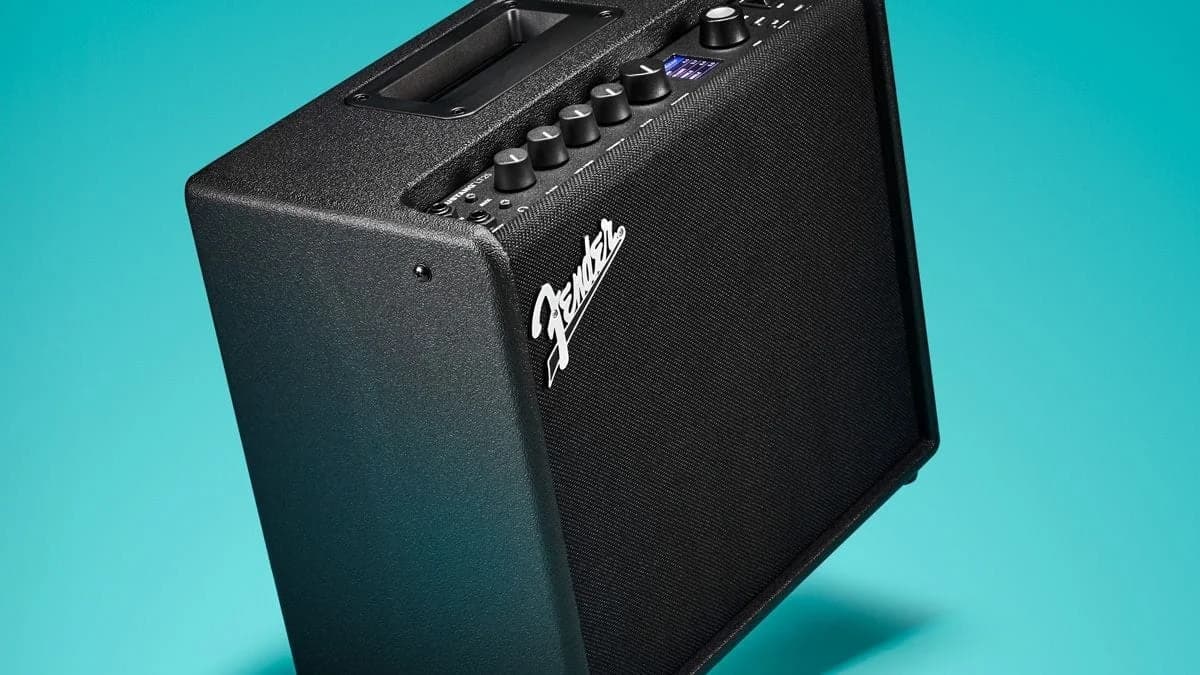
The Mustang LT25 follows Fender’s understated compact-amp look: black cabinet, dark grille, prominent Fender logo and a top/front control panel. The cabinet is made of wood, covered in black textured vinyl, with an integrated recessed handle and an approximate weight of 5.7 kg. It is clearly designed for a bedroom, practice space, small home studio or office.
The construction feels better than many extremely cheap entry-level amplifiers. The wooden enclosure helps both the perception of solidity and the overall feel of the unit. Still, the context matters: this is a compact digital practice combo. It was not designed for constant touring, heavy stage abuse or road cases.
The control layout is one of the design’s strongest points. Instead of hiding everything in menus, Fender kept physical knobs for the most common adjustments. Gain and volume shape the selected amp model; treble and bass provide the main tone adjustment; master controls the final output level. Preset select, Back, Save, Menu and Tap/Tuner handle navigation. For beginners, this reduces friction.
The 8-inch speaker is appropriate for the size and purpose of the product. It provides enough volume for practice and home playing, but it should not be confused with the projection, low-end depth and physical response of a 10-inch or 12-inch combo. That limitation is most noticeable with deep lows, high-gain tones and situations where the player expects the air movement of a larger amplifier.
Technical Specifications
| Specification | Detail |
|---|---|
| Amplifier type | Digital/modeling |
| Power | 25 watts |
| Speaker | 1 x 8" Fender® Special Design |
| Cabinet | Wood enclosure |
| Covering | Black textured vinyl |
| Color | Black |
| Amp models | 20 |
| Effects | 25 |
| Presets | 50 total, including 30 preloaded and 20 easily accessible |
| Display | 1.8" color display |
| Main input | 1 x 1/4" instrument input |
| Auxiliary input | 1/8" stereo |
| Headphone output | 1/8" stereo |
| USB | Yes, for recording and firmware updates |
| Compatible app | Fender Tone Desktop App |
| Footswitch | Compatible with Fender 1-Button Economy footswitch, sold separately |
| Controls | Gain, Volume, Treble, Bass, Master, Preset Select, Back, Save, Menu, Tap Tempo/Tuner |
| Tuner | Built-in chromatic tuner |
| Line out | None |
| Effects loop | None |
| MIDI | Not listed as a product feature |
| Bluetooth | Not available |
| Power requirements | 100–240 VAC, 50–60 Hz |
| Dimensions | 36.8 cm width x 32.4 cm height x 21.0 cm depth |
| Weight | 5.7 kg |
Fender Mustang LT25
 1 / 3
Features and Functionality
The Mustang LT25 uses a straightforward architecture: one physical channel, digital presets and an editable signal chain. In practice, the player chooses a preset, adjusts the amp model, adds or changes effects and saves the result. For a beginner, this is more educational than a system overloaded with advanced parameters.
The 20 amp models cover Fender-style classics, British cleans, rock crunch, modern high gain and direct practice tones. The official manual describes models inspired by circuits such as the Twin, Bassman, Deluxe Reverb, Champ, Vox AC30, Marshall Super Lead, Marshall JCM800, Hiwatt DR103, Mesa Dual Rectifier, Orange OR120 and EVH 5150III. Fender makes clear that third-party names are references to sounds studied during model development, not formal partnerships.
The effects section includes overdrives, fuzzes, compression, EQ, chorus, flanger, tremolo, phaser, touch wah, delays, reverse delay, echo, room, hall, spring, plate and arena reverbs. That is enough to build most core rock and blues tones: clean with spring reverb, crunch with overdrive, lead with delay, chorus textures, hard rock distortion and gated high-gain practice sounds.
USB is an important modern feature. It allows recording to a computer and updating firmware. It will not replace a dedicated audio interface in every situation, but it is very useful for capturing ideas, practicing with a DAW, recording exercises and making simple demos.
The stereo auxiliary input lets you play along with backing tracks or songs. The headphone output supports silent practice. The built-in chromatic tuner is practical and removes the need for a separate tuner pedal or app. The optional one-button footswitch can be configured to switch between two presets, which helps in practice and small performance situations, but it does not turn the LT25 into a stage amp.
Equally important is what the LT25 does not offer: no Bluetooth, no internal battery, no effects loop, no dedicated line out, no MIDI and no mobile app control by phone. Fender lists compatibility with the Fender Tone Desktop App for computer.
Sound and Performance
The Mustang LT25 should be judged for what it is: a compact digital amplifier with an 8-inch speaker, built for practice. Within that frame, it performs very well. Fender-inspired clean tones are its most natural territory. They work nicely for open chords, arpeggios, clean blues, pop, light funk and reverb-based practice. The attack is clear, the response is predictable and noise remains controlled at moderate gain levels.
Crunch tones are particularly enjoyable for blues rock, classic rock and study riffs. Models inspired by Bassman, Deluxe, Vox and Marshall-style sounds help players hear the difference between American and British amp characters. Touch response is present, but it is the response of a compact digital combo, not the three-dimensional elasticity of a loud tube amp pushing a larger speaker.
Rock and high-gain sounds are useful, especially through headphones or at bedroom volume. For modern metal and very low tunings, the 8-inch speaker’s limits become clearer: the low end is not as full as a 12-inch combo, and the physical feel is smaller. Still, the high-gain models perform well for study, songwriting and practice.
At home and in apartments, the Mustang LT25 shines. The Master control allows low-volume playing, the headphone output supports late-night practice, and the presets reduce the time between turning the amp on and actually playing. In a simple home studio, USB is a real advantage for recording ideas. In rehearsal with an acoustic drummer or on stage, it is not the ideal choice. It can work in very controlled moderate-volume situations, but it was not built to compete with drums, bass and PA without reinforcement.
The speaker response is honest for the category. It has enough brightness and definition for practice, but not the depth of a larger cabinet. Players looking for small gigs should consider alternatives with 10-inch or 12-inch speakers, more usable power, a direct output or more stage-focused features.
Artists Who Use It
There is no widely documented use of the Fender Mustang LT25 as the main amplifier of established rock or blues artists on official recordings, tours or professional rigs. That is consistent with the product’s purpose: the LT25 is a practice amplifier, not an artist-signature piece of gear.
For editorial accuracy, the best approach is to separate the physical amp from the tonal references it models. The Mustang LT25 includes models inspired by classic amplifier sounds tied to rock and blues history. The artists below should not be presented as LT25 users, but as useful tone references for understanding why some internal models matter.
Clapton is an essential reference for midrange-rich blues rock, moderate drive and vocal phrasing. In the Mustang LT25 context, this helps explain presets and models aimed at classic crunch and blues overdrive, but it is not a confirmed use of the LT25 by the artist.
Vaughan is a central reference for electric blues with strong attack, full cleans, organic overdrive and dynamic control. The LT25 can approximate this study area with Fender-style clean models, blues overdrive and reverb, although Vaughan’s actual sound depends on volume, technique, pickups, strings and larger amplifiers.
Hendrix is a reference for fuzz, wah, Univibe-style movement, British stacks and experimentation. The Mustang LT25 offers fuzzes, modulation, delay and rock models that let players study parts of that vocabulary at home volume, without implying any direct relationship to Hendrix’s historic recordings.
Gilmour is an important reference for ambient cleans, musical delays, sustain and expressive lead tones. The LT25 does not replicate a Pink Floyd studio rig, but its delays, reverbs, compression and clean models help beginners understand spacious, singing guitar sounds.
Who It Is For
The Fender Mustang LT25 makes strong sense for beginners who want a first amplifier that is genuinely useful. It avoids the common frustration of very cheap amps that offer one limited clean sound and an uninspiring distortion. With the LT25, a student can explore styles, hear different gain types and understand how reverb, delay, modulation and EQ shape the final tone.
It is also a good choice for intermediate players who need a compact amp for a bedroom, office or secondary practice space. Even players with larger amps or pedalboards can use the LT25 as a quick practice tool, idea recorder and headphone amp.
For blues, classic rock, pop, worship, indie and light hard rock, it provides enough range. For modern metal, it works for practice but should not be expected to deliver the pressure of a larger combo. For clean jazz and technical study, the clean models are more than adequate. For apartments, it is one of the strongest propositions in its class because it remains usable at low volume.
It is not the best choice for stage players, loud bands with acoustic drums, players who need an effects loop, guitarists who want integrated Bluetooth or anyone planning to use complex external rigs with four-cable-method routing. It is also not aimed at tube purists seeking organic response at high volume.
Comparison with Competitors
| Model | Best at | Practical difference |
|---|---|---|
| Fender Mustang LT25 | Ease of use, Fender cleans and home practice | Simpler and more direct than many entry-level modelers. Its strengths are clean tones, classic crunch and accessible operation. |
| BOSS Katana Mini | Extreme portability and battery operation | The Katana Mini is smaller, more portable and uses an analog gain circuit, but it offers fewer presets, fewer effects and less digital flexibility than the LT25. |
| Marshall CODE 25 | Marshall ecosystem, Bluetooth and many presets | The CODE 25 has a 10-inch speaker, Bluetooth and many presets. It may suit players who want a Marshall-oriented identity, but the interface can feel less immediate for beginners. |
| Line 6 Spider V 20 MkII | Large model library and software integration | The Spider V 20 MkII offers a wide library of models and effects via software, while the LT25 is more straightforward for players who want to turn on, choose a tone and play. |
| Blackstar ID:Core 10/20 | Wide stereo sound and modern home practice | ID:Core amps work well for stereo spread and home playing. The LT25 is more traditional as a combo and more Fender-like in its clean character. |
This comparison shows that the Mustang LT25 does not win by having the most aggressive spec sheet. It wins when the priority is simplicity with good core tones. The BOSS Katana Mini is more travel-friendly. The Marshall CODE 25 offers more Marshall flavor and Bluetooth. The Line 6 Spider V 20 MkII goes wider in modeling. The LT25 occupies the sweet spot for the player who wants variety without getting lost.
Pros and Cons
| Pros | Cons |
|---|---|
| Simple, beginner-friendly interface | 8-inch speaker limits low end, projection and big-amp feel |
| Good clean and crunch tones for practice | Not ideal for loud rehearsals or stage use |
| 20 amp models and 25 onboard effects | No Bluetooth |
| USB for recording and firmware updates | No effects loop or dedicated line out |
| Built-in chromatic tuner | Editing is more limited than on larger modelers |
| Headphone output and auxiliary input for silent practice | Footswitch sold separately |
| Wood enclosure and solid construction for the price class | High gain is useful for practice but does not replace a larger combo |
The overall balance is positive, but it should not be romanticized. The Mustang LT25 is excellent when used within its intended purpose. When a player tries to make it a stage amp, a professional pedal platform or a substitute for a 12-inch combo, its limitations become clear.
Final Verdict
The Fender Mustang LT25 is worth buying for players who want a complete, easy-to-use and musical practice amplifier. It is one of the safest first-guitar-amp choices because it offers real variety without making the experience complicated. A beginner can play clean, crunch, rock, blues, pop, delay-based sounds, reverbs and multiple drive flavors before fully understanding the technical details behind those tones.
It shines at home, in bedrooms, apartments, small home studios and daily practice routines. The combination of presets, amp models, effects, tuner, headphones and USB makes the LT25 far more useful than a basic combo with no digital features.
The recommendation is clear: choose the Mustang LT25 if you want to study better, explore tones and own a reliable compact amp without entering a complex ecosystem. Consider a competitor if you need internal battery power, Bluetooth, more volume, a larger speaker, stage features or deeper editing. As a serious first amplifier, however, the LT25 is one of Fender’s most coherent modern products for developing guitarists.