
Basic Data
| Field | Information |
|---|---|
| Full name | Positive Grid Spark 2 / Positive Grid Spark 40 / Positive Grid Spark MINI |
| Brand | Positive Grid |
| Category | Digital modeling combo amplifier, practice amp and Bluetooth speaker |
| Line/series | Spark Series |
| Country of manufacture | Not consistently specified officially by model |
| Launch period | Spark 40: 2019/2020 cycle; Spark MINI: announced in 2022; Spark 2: announced in 2024 |
| Approximate price range | US: Spark MINI around US$199–229; Spark 40 around US$239–269; Spark 2 around US$255–299; Brazil: usually above R$2,500 depending on import channel and stock |
| Status | Spark 2, Spark 40 and Spark MINI remain commercially available, with availability varying by country |
| Official page | Positive Grid Spark 2, Spark 40 and Spark MINI |
This review covers the Positive Grid Spark family through three core models: Spark 2, Spark 40 and Spark MINI. The purpose is to understand which one makes the most sense for practice, home recording, silent playing, tone building and everyday use by rock, blues, pop and modern guitar players.
Overview
The Positive Grid Spark line changed the practice amp category. Before Spark, many small combos were useful for quiet playing but limited in tone, connectivity and learning tools. Positive Grid built a broader ecosystem: physical amplifier, mobile app, digital modeling, tone library, Bluetooth playback, USB recording and practice features.
Spark 40 established the formula with 40 watts, two 4-inch speakers, 33 amp models, 43 effects, Bluetooth and the Spark app. Spark MINI took the same concept into a 10-watt battery-powered portable format. Spark 2 updates the platform with 50 watts, redesigned speakers, onboard looper, AI tone features, Wi-Fi, stereo 1/4-inch outputs and a newer modeling engine.
The Spark family is not important because it replaces a loud tube amp on stage. It matters because it makes daily playing easier: play along with songs, test tones, record ideas, practice with headphones, use backing tracks and move from clean to crunch to high gain without building a full pedalboard.
Construction and Design
The Spark line avoids the cheap plastic look associated with many small practice amps. Spark 40 and Spark 2 use a desktop combo format, textured vinyl/tolex-style covering, retro grille and top-mounted controls. They fit naturally in a living room, office or home studio.
Spark 40 weighs 5.2 kg, measures 350 x 180 x 190 mm and has a removable handle. The top panel is straightforward: amp type, gain, three-band EQ, master, modulation, delay, reverb, output volume, music volume, four presets and tap/tuner.
Spark MINI is the portable model. At 1.5 kg, with an internal battery, two 2-inch speakers and a passive radiator, it is built for a desk, bedroom, travel, backstage use and casual practice. Its panel is minimal: four-preset selector, guitar volume and music volume.
Spark 2 is the most developed design. Positive Grid redesigned the panel, expanded physical presets to eight, added dedicated looper controls and uses two angled 4-inch full-range speakers with horns. It also adds stereo 1/4-inch line outputs, USB-C and compatibility with an optional removable battery.
Technical Specifications
| Specification | Spark 2 | Spark 40 | Spark MINI |
|---|---|---|---|
| Type | Smart digital combo amp | Smart digital combo amp | Portable smart digital combo amp |
| Power | 50W RMS Class D | 40W Class D | 10W Class D |
| Speakers | 2 x 4" full range with angled horn | 2 x 4" custom designed | 2 x 2" custom designed + passive radiator |
| Cabinet | Bass reflex | Bass reflex | Passive radiator |
| Stereo/mono | Stereo | Stereo | Stereo |
| Maximum SPL | 114 dB SPL RMS / 120 dB SPL peak @ 1m | 116 dB SPL @ 1m | 90 dB SPL @ 1m |
| Amp models | 33 models for electric, acoustic and bass | 33 models | 33 models |
| Effects | 43 effects | 43 effects | 43 effects |
| Physical presets | 8 programmable | 4 programmable | 4 programmable |
| Onboard looper | Yes, up to 60 seconds | No | No |
| App | Spark App for iOS/Android | Spark App for iOS/Android | Spark App for iOS/Android |
| Bluetooth | Bluetooth 5.0 | Bluetooth 4.2 | Bluetooth 5.0 |
| Instrument input | 1 x 1/4" | 1 x 1/4" | 1 x 1/4" |
| Aux in | No dedicated aux input specified for Spark 2 | 1 x 1/8" | 1 x 1/8" |
| Headphone output | 1 x 1/8" | 1 x 1/8" | 1 x 1/8" headphone/line out |
| Line output | 2 x 1/4" L/Mono and R | No dedicated line out | 1/8" headphone/line out |
| USB audio | 1 In x 2 Out, 24-bit/44.1 kHz | 1 In x 2 Out, 16-bit/48 kHz | 1 In x 2 Out, 16-bit/44.1 kHz |
| Power supply | DC 20V / 3.25A | 19V / 2.5A adapter | USB-C 5V / 2A |
| Battery | Optional Spark Battery, up to 12h at medium volume | No | Built-in 3,000 mAh, up to 8h |
| Dimensions | 375 x 180 x 214 mm | 350 x 180 x 190 mm | 146.5 x 123 x 165 mm |
| Weight | 5.5 kg | 5.2 kg | 1.5 kg |
| Footswitch | Optional Spark Control X | Optional Spark Control | Optional Spark Control |
Positive Grid Spark Series
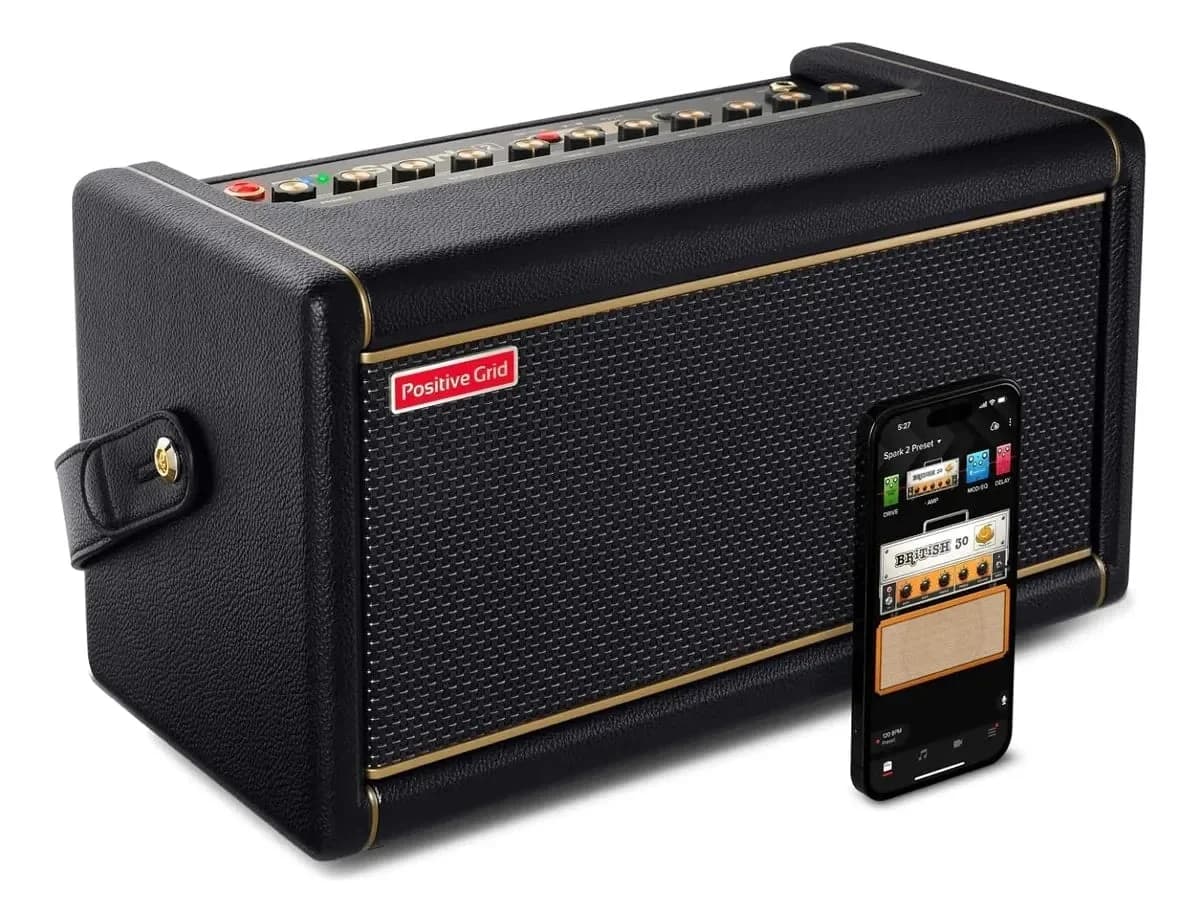 1 / 4
1 / 4Features and Functionality
The main strength of Spark is that the amplifier does not end at the control panel. The Spark app is central to the experience, giving access to amp models, virtual pedals, modulation, delay, reverb, noise gate, compressor, community presets and practice tools such as Auto Chords and Smart Jam.
Spark 2 is the most complete model. It includes 33 amps, 43 effects, eight onboard presets, a looper with up to 60 seconds of recording and Creative Groove Looper inside the app. Spark AI lets players describe a target tone and receive patch suggestions. It is still digital modeling and still depends on editing, volume and context, but it helps players who do not yet know how to build a full amp/cab/effects chain.
Spark 40 is older but still highly functional. It offers more traditional physical control, four presets, Bluetooth playback, Spark app access and USB recording. Its main limitations are the lack of onboard looper, Wi-Fi and dedicated stereo line outputs.
Spark MINI trades physical control and volume for portability. It has an internal battery, USB-C, Bluetooth 5.0, aux input, headphone/line output and access to the same universe of amps and effects through the app. It is an excellent travel, silent practice and casual playing amp.
Tone and Performance
The Spark family is best judged by context. At bedroom, home office and backing-track volume, all three models provide a convincing experience. Cleans are bright enough for pop, light funk, clean blues and chorus arpeggios. Crunch sounds cover classic rock, indie, blues rock and moderate hard rock. High-gain tones work for practicing heavy riffs, although demanding modern metal players may prefer a dedicated modeler or larger FRFR monitors.
Spark 40 sounds full for its size, with generous low end. That helps when playing alone because the guitar feels bigger, but it can become excessive in some rooms or presets, especially with humbuckers, lower tunings or bass-heavy backing tracks.
Spark MINI impresses because of scale, not because it breaks physics. It sounds large for its size, especially for solo practice and Bluetooth playback, but two 2-inch speakers and a small cabinet cannot produce the body of a larger combo. It is excellent for phrasing, scales, repertoire, backing tracks and fast tone ideas, but it is not a band rehearsal amp.
Spark 2 is the best performer in the family. Its 50W power, full-range horn speakers, angled speaker design and Sonic IQ processing create a wider stereo field and more clarity than Spark 40. Extra headroom helps clean tones and backing-track balance. The stereo 1/4-inch line outputs also make it more practical for monitors, mixers or external systems.
Artists Who Use It
Steve Vai is the strongest verified artist association in the Spark MINI family, especially through the Spark MINI Vai edition. Positive Grid states that the model was custom-designed by Vai, with a special finish, four presets created by him and a custom cable. The key context is portable practice, warm-up, writing and quick tone access, not a classic album tone recorded with Spark.
Nuno Bettencourt appears in official Spark 2 campaign material and demonstrations. This should be read as endorsement, demonstration and tone collaboration, not as a claim that Extreme's classic tones were built with Spark.
Jake Bowen is cited by Positive Grid using Spark 2 on tour to warm up backstage. This makes the Spark 2 relevant as a portable study, warm-up and idea tool when a full rig is impractical.
Zakk Wylde has been associated with the Spark MINI ecosystem through special collaborations and ToneCloud tones. The safest connection is with presets and high-gain/clean character inside the Spark platform, not classic recordings made with the amp.
Paul Gilbert also appears in Spark MINI/ToneCloud collaborations and presets. For players studying rock phrasing and alternate picking, the value is access to tones inspired by a technically precise player inside a compact practice amp.
Who Is It For?
The Spark family makes sense for guitarists who want to play more. A good practice amp is not only the one that wins an isolated tone shootout; it is the one that stays plugged in, accessible and ready when inspiration appears.
Spark MINI is ideal for beginners, students, apartment players, travelers and anyone who wants an amp that also works as a Bluetooth speaker. It is great for blues, pop, light rock, backing-track practice and headphones. It is not ideal for rehearsals with drums, stage use or players who want full physical control without the app.
Spark 40 remains a good option for players who want more body at home, traditional physical controls and a lower price than Spark 2. It loses to Spark 2 in looper functionality, output routing and updated processing, but it can still be excellent value.
Spark 2 is the best current option for players buying today with features, longevity and integration in mind. It works for serious practice, home studio, demos, USB recording, looper work, electric guitar, acoustic guitar and bass.
It is not the best choice for tube purists, players who need a traditional stage combo, guitarists who dislike app dependence or users who require a physical effects loop, full MIDI and professional routing.
Comparison With Competitors
| Alternative | Best at | Where Spark wins | Where the competitor may be better |
|---|---|---|---|
| Boss Katana 50 Gen 3 | Light rehearsal, small stage and traditional combo feel | App ecosystem, Bluetooth, practice tools and tone library | More stage volume, 12" speaker and conventional amp feel |
| Yamaha THR30II Wireless | Refined desktop sound and premium home practice | ToneCloud, Smart Jam, Auto Chords and Spark 2 AI/looper | More polished hi-fi desktop feel |
| Line 6 Catalyst CX 60 | Modeling closer to stage use | Practice workflow, app and Bluetooth | Better band-oriented amp projection |
| Blackstar ID:Core V4 | Value and simple stereo practice | Spark app, tone library and educational features | Lower price and simplicity |
| Fender Mustang GTX50 | Modeling, presets, footswitch and Fender heritage | More direct connected-practice experience | 12" speaker and fuller digital-combo feature set |
For connected practice, Spark 2 is one of the most complete options. For rehearsal and small stages, Boss Katana 50 Gen 3 may feel more direct because of its 12-inch speaker. For refined desktop tone, Yamaha THR remains strong. For extreme portability, Spark MINI competes with compact amps and smart speakers, while offering more guitar-focused tools than most.
Pros and Cons
| Pros | Cons |
|---|---|
| Very complete ecosystem for study, practice and tone creation | App dependence to unlock the full experience |
| 33 amp models and 43 effects across the three main models | Overprocessed presets can sound artificial if not edited |
| Spark 2 adds looper, stereo line outs, USB-C and updated engine | Spark 2 becomes more expensive with optional battery and footswitch |
| Spark MINI is extremely portable and battery-powered | Spark MINI lacks volume and body for band rehearsal |
| Bluetooth, Auto Chords and Smart Jam encourage daily practice | No physical effects loop or full MIDI implementation |
| Useful for electric guitar, acoustic guitar and bass practice | Tube purists may miss the physical response of a traditional amp |
The biggest advantage is reduced friction. Powering up, choosing a preset, streaming a song, loading a backing track, recording an idea and trying another tone is easy. The biggest limitation is that convenience does not replace curation: ToneCloud contains great sounds and exaggerated ones.
Final Verdict
The Positive Grid Spark family is worth it for players who want a modern, versatile and connected practice amplifier. Spark MINI is the most portable and fun; Spark 40 is the classic entry point; Spark 2 is the strongest editorial recommendation for players buying today and wanting the most complete package.
Spark 2 shines as a study and creation hub: it has enough volume for home, looper tools, varied tones, USB recording, stereo outputs and an app experience that genuinely helps players practice more. It does not automatically replace a stage combo, but it expands what a practice amp can be.
Spark 40 remains relevant when the price is right and the player does not need looper, Wi-Fi or stereo line outs. Spark MINI is excellent when absolute portability is the priority. For rehearsal, stage and big-cabinet feel, competitors such as Boss Katana 50 Gen 3, Fender Mustang GTX50 or Line 6 Catalyst may feel more natural.
The editorial conclusion is clear: if the goal is to practice more often, explore tones, play along with music and record ideas without building a complex setup, the Spark line is one of the most complete solutions in the market. For the modern bedroom, home-studio and mobile guitarist, Spark 2 is the most balanced and future-ready model in the Positive Grid ecosystem.