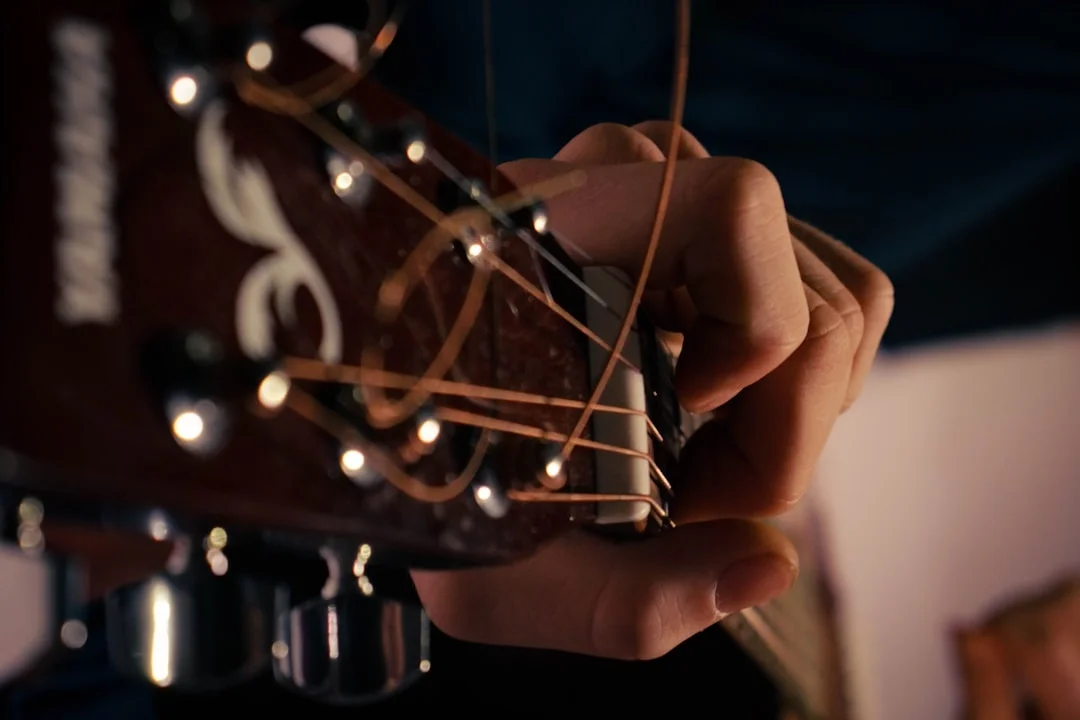

Tuning your guitar is one of the first things every guitarist needs to learn. The good news is that you do not need perfect pitch, music theory, or complicated terms to get started.
At the beginning, the best approach is to use a tuner. It can be a phone app, a clip-on tuner attached to the headstock, or a pedal tuner. The important thing is to build the habit of tuning every time before you play.
An out-of-tune guitar makes practice harder, makes chords sound strange, and can make you think you are playing incorrectly when the real problem is simply tuning.
Standard Guitar Tuning
The most common guitar tuning is called standard tuning. From the thickest string to the thinnest, the notes are:
| String | Note | How to remember it |
|---|---|---|
| 6th string, the thickest | E | Low E |
| 5th string | A | A |
| 4th string | D | D |
| 3rd string | G | G |
| 2nd string | B | B |
| 1st string, the thinnest | E | High E |
This tuning is written as:
It is the standard used in most lessons, tabs, videos, and beginner methods for guitar and acoustic guitar. If you are just starting, stay with this tuning before trying alternative tunings.
What Does Flat or Sharp Mean?
When you use a tuner, it shows whether the string is below or above the correct pitch.
| What the tuner shows | What it means | What to do |
|---|---|---|
| Needle or light to the left | String is flat, too low | Tighten the peg little by little |
| Needle or light to the right | String is sharp, too high | Loosen the peg little by little |
| Needle in the center | String is in tune | Move to the next string |
The secret is to turn the tuning peg slowly. Small movements can change the pitch a lot.
Best Method for Beginners: Use a Tuner
For beginners, a tuner is the safest method. It shows exactly what note the string is producing and helps you correct it without relying only on your ear.
There are three main types.
Phone Tuner App
A phone app is the cheapest and fastest way to start. Open the app, choose guitar or acoustic guitar, and play one string at a time.
It is a good option for home practice, especially in the beginning. The downside is that it uses the phone microphone, so background noise can confuse the app.
| App | Best for |
|---|---|
| Fender Tune | Beginners who want something simple and visual |
| GuitarTuna | Players who tune guitar, acoustic guitar, bass, and ukulele |
| Boss Tuner App | Players who want a traditional tuner-style screen |
| Cifra Club Tuner | Portuguese-speaking users who prefer a local app |
For home practice, an app is enough to get started.
Clip-On Tuner
A clip-on tuner attaches to the headstock of the guitar or acoustic guitar. It reads the vibration of the instrument, not only the sound in the room.
That makes a big difference. Even if people are talking, the TV is on, or other instruments are playing nearby, a clip-on tuner usually works better than a phone app.
For beginners, this is probably the best first purchase: it is affordable, small, easy to use, and works for both electric and acoustic guitar.
| Model | Recommended for |
|---|---|
| D'Addario Eclipse Headstock Tuner | Good all-around option for guitar, acoustic guitar, bass, and ukulele |
| Boss TU-02 or TU-03 | Simple, reliable, and easy to find |
| Korg PitchCrow / AW-4G | Compact and accurate |
| Snark Clip-On | Popular, practical, and easy to read |
Clip-On Tuners
 1 / 4
1 / 4Pedal Tuner
A pedal tuner is more useful for players who already use an amplifier, pedals, or plan to play live. It sits on the floor and connects between the guitar and the amplifier.
The main advantage is silent tuning. You press the pedal, the guitar signal is muted, and you tune while looking at the display.
For a beginner practicing at home, it is not required. But if you are building a pedalboard, a tuner is one of the first pedals that makes sense to buy.
| Model | Recommended for |
|---|---|
| Boss TU-3 | Classic, durable, and widely used on stage |
| Korg Pitchblack X | Excellent visibility and high accuracy |
| TC Electronic PolyTune 3 Mini | Compact, modern, and great for small pedalboards |
| Behringer TU300 | More affordable option to get started |
Pedal Tuners
 1 / 4
1 / 4Which Tuner Should You Buy First?
For a beginner, the recommendation is simple:
| Player profile | Best choice |
|---|---|
| Absolute beginner | App or clip-on tuner |
| Plays acoustic and electric guitar | Clip-on tuner |
| Practices at home in a quiet room | App is enough |
| Plays with a band | Clip-on tuner or pedal tuner |
| Already uses a pedalboard | Pedal tuner |
| Plans to play live | Pedal tuner |
Step-by-Step: How to Tune Your Guitar
Here is the practical process.
- Turn on the tuner or open the app.
- Play only one string at a time.
- Start with the 6th string, the thickest one.
- Check which note appears on the tuner.
- Adjust the tuning peg until you reach the correct note.
- When the needle is centered, move to the next string.
- Repeat the process until you reach the 1st string.
The order is:
5th string: A
4th string: D
3rd string: G
2nd string: B
1st string: E
Play the string clearly, but do not hit it too hard. If you pick too aggressively, the pitch can jump and make the tuner harder to read.
Manual Method: Tuning One String from Another
Besides using a tuner, there is a classic method every guitarist should know: tuning one string by using another string as a reference.
This is very useful when you already know that one string is in tune. From that string, you can tune the others by comparing the sound between them.
| Reference string | Where to press | Should match |
|---|---|---|
| 6th string, low E | 5th fret | Open 5th string, A |
| 5th string, A | 5th fret | Open 4th string, D |
| 4th string, D | 5th fret | Open 3rd string, G |
| 3rd string, G | 4th fret | Open 2nd string, B |
| 2nd string, B | 5th fret | Open 1st string, high E |
For example, if the 6th string is tuned to E, press its 5th fret. That note is A. Now play the open 5th string. Both notes should sound the same.
If the 5th string is too low or too high, adjust its tuning peg until it matches the note from the 6th string at the 5th fret.
Then repeat the process with the remaining strings.
Step-by-Step Manual Tuning
- Make sure at least one string is in tune as a reference.
- Play the 6th string pressed at the 5th fret.
- Play the open 5th string.
- Adjust the 5th string until both notes match.
- Play the 5th string pressed at the 5th fret.
- Compare it with the open 4th string.
- Continue until you reach the 1st string.
- When moving from the 3rd string to the 2nd string, remember: use the 4th fret, not the 5th.
The sequence is:
5th string at the 5th fret = open 4th string
4th string at the 5th fret = open 3rd string
3rd string at the 4th fret = open 2nd string
2nd string at the 5th fret = open 1st string
Does the Manual Method Replace a Tuner?
For beginners, not completely.
The manual method is excellent for ear training and for understanding the instrument. But it depends on one important condition: at least one string must already be correctly tuned.
If the reference string is wrong, all the other strings will also be wrong compared with standard tuning. The guitar may sound in tune with itself, but it will not necessarily be at the correct pitch.
So the ideal approach is:
Over time, you will start hearing when a string is slightly too high or too low.
Be Careful When Tightening the String
A common beginner mistake is turning the tuning peg too fast. This can make the string too sharp and may even break it, especially the thinner strings.
Make small adjustments.
Play the string, check the tuner, turn a little, play again, and check once more.
With time, you will get a better feel for how much you need to turn the peg.
My Guitar Goes Out of Tune a Lot: Is That Normal?
Yes, up to a point.
A guitar can go out of tune for several reasons:
| Situation | Why it happens |
|---|---|
| New strings | They are still stretching |
| Temperature changes | Wood and metal react to climate |
| Bends | The string is pulled and may not return perfectly |
| Tremolo bridge use | It changes string tension |
| Loose or low-quality tuners | They hold tuning less effectively |
| Old strings | They lose stability and brightness |
If you just changed strings, it is normal to tune several times during the first few days.
When Should You Tune?
Tune every time:
- Before practicing.
- Before recording.
- Before playing with other people.
- After taking the guitar out of the case.
- After changing strings.
- When chords start sounding strange.
Tuning should become part of your routine, just like turning on the amplifier or grabbing a pick.
Can You Tune Electric and Acoustic Guitar the Same Way?
Yes. Electric guitar and acoustic guitar usually use the same standard tuning:
The difference is mostly the type of tuner.
On acoustic guitar, a clip-on tuner works very well because it reads the vibration of the wood. On electric guitar, a clip-on tuner also works, but players who play plugged in may prefer a pedal tuner.
If you own both electric and acoustic guitar, a clip-on tuner is an excellent choice because it works for both instruments.
What About Different Tunings?
There are many alternative tunings, but you do not need to worry about them right now.
The most common ones are:
| Tuning | Notes | Where it appears |
|---|---|---|
| Standard | E A D G B E | Rock, pop, blues, general study |
| Drop D | D A D G B E | Heavy rock, metal, lower riffs |
| Half-step down | Eb Ab Db Gb Bb Eb | Blues, classic rock, Hendrix, Stevie Ray Vaughan |
| Open G | D G D G B D | Blues, slide, Rolling Stones |
| DADGAD | D A D G A D | Folk, fingerstyle, Celtic music |
For beginners, the best path is to master standard tuning first. Later, when you learn specific songs, you can explore other tunings.
Tips to Keep Your Guitar in Tune Longer
Change strings when they are old, rusty, or dull.
After installing new strings, stretch each string lightly and tune again a few times.
Avoid leaving the guitar in very hot, humid, or sunny places.
Keep the instrument in a gig bag or case when you are not using it.
Check whether the tuning pegs are firm.
If the guitar goes out of tune too much even with new strings, it may need a setup from a luthier or guitar technician.
Conclusion
Tuning your guitar does not need to be complicated. In the beginning, use a tuner and follow the string order:
Play one string at a time, adjust slowly, and check whether the tuner is centered.
For beginners, the best first purchase is a clip-on tuner. It is simple, affordable, works for electric and acoustic guitar, and helps you build an essential habit: never practicing out of tune.
Then, also practice the manual method of comparing one string with another. It trains your ear, improves your musical perception, and helps you understand the instrument better.
Over time, your ear will improve too. But in the beginning, trust the tuner. It is your best friend for practicing better, playing with more confidence, and hearing your real progress.