
Epiphone enters 2026 in an interesting position. For many players, it is still remembered as “the affordable Gibson.” That description is not wrong, but it is too small. Epiphone remains the main gateway for guitarists who dream of a Les Paul, SG, ES-style guitar, or Gibson-inspired acoustic, but it has also become something broader: a historic brand with realistic prices, a wide catalog, and instruments designed for the way people actually play today.
The modern guitarist does not buy gear the same way players did twenty years ago. Today’s player compares reviews, records through an interface, uses plugins, plays at church, rehearses with bands, posts videos, cares about how a guitar looks on camera, and evaluates weight, tuning stability, pickups, resale, availability, and maintenance. In that environment, Epiphone has become more strategically important because it gives access to the Gibson vocabulary without demanding Gibson USA money.
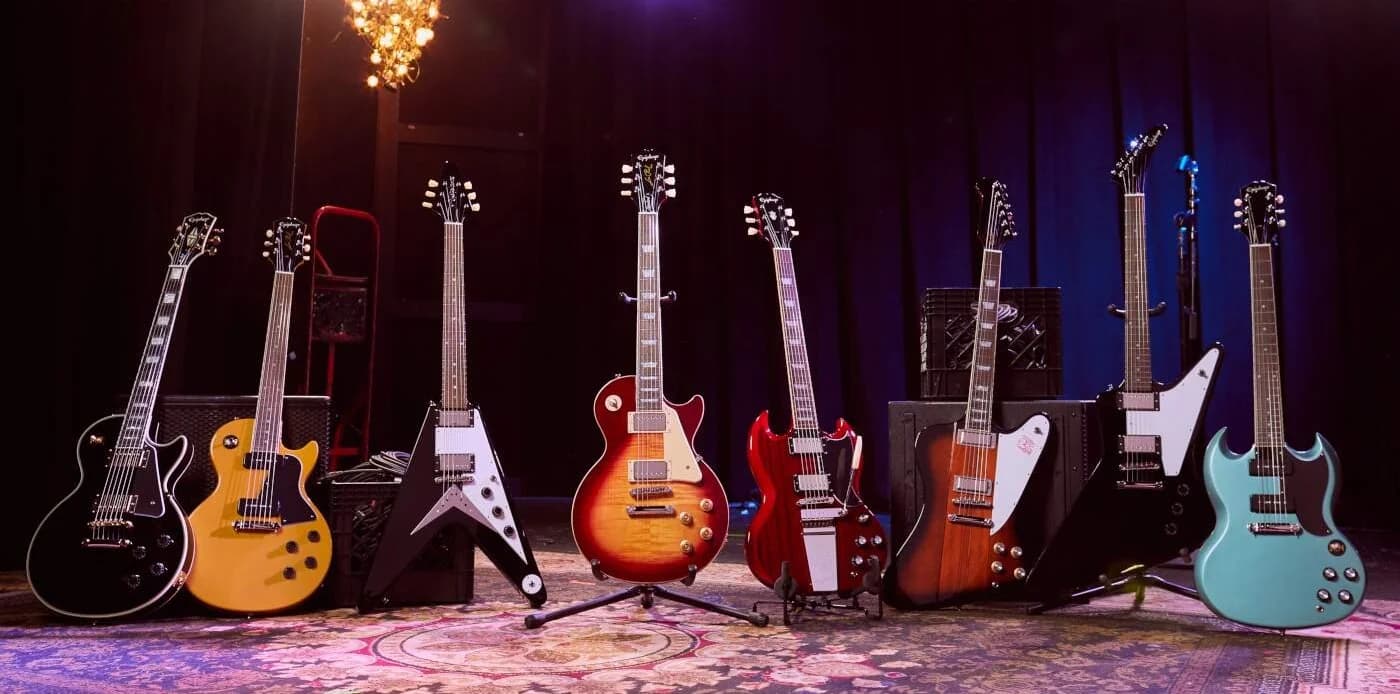
The most interesting point is that, in 2026, Epiphone is not only copying Gibson. It offers Gibson-inspired Les Pauls, SGs, Explorers, Flying Vs, and ES-style instruments, but it also has the Casino, Riviera, Sheraton, Coronet, Wilshire, Standard acoustics, artist signatures, and the Futura Series, which reimagines classic shapes for modern performance. The result is a brand that is harder to define — and more useful to analyze.
Epiphone in 2026
 1 / 3
1 / 3Epiphone is no longer just a cheaper Gibson
Epiphone’s story starts long before it became part of Gibson. The brand grew out of the Stathopoulos family’s instrument-making tradition, became known for banjos, archtops, semi-hollows, and professional instruments, and at certain points competed directly with Gibson, especially in the jazz and semi-acoustic market. Gibson’s acquisition of Epiphone in 1957 changed the brand’s commercial role, but it did not erase its identity.
For many years, players treated Epiphone mostly as a budget alternative. That made sense: it was the most accessible way to get into Gibson-style shapes. But that view reduced Epiphone to a permanent comparison. The question was always: “How close is it to a Gibson?” In 2026, the better question is: “What musical problem does this Epiphone solve for this player?”
That shift matters because an Epiphone does not need to beat a Gibson in prestige to be a great instrument. It needs to be well built for its price, stay in tune, have usable pickups, accept a proper setup, work with current amps and plugins, and make the player want to play more. When that happens, it stops being merely an alternative and becomes a real tool for the stage, studio, bedroom, rehearsal room, and writing process.
There is also a psychological factor: Epiphone removes fear. An expensive Gibson can intimidate a beginner or intermediate player. A good Epiphone invites you to rehearse, record, travel, modify, set up, and learn without the same anxiety of damaging a premium instrument. For many musicians, that freedom is as valuable as the money saved.
The 2026 catalog: tradition, Custom, Originals, and Futura
Les Paul: the emotional center of the brand
The Les Paul remains Epiphone’s commercial and emotional core. It condenses the Gibson fantasy into a familiar recipe: single-cut body, 24.75-inch scale, set neck, Tune-O-Matic bridge, two humbuckers, four controls, and generous sustain. For blues rock, classic rock, and hard rock, it is still one of the most recognizable guitar platforms in the world.
As a review, the practical verdict is simple: an Epiphone Les Paul is best when the buyer understands its limits. It can be heavy, upper-fret access is not as open as on a superstrat, and the ergonomics are traditional. But when it is well set up, it delivers strong mids, convincing sustain, thick lows, and the feel of a solid instrument. For riffs, power chords, singing leads, and doubled rhythm tracks, it remains excellent.
Casino, Riviera, and Sheraton: Epiphone with its own identity
These instruments show why Epiphone should be viewed from within its own history. Sometimes the best Epiphone is not the one that looks the most like a Gibson. Sometimes the most musical choice is precisely the guitar that feels most Epiphone.
Futura Series and the modern player
The Futura Series is one of the clearest signs that Epiphone wants to be more than a nostalgia brand. It mixes traditional shapes with features that make sense for modern stages and digital content: Chromashift finishes, stainless steel frets, compound-radius boards, locking tuners, ProBucker Ignite pickups, coil splitting, phase options, and a more aggressive visual identity.
Technically, these choices are not only cosmetic. Stainless steel frets usually last longer and maintain a slick playing feel. A compound-radius board makes lower-position chords comfortable while helping bends higher up the neck. Locking tuners make string changes easier and can help tuning stability. Coil splitting and phase options expand the sound palette, even though a split humbucker does not automatically become a true vintage single coil.
The question is: is this still Epiphone? Yes — and that may be the point. Epiphone has always lived between tradition and adaptation. In 2026, that adaptation is more explicit. Futura is not trying to please the purist who wants a Les Paul frozen in the 1950s. It is aimed at the player who uses plugins, alternate tunings, video content, stage visuals, and versatile switching.
How to choose an Epiphone in 2026
The best Epiphone is not the most expensive or the best-looking one. It is the instrument that fits your repertoire, hands, and rig. Instead of asking “what is the best guitar?”, ask “which guitar solves my sound with the least friction?”
| Player profile | Models that make sense | Why |
|---|---|---|
| Blues rock, classic rock, hard rock | Les Paul Standard 50s/60s, Les Paul Custom | Sustain, strong mids, humbuckers, classic language |
| Raw rock, punk, garage, direct blues | Les Paul Special, Junior, SG Special P-90 | P-90 bite, dynamics, simplicity |
| Indie, Britpop, pop rock, worship | Casino, Riviera, Sheraton, ES | More air, less compression, semi-hollow presence |
| Modern metal and low tunings | Prophecy, Explorer, Flying V, Futura RD/Explorer | Hotter pickups, faster feel, clearer response |
| Stage visuals and content creation | Futura Series, Les Paul Modern, SG Modern | Bold finishes, comfort, modern switching |
| Acoustic songwriting and stage use | J-45, Hummingbird, SJ-200, J-45 Express | Gibson-inspired looks, electronics, lower price |
Epiphone vs Gibson: an honest comparison
The Gibson comparison is inevitable, but it needs honesty. A current Epiphone is not a Gibson USA with a different logo. There are real differences in wood selection, finish work, labor, hardware, quality control, prestige, and resale value. Gibson remains the symbolic and industrial top of the Gibson/Epiphone world.
But not every player needs to pay for the symbolic top to make real music. A well-set-up Epiphone can record well, perform reliably, and inspire a player for years. In many contexts — practice, church, local bands, home recording, content, small stages — the practical difference may be much smaller than the price difference.
| Criterion | Epiphone | Gibson |
|---|---|---|
| Price | Far more accessible | High, especially USA and Custom Shop |
| Prestige | Strong, value-oriented | Highest within the Gibson world |
| Practical use | Excellent for practice, stage, and recording | Excellent, with superior selection and finish |
| Fear of use | Lower; invites transport and modification | Higher for many owners due to value |
| Resale | Good on classic models, but lower | Generally stronger |
| Identity | Gibson tradition plus Epiphone originals | The main brand lineage |
Where Epiphone wins — and where caution still matters
Epiphone’s biggest win in 2026 is that it offers real paths. A player does not have to choose only between cheap and expensive. The catalog covers vintage, modern, semi-hollow, P-90, humbucker, acoustic, metal, artist signatures, historic models, and visually bold instruments.
Another win is the improved seriousness of many specifications. CTS pots on several Inspired by Gibson models, more convincing ProBuckers, long neck tenons on selected instruments, Grover hardware, Graph Tech nuts, and premium gig bags on some models reduce the feeling that you will need to replace half the guitar immediately. Not every model has every feature, but the current catalog is more serious than the old stereotype suggests.
Caution still matters. Quality control can vary by unit. Some guitars arrive needing setup. Nut work, fret ends, intonation, and pickup height should be checked. Some Les Pauls are heavy. Hollowbodies can feed back. Very modern models may not please purists. Availability and pricing can also fluctuate sharply depending on region.
Recommended video: hearing modern Epiphone in action
Before the verdict, it helps to hear the brand in action. Manufacturer demos show the instrument in an ideal scenario, while independent reviews often reveal weight, feel, noise, finish, and real-world response. Both are useful.
Verdict: is Epiphone in 2026 a smart choice?
Yes — if the purchase is made with clear criteria. Epiphone in 2026 is one of the most important brands for guitarists who want the Gibson universe without turning the purchase into a luxury investment. It offers strong visuals, familiar tones, historic models, and a modern line that responds to stage, recording, and content-creation needs.
The best thing about Epiphone is the balance between desire and reality. A Gibson may be the dream. An Epiphone may be the guitar you actually buy, set up, rehearse with, record, post, modify, and use without fear. That matters. For many musicians, that is how music actually happens.
The Luciano Bastos Guitar recommendation is simple: look at Epiphone without prejudice, but without romanticizing it. For classic rock, choose a Les Paul Standard or SG. For raw dynamics, consider P-90s. For Britpop, indie, or semi-hollow tones, look at Casino, Riviera, and Sheraton. For metal and modern performance, evaluate Prophecy and Futura. For Gibson-inspired acoustics, check J-45, Hummingbird, and SJ-200 Epiphone models.
Modern Epiphone does not automatically replace Gibson. It has a different job: making the Gibson vocabulary more accessible, more usable, and closer to the real player. In 2026, that job feels more relevant than ever.