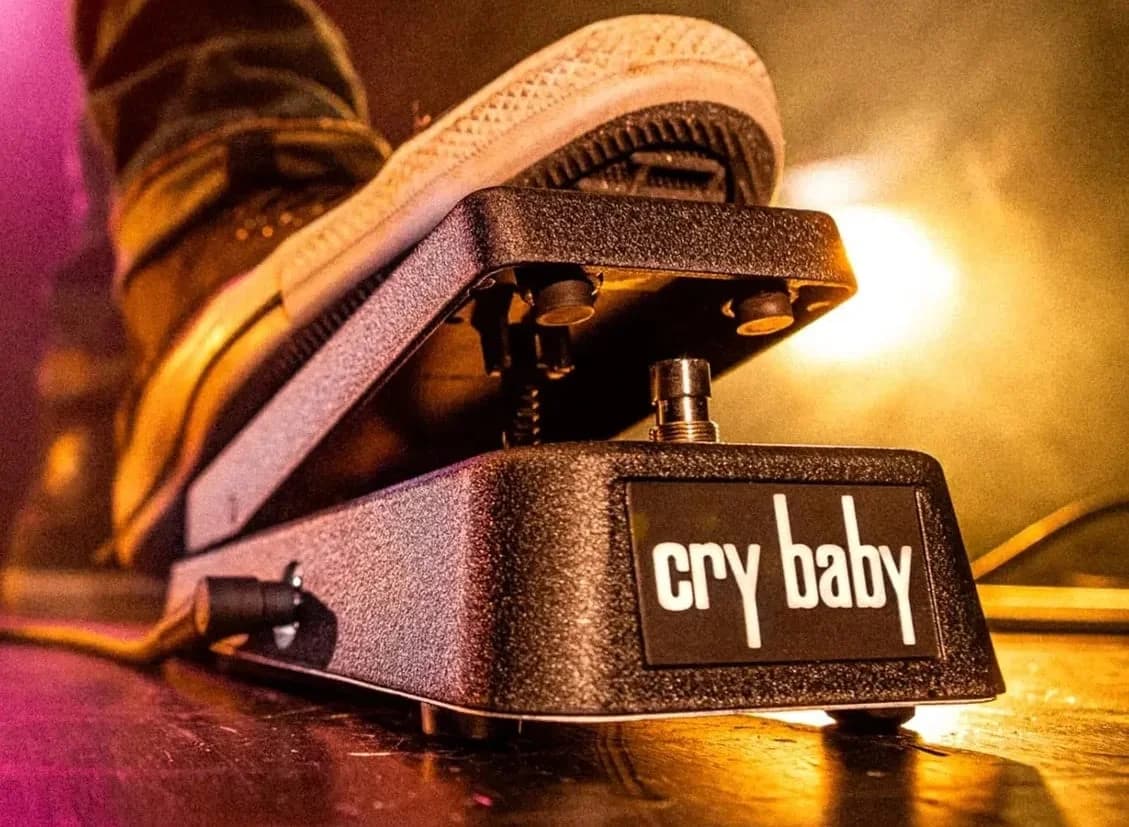
Basic Data
| Field | Information |
|---|---|
| Full name | Dunlop Cry Baby Mini 535Q Wah |
| Brand | Dunlop / Jim Dunlop |
| Category | Analog wah-wah pedal for guitar |
| Line/Series | Cry Baby / Mini / 535Q |
| Model code | CBM535Q |
| Country of manufacture | Not consistently stated by the manufacturer in public product materials |
| Approximate price range | USA: around $179.99; Europe: roughly $180–220; other markets vary with import costs and exchange rates |
| Status | In production |
| Official page | jimdunlop.com/cry-baby-mini-535q-wah |
Overview
The Dunlop Cry Baby Mini 535Q Wah solves two very common problems at once: players want the expressive sweep of a Cry Baby wah, but they often do not have the pedalboard space for a full-size rocker. This model takes the more flexible 535Q concept and places it in a mini enclosure that is roughly half the size of a standard wah.
It is not the simplest wah in the Dunlop catalog. That role belongs more naturally to the Cry Baby GCB95 or the standard Cry Baby Mini CBM95. The Mini 535Q is aimed at guitarists who want to shape the wah’s behavior: choose the sweep range, adjust the Q response and kick in a level boost when a solo needs to step forward.
That makes it especially relevant for rock, blues, hard rock, fusion and funk players who treat wah as a performance tool rather than a once-in-a-while effect. It remains fully immediate, with no menus, apps, presets or digital layer, but it offers enough control to match different guitars, pickups, amps and gain structures.
Build and Design
The first thing you notice is the footprint. The Cry Baby Mini 535Q keeps the visual language of the Cry Baby family: black housing, treadle design, non-slip surface and stage-ready rocker format. But it occupies far less board space, which matters when your setup already includes tuner, drives, modulation, delay, reverb and an isolated power supply.
The trade-off is ergonomics. Because the pedal is smaller, the physical sweep and foot area require some adjustment. Players with larger feet, boots or a long history with full-size wah pedals may find it more sensitive at first. It does not sound small, but it does feel physically smaller under the foot.
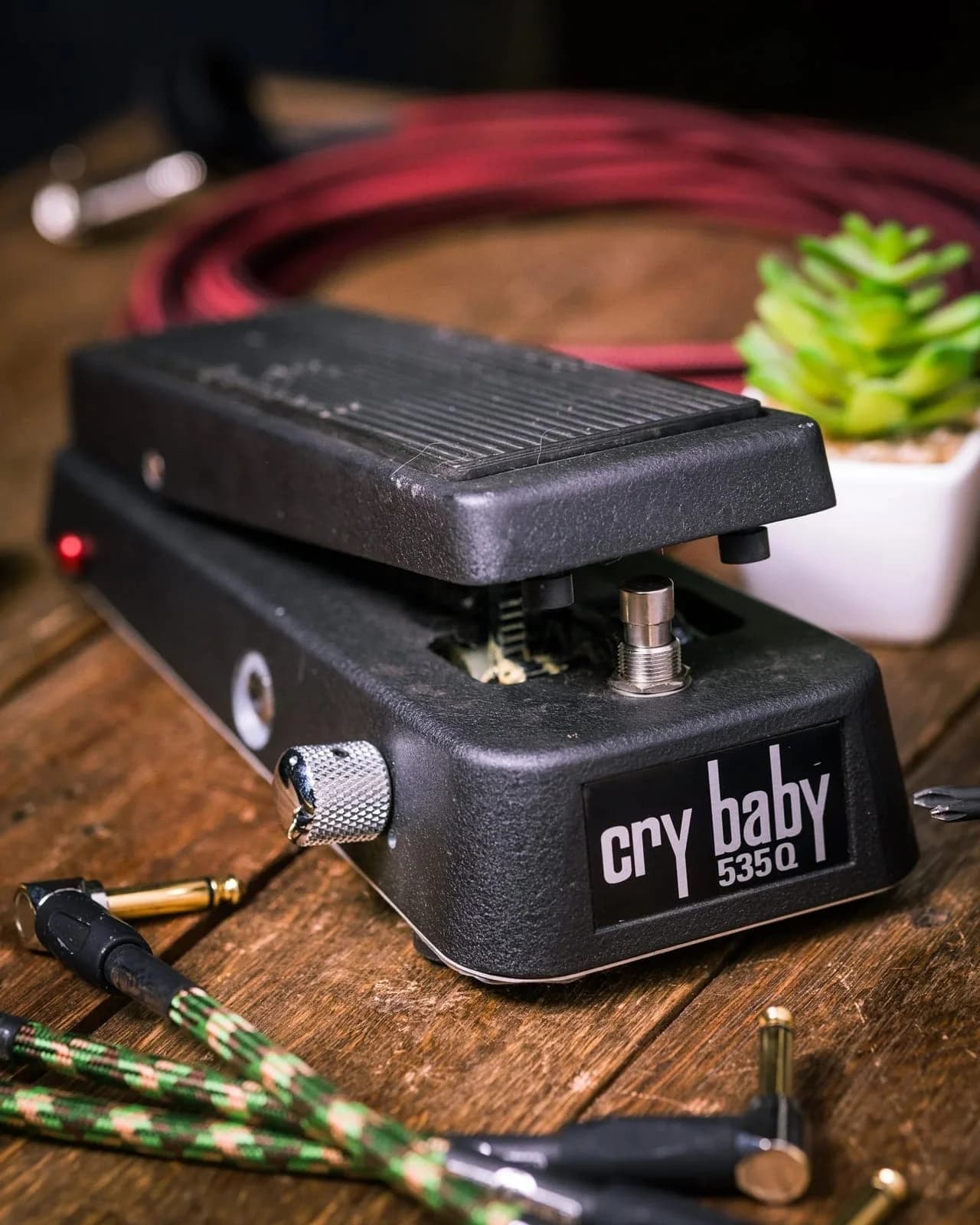
The side controls are a core part of the design. Range, boost volume, Q and the boost switch sit on the side, leaving the treadle free for wah operation. This is practical, but it also means the knobs are not intended for constant foot adjustments mid-song. Set them before the song, then use the treadle expressively.
Technical Specifications
| Specification | Information |
|---|---|
| Effect type | Analog wah-wah |
| Model | CBM535Q |
| Format | Mini wah, roughly half the size of a standard wah |
| External controls | Range Selector, Volume, Q, Boost switch, on/off footswitch |
| Frequency ranges | 270Hz–1300Hz; 320Hz–1650Hz; 360Hz–1840Hz; 420Hz–2100Hz |
| Q control | Adjusts wah intensity/bandwidth |
| Boost | Adjustable; manual lists 0.1dB to 17dB range, commonly described in operation as up to +16dB |
| Input impedance | 1MΩ |
| Output impedance | Approximately 1.5kΩ |
| Signal-to-noise ratio | 90dBV heel down; 97dBV toe down |
| Filter gain | 15dB with Q control fully clockwise and boost off |
| Bypass | True Hardwire |
| Current draw | 2.5mA |
| Power | 9V battery or compatible 9V DC supply, including Dunlop ECB003/ECB003EU and DC Brick/Iso-Brick/Mini Iso-Brick supplies |
| Inputs/outputs | 1/4" mono instrument input and amplifier output |
| Power supply included | Not listed as included by the manufacturer |
| Battery included | May vary by market and retailer |
Dunlop Cry Baby Mini 535Q
 1 / 4
Features and Functions
The key feature is the range selector. It lets you choose between four sweep ranges, from a lower, thicker response to a brighter, sharper upper range. In practical terms, it changes where the wah “speaks.” Lower settings feel fuller and can work well for blues, rhythm playing and thicker riffs. Higher settings emphasize harmonics, attack and lead lines that need to cut through a band.
The Q control shapes the character of the filter. A narrower Q gives the wah a sharper, more nasal and focused voice. A wider response feels smoother and broader, which can be more useful for clean funk, rhythmic parts and less aggressive wah textures.
The boost is another important addition. It is not an overdrive; it is a level lift. Into a clean amp, it helps the wah stand forward. Into an already driven rig, it can add presence and sustain, but it may also increase noise or push the next gain stage harder than expected. The best approach is to set the boost within the full rig at performance volume.
There are no presets, MIDI, USB, Bluetooth, tuner, effects loop, app or audio-interface features. That is not a weakness. This is an analog wah with physical controls, designed for immediate expression and reliable integration.
Tone and Performance
The Cry Baby Mini 535Q delivers the familiar Cry Baby vocal sweep but with much more tuning range than the GCB95. It can sound rounded and vocal in the midrange, aggressive and cutting in higher ranges, or smoother and wider with a less extreme Q setting. Its strongest quality is that it lets the player move beyond a single fixed wah voice.
For blues and classic rock, middle range settings with a moderate Q preserve body while keeping the effect musical. For hard rock, the boost can help solos jump forward, especially before overdrives or already compressed amps. For funk and pop, lowering the intensity and avoiding extreme settings can produce a more rhythmic, less harsh sweep.
Placement in the signal chain matters. Before gain pedals, the Mini 535Q tends to sound more organic and vocal. After gain, it becomes more dramatic and filter-like, but sometimes less traditional. With vintage-style fuzz circuits, especially germanium fuzzes, the interaction can be unpredictable, so testing in the real rig is essential.
At home, high-Q and high-range settings may sound too forward at low volume. In rehearsal and on stage, that same projection can be exactly what helps the guitar be heard. In the studio, the Mini 535Q is more useful than a one-voice wah because you can tune the sweep to avoid fighting vocals, bass, snare and overdubbed guitars.
Artists Who Use It
The Mini 535Q itself is not as widely documented as a specific artist pedal as Dunlop’s signature wah models. The most accurate way to place it is within the wider Cry Baby/535Q vocabulary: a compact, adjustable version of a sound language associated with many major rock and blues players. The artists below are relevant references for the wah tradition and, in several cases, for Cry Baby or Dunlop wah models, but not necessarily confirmed Mini 535Q users.
Hendrix is one of the defining references for wah in rock guitar. His psychedelic phrasing and vocal-like sweeps helped turn the wah into an expressive instrument. The Mini 535Q is not a replica of his exact gear, but it can reach aggressive, singing sweep textures that belong to the same vocabulary.
Clapton helped bring wah into late-1960s blues rock, using it in raw, improvisational contexts. Players chasing a less extreme, more blues-based approach can set the Mini 535Q to a middle range with a wider Q for a smoother, more musical sweep.
Hammett is one of the most visible modern wah users in metal and hard rock. While he uses his own signature wah models, the Mini 535Q offers tools that fit that approach: a focused Q, brighter range options and boost for lead emphasis.
Slash’s wah tones are associated with sustained hard-rock leads, strong mids and vocal phrasing. The Mini 535Q works well in that territory when placed before drive or a saturated amp, especially with a moderate boost that lifts solos without making the sweep overly sharp.
Cantrell has documented links to Cry Baby signature wah models with a darker, throatier response. The Mini 535Q is not a replacement for his signature model, but its range, Q and boost controls can explore heavier, more guttural wah textures for dense riffs and leads.
Who It Is For
The Cry Baby Mini 535Q is an excellent choice for intermediate and advanced guitarists who know they want a wah but do not want to be locked into one voice. It can also work for serious beginners, provided they are willing to learn what range, Q and boost do.
It makes sense for classic rock, blues rock, hard rock, funk, fusion, pop grooves and expressive metal leads. It is also strong for stage players with compact boards, church players who need space efficiency, and home-studio guitarists who want several wah colors without buying multiple pedals.
It is not ideal for someone who wants the simplest wah possible. If you want one classic sound with minimal decision-making, the GCB95 may be better. It may also be less comfortable for players with large feet or anyone who strongly prefers the feel of a full-size wah.
Competitor Comparison
| Model | Best for | Direct comparison |
|---|---|---|
| Dunlop Cry Baby Mini 535Q | Compact control | More adjustable than the Cry Baby Mini CBM95 and smaller than the full-size 535Q. One of the best-balanced choices for range, Q and boost in a small format. |
| Dunlop Cry Baby GCB95 | Classic simplicity | Cheaper, larger and more direct. It has fewer controls but delivers the traditional Cry Baby experience with no setup complexity. |
| Dunlop Cry Baby Mini CBM95 | Simple mini wah | Saves space and offers selectable voicings, but it does not provide the same level of Q, range and boost control as the Mini 535Q. |
| Boss PW-3 Wah | Modern versatility | Compact and practical with Rich/Vintage modes, but simpler in concept. The Mini 535Q offers deeper hands-on shaping. |
| Vox V847-A | Vintage wah flavor | More traditional and less adjustable. Great for vintage character, less flexible than the Mini 535Q. |
| Morley Steve Vai Bad Horsie 2 | Live convenience | Optical switching and auto-on feel very practical live. The Mini 535Q stays closer to the Cry Baby family sound and is smaller. |
Pros and Cons
| Pros | Cons |
|---|---|
| Cry Baby voice with far more control than basic models | Smaller treadle may not suit players who prefer full-size wahs |
| Compact footprint saves real pedalboard space | Small side knobs are not ideal for fast stage adjustments |
| Four frequency ranges adapt well to different rigs | More complex than a simple plug-and-play wah |
| Q control moves from wide and smooth to narrow and focused | Extreme settings can sound harsh in some rigs |
| Adjustable boost helps leads cut through | Boost can increase noise or overload sensitive gain stages |
| True Hardwire bypass and low current draw | Power supply is generally not included |
| Strong for rock, blues, funk and hard rock | Does not fully replicate the physical feel of a traditional wah |
Final Verdict
The Dunlop Cry Baby Mini 535Q Wah is absolutely worth considering if you want Cry Baby DNA in a compact, highly adjustable format. It is not merely a smaller classic wah; it is a practical tone-shaping tool with real control over sweep range, response intensity and lead level.
Its greatest strength is the balance of flexibility and efficiency. It fits crowded pedalboards, but it does not force you into one fixed wah voice. For blues, classic rock, hard rock, funk and expressive lead playing, it is one of the strongest compact wah pedals in its price class.
Choose the Mini 535Q if you want a small, flexible and musical wah. Choose the GCB95 if you want classic simplicity. Choose a Morley auto-on design if live convenience is your top priority. Choose a signature wah if you want one artist-specific voice. For most players who want a compact wah with serious tone control, the Cry Baby Mini 535Q is a highly convincing choice.