Basic Data
| Field | Information |
|---|---|
| Full name | Gibson Les Paul Standard 50s |
| Brand | Gibson — Gibson Brands, Inc. |
| Category | Solid-body electric guitar |
| Launch year | 1952 as the Gibson Les Paul; the Standard humbucker/sunburst configuration emerged in the late 1950s |
| Status | In production, with current versions in the Original Collection and Custom Shop lines |
| Dimensions | 24.75-inch scale length; overall external dimensions vary by version and are not published by Gibson in a single standardized format |
| Weight | Varies by unit; the current Standard 50s uses a non-weight-relieved mahogany body |
| Power | Passive; no battery required |
| Price range | New: official U.S. reference around US$2,799 for Standard 50s/60s models; used: varies widely by year, condition, provenance, and local market |
Overview
The Gibson Les Paul is not merely a famous guitar: it is one of the core languages of electric guitar. Since its original 1952 launch, it has helped define a sound built on solid-body construction, a set neck, short scale length, strong midrange, abundant sustain, and a sense of density that runs through blues, classic rock, hard rock, and heavy rock. The current Standard 50s works as a modern reading of the historical recipe that made late-1950s Les Pauls legendary.
Its purpose is clear: to deliver a full-bodied, touch-responsive, premium traditional instrument. It attracts players looking for a thick, vocal, authoritative sound, especially through tube amplifiers pushed into breakup. At the same time, it is not a neutral guitar: its personality appears immediately, with solid lows, pronounced mids, and rounded highs.
As a stage and studio instrument, the Les Paul remains relevant because it combines operational simplicity with enormous expressive range. Two humbuckers, independent volume and tone controls, a three-way selector, and a Tune-O-Matic bridge look basic on paper, but this architecture allows real variation between warm rhythm sounds, singing lead tones, thick crunch, and dynamically sensitive blues.
Understanding the Les Paul Model Family
One of the biggest questions for players entering the Gibson world is realizing that "Les Paul" does not mean one single guitar, but a full family of models with different goals. The silhouette, short scale, set neck, and tonal heritage are shared traits, but each version changes the practical experience: weight, finish, pickups, electronics, level of decoration, touch response, and price.
The Standard is the historical reference point, especially in its 50s and 60s interpretations. The 50s version generally emphasizes a fuller neck, a more vintage construction concept, and moderate-output Burstbuckers; the 60s version usually brings a slimmer neck and a slightly more immediate feel. The Custom occupies the premium, luxury end of the family, with more sophisticated finishing, decorative binding on the body and neck, gold hardware on many versions, and a high-prestige feel. The Studio was created to deliver the essential Les Paul sound with less visual ornamentation, making it a more rational stage and studio option. The Junior and Special simplify the formula with P-90s, fewer controls, and a rawer, more direct voice.
| Model | Purpose | Practical description |
|---|---|---|
| Les Paul Standard 50s | Recreate the late-1950s classic experience | Non-weight-relieved mahogany body, maple top, fuller neck, and moderate-output Burstbuckers. Best for players seeking the traditional, full-bodied Les Paul with vintage response and sustain. |
| Les Paul Standard 60s | Deliver classic tone with a faster playing feel | SlimTaper neck, Burstbucker 61 pickups, and a slightly more immediate attack. A strong fit for players who like Les Paul tone but prefer a slimmer neck and more agile left-hand feel. |
| Les Paul Custom | Offer the most luxurious and refined version of the family | More sophisticated finishing, decorative binding on the body and neck, often gold hardware, and ebony fingerboard on many versions. Suited to players who want a premium-looking Les Paul with high-end construction and stage presence. |
| Les Paul Studio | Deliver the Les Paul essence with less visual luxury | Fewer decorative appointments and a stronger focus on sound, build, and function. Often the most rational choice for players who want a real Gibson USA for stage or studio without paying for Standard or Custom cosmetics. |
| Les Paul Classic | Combine traditional looks with more flexible features | Vintage-inspired Standard look, open-coil pickups, and, on many versions, coil split and phase options. Good for players who want classic tone with broader sonic range. |
| Les Paul Modern | Adapt the Les Paul platform to contemporary needs | Modern weight relief, improved upper-fret access, faster neck, and more versatile electronics. Useful for players who love the Les Paul shape but want modern ergonomics and features. |
| Les Paul Junior | Prioritize simplicity, attack, and direct response | Slab mahogany body, one dogear P-90, one volume, one tone, and wraparound bridge. Excellent for rock, punk, raw blues, and players who prefer fewer controls with strong personality. |
| Les Paul Special | Keep P-90 rawness with more tonal options | Slab mahogany body, two P-90s, and independent controls. A simple, expressive alternative for players who want an open, mid-forward voice with more range than a Junior. |
In practice, the question should not be only "which Les Paul is best?" but "which Les Paul fits my hand, my repertoire, and my amplifier?". The Standard is the most balanced reference for the complete classic experience. The Studio is the most direct entry point into a Gibson USA Les Paul. The Custom is a visual and sonic statement. The Junior and Special are simpler alternatives, but extremely expressive, especially for players with strong dynamics and an amplifier working near its limit.
Construction and Design
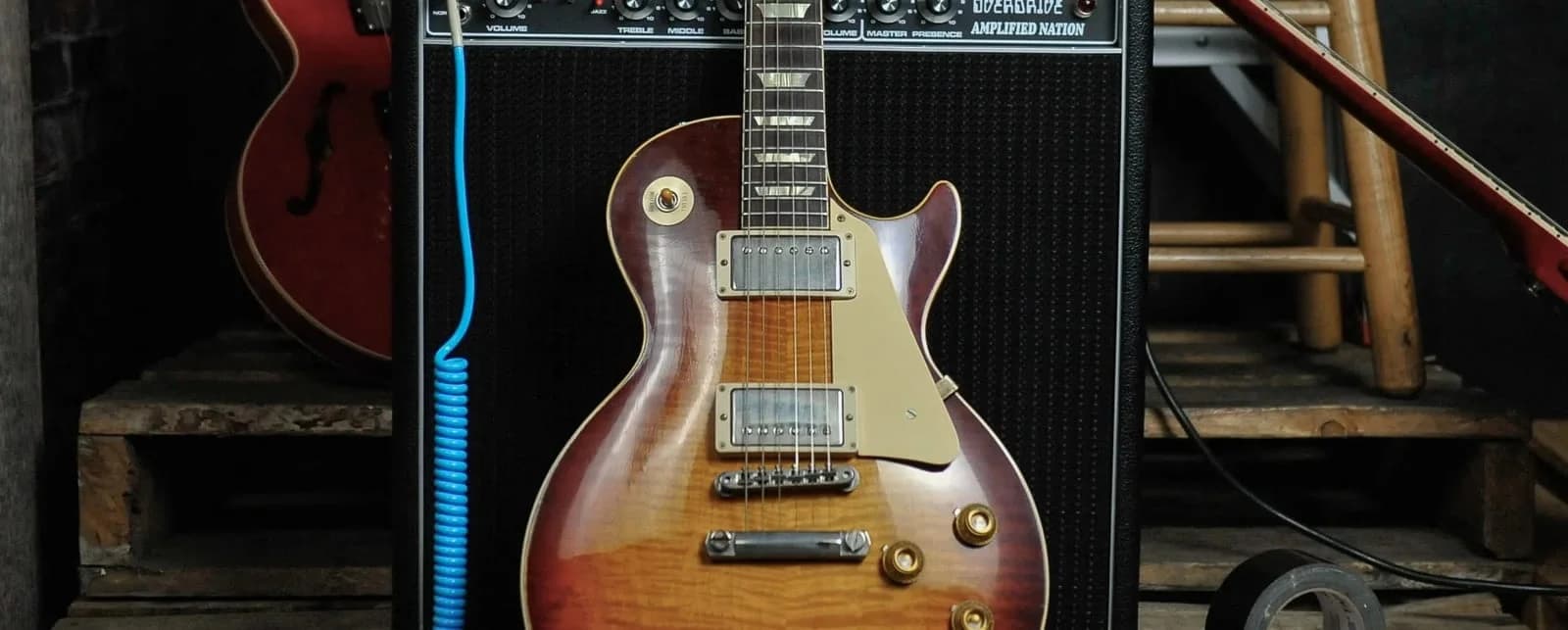
The classic formula of the current Les Paul Standard 50s uses a non-weight-relieved mahogany body with a carved figured maple top. This pairing is central to the identity of the instrument: mahogany contributes body, midrange, and sustain, while maple adds attack, definition, and bite. The neck is also mahogany and set into the body, with an Indian rosewood fingerboard, acrylic trapezoid inlays, and 22 medium jumbo frets.
The design is compact, heavy, and luxurious. The 24.75-inch scale length supports bends and vibrato with a lower perceived string tension than longer-scale guitars, while the 50s Vintage neck profile delivers a substantial hand feel. For players who like feeling wood in the hand, this is part of the charm; for players who prefer modern shred ergonomics, it may feel too robust.
The hardware package preserves the traditional language: ABR-1 Tune-O-Matic bridge, aluminum stop bar, Vintage Deluxe tuners with Keystone buttons, gold Top Hat knobs, and nickel hardware. The nitrocellulose finish reinforces the vintage character and tends to age organically, but it also requires more care against marks, stand reactions, and natural wear.
Technical Specifications
| Specification | Gibson Les Paul Standard 50s |
|---|---|
| Body | Non-weight-relieved mahogany |
| Top | Carved figured maple |
| Neck | Mahogany |
| Neck profile | 50s Vintage |
| Fingerboard | Bound Indian rosewood |
| Scale length | 24.75 inches |
| Frets | 22 medium jumbo |
| Inlays | Acrylic trapezoids |
| Neck pickup | Burstbucker 1 with Alnico 2 magnet |
| Bridge pickup | Burstbucker 2 with Alnico 2 magnet |
| Controls | 2 volumes, 2 tones, and 3-way toggle switch |
| Bridge | ABR-1 Tune-O-Matic |
| Tailpiece | Aluminum Stop Bar |
| Tuners | Vintage Deluxe with Keystone buttons |
| Nut | Graph Tech |
| Hardware finish | Nickel |
| Factory strings | .010, .013, .017, .026, .036, .046 |
| Case | Gibson hardshell case |
Gibson Les Paul
 1 / 2
1 / 2Features and Functionality
The Les Paul Standard 50s uses simple but highly musical electronics. Its two Burstbucker humbuckers are voiced to evoke the open, slightly irregular response of classic PAF-style pickups, with Alnico 2 magnets and moderate output. The neck pickup delivers full lows and creamy mids; the bridge pickup adds cut, attack, and presence for riffs and solos.
The four independent controls are essential to the instrument. Separate volumes let players balance neck and bridge pickups, clean up gain from the guitar, or use the middle position as a highly adjustable third voice. The tone controls help tame treble, thicken leads, and move the guitar toward jazzier or bluesier textures.
The ABR-1 Tune-O-Matic bridge with stop bar offers precise action and intonation adjustment, along with the firm feel many players associate with a Les Paul. There is no vibrato, coil split, or active circuit in the traditional Standard 50s; the strength of the design lies in its direct, passive, predictable response.
Sound and Performance
The Gibson Les Paul Standard sounds dense, naturally compressed, and strongly mid-focused. Clean, it tends to be warm and large, with less percussive snap than a classic single-coil guitar but more harmonic mass. On the neck pickup, blues phrases become vocal; on the bridge pickup, riffs sound strong, defined, and ready to push an amplifier into saturation.
With overdrive, the Les Paul reveals its best-known identity. Sustain comes easily, notes seem to hang in the air longer, and gained-up chords retain a thick harmonic center. Dynamics depend heavily on the picking hand: played lightly, it cleans up and breathes; attacked harder, it responds with compression, volume, and authority.
Its clarity is not that of a naturally bright, open guitar. In overly dark rigs, the Les Paul can become boomy; through already mid-heavy amps, it may require careful EQ. When matched with a good amplifier and properly set up, however, it delivers one of the most recognizable sounds in electric music.
Artists Who Use It
Jimmy Page turned the sunburst Les Paul Standard into one of the defining images of 1970s rock. His Number One, a 1959 Les Paul Standard acquired with encouragement from Joe Walsh, became central to Led Zeppelin's classic period, especially in live performances and recordings associated with saturated Marshall tone, heavy riffs, and long vocal-sustain solos. The combination of Les Paul, British amplifier, and expressive right hand helped establish the model as a sophisticated hard rock tool.
Slash is one of the modern guitarists most closely associated with the Les Paul silhouette. Although the main guitar on Appetite for Destruction was a 1959-style replica built by Kris Derrig, his later partnership with Gibson and his collection of Les Paul Standard models made the instrument inseparable from his sound. Slash's tone combines singing mids, long sustain, wide vibrato, and enough gain for expressive solos without losing melodic definition.
Gary Moore used Les Pauls during essential phases of his career, including the blues-rock period that made Still Got the Blues a reference point for vocal tone, intense sustain, and dramatic bends. His association with vintage Les Pauls, including instruments linked to Peter Green's history, reinforces the model's ability to sound aggressive and lyrical at the same time, with attack that responds directly to touch intensity.
Billy Gibbons is inseparable from Pearly Gates, his 1959 Les Paul Standard. In ZZ Top, the guitar helped build a dry, greasy Texas blues-rock sound full of personality, compact riffs, strong mids, and enough sustain to make minimalist phrases feel huge. His use shows how the Les Paul can be both a heavy rock machine and a tool for groove and musical economy.
Who It Is For
The Gibson Les Paul Standard makes sense for guitarists seeking a serious instrument for rock, blues, hard rock, classic rock, and studio work. It favors players who value sustain, full tone, dynamic response, traditional construction, and expressive control through volume and tone knobs. It is also a strong choice for musicians using tube amplifiers who want a guitar that can push the preamp without relying on active electronics.
It is not the best choice for players who prioritize ultra-light ergonomics, modern upper-fret access, floating bridges, crystalline single-coil tones, or a tight budget. Weight can be an issue during long shows, the single-cutaway body limits extreme upper-register access, and the price places the instrument firmly in the premium category. For some musicians, an SG, a Stratocaster, or a superstrat may be a better fit.
Pros and Cons
| Pros | Cons |
|---|---|
| Full-bodied tone with strong mids and immediately recognizable natural sustain. | Weight varies and can be high, especially in non-weight-relieved versions. |
| Traditional construction with mahogany body, maple top, and set neck. | Expensive compared with professional alternatives from other brands. |
| Simple passive electronics that respond musically to volume and tone adjustments. | Upper-fret access is less comfortable than on modern double-cutaway designs. |
| Excellent performance in rock, blues, hard rock, and recordings with saturated amplifiers. | Can sound dark or congested in rigs with too much low-mid emphasis. |
| Enormous historical and cultural value, directly tied to some of the most important electric guitar tones. | Nitrocellulose finish requires more care than modern synthetic finishes. |
Final Verdict
The Gibson Les Paul Standard remains one of the most important electric guitars ever produced because its relevance is not based only on nostalgia. It delivers a response that is still hard to replace: dense notes, generous sustain, vocal mids, and a physical sense of power. For blues, classic rock, and hard rock, few guitars sound so immediately ready to occupy space in a mix.
It is not universal, nor is it the rational purchase for everyone. Players who need light weight, extreme modern versatility, or bright single-coil textures may find better options elsewhere. But for the guitarist seeking the Les Paul experience in its most traditional form, the Standard 50s is a serious, expensive, honest, deeply musical choice.