Basic Data
| Field | Information |
|---|---|
| Full name | JOYO JW-06 Digital Wireless Transmitter and Receiver |
| Brand | JOYO |
| Category | Digital wireless instrument system |
| Line/series | JOYO Wireless / JW Series |
| Country of manufacture | China, consistent with the brand's origin and global distribution |
| Approximate price range | US: around $70; UK/Europe: around £75; Brazil: usually imported, with pricing depending on availability |
| Status | In production / sold internationally |
| Official page | JOYO JW-06 Digital Wireless Transmitter and Receiver |
The JOYO JW-06 is a compact digital wireless system for guitar, bass and instruments with a compatible mono 1/4-inch output. It includes a transmitter, a receiver and a portable charging case, positioning itself as an entry-to-mid-level option for players who want to ditch the cable without investing in professional rack or bodypack systems.
Although it is technically an accessory, it directly affects the playing experience. It changes mobility, simplifies small-stage and practice setups, and depends on latency, frequency response, battery life and signal stability to feel convincing in real use.
Overview
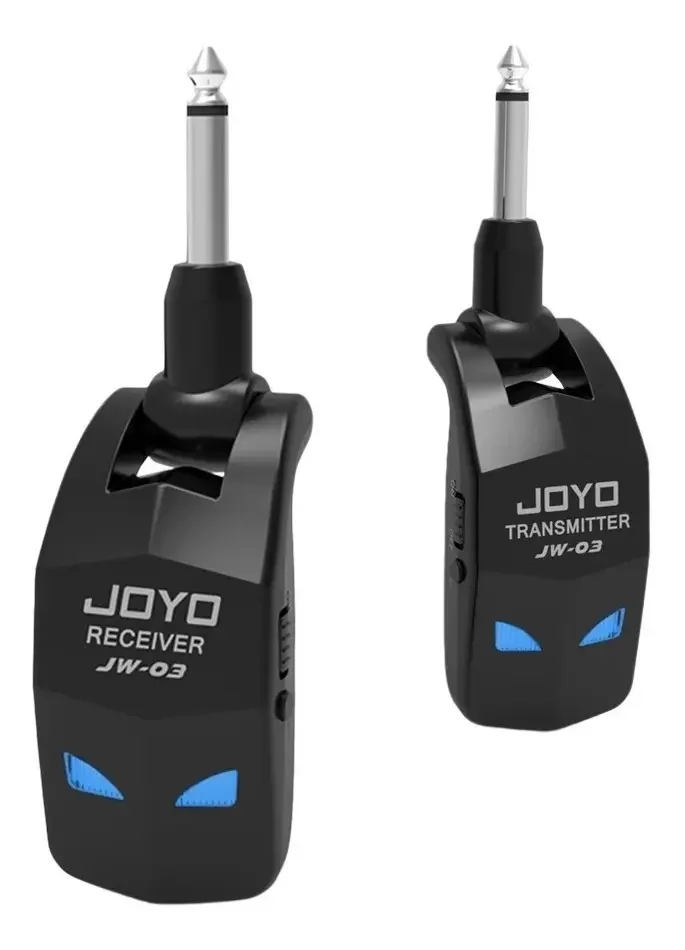
The JW-06 can be seen as the more practical and more modern sibling of the JW-03. While many budget wireless systems still operate in the 2.4 GHz band, the JW-06 uses 5.8 GHz, a range that usually competes less with common household routers, Bluetooth devices and everyday wireless traffic. That does not make it immune to interference, but it helps explain why this model is attractive for home players, churches, rehearsals, small stages and mobile rigs.
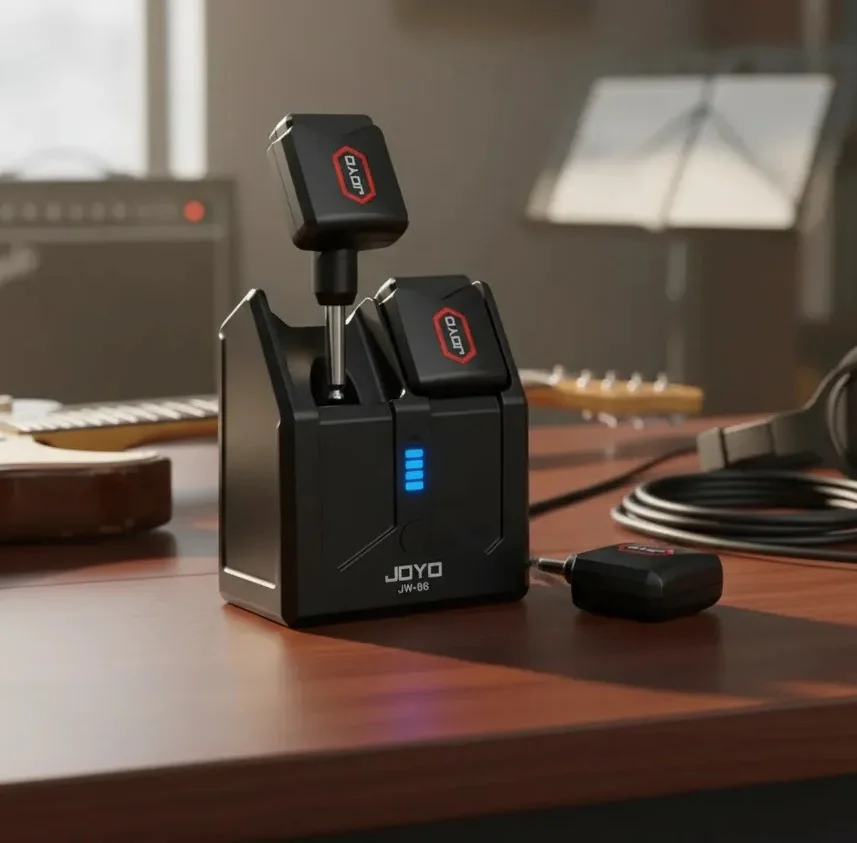
Its most important feature is the charging case. Instead of relying only on the individual charge of the transmitter and receiver, the player carries a storage case that also works as a portable charging station. For anyone who has had a wireless system die during rehearsal, that detail is not just convenient; it is operational insurance.
In the market, it competes with systems such as the Lekato WS-50, XVive A58 and NUX B-5RC. It is not designed to replace professional Shure, Line 6 or Sennheiser systems, but to deliver affordable wireless freedom, plug-and-play operation and enough performance for most non-critical situations.
Construction and Design
The JW-06 follows the compact folding-plug format common to modern budget wireless systems. The transmitter plugs into the instrument, while the receiver plugs directly into an amplifier, pedal, modeler, interface or compatible instrument input. The articulated plug helps it adapt to Stratocaster, Les Paul, Telecaster, bass and side-jack instruments, although guitars with recessed or unusual jack plates may require extra care.
The construction is mainly plastic/ABS, which is expected at this price point. It does not feel like a heavy touring system, but it is light, portable and sturdy enough for home use, rehearsals and moderate gigging. The charging case is the strongest part of the design: it protects the units during transport, centralizes charging and makes the system much more practical than models that require separate USB charging every time.
The finish is discreet and functional. Visual indicators show charge, pairing and operating status, while the buttons allow re-pairing and channel bank switching. This is a design for players who want to plug in and play, not navigate menus or apps before making sound.
Technical Specifications
| Specification | Verified information |
|---|---|
| Type | Digital wireless instrument system |
| Components | Transmitter, receiver and charging case |
| Wireless band | 5.8 GHz ISM |
| Audio resolution | 48 kHz / 24 bit |
| Stated latency | Less than 6 ms |
| Stated range | More than 20 m / approximately 60 ft |
| Frequency response | 10 Hz – 22 kHz ±1 dB |
| Stated distortion | Less than 0.02% at 1 kHz / -10 dBFS in manual documentation; some listings cite less than 0.029% |
| Anti-interference method | Frequency hopping |
| Channel banks | 4 |
| Internal battery | Rechargeable 3.7 V / 500 mAh lithium battery |
| Battery life per charge | More than 5 hours on a full charge, according to manual specifications |
| Battery life with case | Some retailer listings cite more than 15 hours when used with the charging case |
| Dimensions of set/case | 84 x 100 x 46 mm |
| Weight listed in Brazil | 237 g |
| Included accessories | Owner's manual and USB charging cable |
| Main compatibility | Electric guitar, electric bass and instruments with compatible mono 1/4-inch output |
The specification sheet puts the JW-06 above many basic wireless units, especially because of its 48 kHz/24 bit audio, 5.8 GHz operation and charging case. Still, specifications do not replace testing in the actual environment: stages with many routers, digital lighting systems, wireless in-ear monitors and other RF devices can change the perceived stability.
JOYO JW-06
 1 / 3
1 / 3Features and Functionality
The JW-06 is designed to be simple. There is no app, software editor, MIDI, USB audio, effects loop, tuner or preset system. Its job is to transmit the instrument signal to the destination with as little friction as possible.
Its key features are:
- 5.8 GHz digital wireless transmission;
- 48 kHz/24 bit audio;
- simple transmitter/receiver pairing;
- up to 4 channel banks;
- one-to-one operation and, according to some seller documentation, one transmitter to multiple receivers in specific contexts;
- portable charging case;
- 5 V output on the case for emergency charging of compatible devices;
- charge and status indicators;
- folding/articulated 1/4-inch plug.
In practice, the charging case is the most valuable feature. Small wireless systems usually fail less because of tone and more because of routine: forgetting to charge, losing the cable or leaving for rehearsal with half a battery. The case reduces that risk by keeping both units stored, protected and ready to recharge.
Sound and Performance
For a guitar wireless system, the highest compliment is not being noticed. The JW-06 aims for exactly that: preserving the feel of playing through a cable, with low enough latency not to bother most players during practice, rehearsal or small-stage performance. Its stated sub-6 ms latency sits in a range that is generally comfortable for electric guitar, especially when the rest of the rig is not adding meaningful delay.
The sound is expected to be clean and direct. Its stated 10 Hz to 22 kHz frequency response easily covers the useful range of guitar and bass, so the practical limitation is usually less about frequency extension and more about link stability, instrument output level, amp/pedal/modeler quality and the RF environment. On clean tones, the system should preserve attack and brightness without drastically changing the instrument's character. With crunch, drive and distortion, the difference from a cable tends to become less obvious, provided the signal remains stable.
The dynamics are appropriate for the price and purpose. Players who use the guitar volume to clean up overdrive, play blues with touch variation or switch between soft and aggressive picking should find the response natural enough for everyday use. However, very demanding musicians, professional studios and large-stage rigs may still prefer professional wireless systems with more advanced RF management and more rugged construction.
The perceived noise depends on the whole rig. The JW-06 will not fix grounding issues, noisy pickups, poor power supplies or noisy pedals. Its role is to replace the cable between instrument and input; if the setup is already noisy, wireless may simply make that more apparent. The practical recommendation is to test the system in the actual venue, especially in churches, bars and stages with many wireless devices.
Use in Rock and Blues
The JW-06 makes sense for guitarists who need to move between pedalboard, amplifier and small stage without dragging a cable across the floor. In classic rock, hard rock and pop rock, it helps keep the setup cleaner and reduces tripping hazards in tight spaces.
For blues, the key issue is preserving volume dynamics, attack and the ability to clean up overdrive. The JW-06 is not tied to a specific famous artist, but it can serve players who want freedom without losing the basic response of the guitar.
Because it works with compatible mono 1/4-inch instrument outputs, bassists can also benefit from the mobility. Its stated frequency response is wide, but high-output active basses should be tested carefully to avoid unexpected behavior or input overload.
There is no editorially reliable evidence of widely known rock or blues artists using the JOYO JW-06 as a central part of their rig. For that reason, the correct angle is not celebrity endorsement, but practical utility: it is an affordable wireless system for real players who want movement, a cleaner setup and simple operation.
Who It Is For
The JOYO JW-06 is recommended for beginner-to-intermediate guitarists and bassists who want to try a wireless system without paying for professional solutions. It works well for home practice, home studio ideas, band rehearsal, church performance, bar gigs and small-to-medium rooms.
It is also a strong option for players already using the JW-03 or another budget 2.4 GHz wireless unit who want a more complete setup with a charging case and 5.8 GHz operation. For musicians who often forget to charge gear, the case is a major argument.
It is not the best choice for professional tours, large stages, highly congested RF environments, players who need extremely rugged construction or technicians who require advanced frequency coordination. It is also not ideal for anyone expecting app control, built-in tuning, stereo routing, XLR, MIDI or professional multi-system management.
Comparison with Competitors
| Model | Proposition | Strengths | Limitations | Best for |
|---|---|---|---|---|
| JOYO JW-06 | 5.8 GHz wireless with charging case | Strong value, practical case, 48 kHz/24 bit, 4 channels | Basic construction, no advanced features, little professional association | Beginners and intermediates seeking convenience |
| JOYO JW-03 | Compact 2.4 GHz wireless | Simpler and usually cheaper | No robust charging case and more exposed to 2.4 GHz congestion | Players who want to spend less |
| Lekato WS-50 | Affordable wireless with case | Very popular, similar format, good convenience | Quality may vary by batch and OEM market | Direct budget alternative |
| XVive A58 | More premium 5.8 GHz wireless | Stronger brand reputation in the category, good build perception | Usually more expensive | Players who want to step up while keeping a compact format |
| NUX B-5RC | Compact wireless with charging case | Good integration, solid reputation, simple operation | Usually priced above JOYO | Players who prioritize reliability and finish |
Compared with the JW-03, the JW-06 is clearly more complete: 5.8 GHz, charging case and more modern specs. Compared with alternatives such as the XVive A58 and NUX B-5RC, the JOYO tends to win on price but may lose on perceived finish, support consistency and confidence for heavy professional use.
The right choice depends on the risk of the context. For home, rehearsal and small stages, the JW-06 is highly competitive. For critical shows, professional recording or frequent gigging, a higher-tier system may be worth considering.
Pros and Cons
| Pros | Cons |
|---|---|
| Operates in 5.8 GHz, away from the more crowded 2.4 GHz band | Can still suffer interference depending on the environment |
| Charging case greatly improves practicality | Plastic/ABS construction is not premium-grade |
| Stated latency below 6 ms | Does not replace professional RF systems |
| 48 kHz/24 bit audio | No app, tuner, USB audio or advanced features |
| Stated range above 20 m | Real battery life depends on charge, use and battery age |
| Four channel banks | No strong known-artist endorsement |
| Strong value for money | May not fit perfectly into every instrument jack |
The overall balance is positive if the product is bought with the right expectations. The JW-06 is a convenience and mobility tool, not a definitive professional solution. Its value is in removing the cable from the floor at an accessible price with simple operation.
Final Verdict
The JOYO JW-06 is worth it for players who want to enter the wireless world with more security than basic units without a charging case. It delivers the essentials: stated low latency, wide frequency response, 5.8 GHz operation, simple pairing and a charging case that solves one of the biggest weaknesses of cheap wireless systems: battery routine.
For rock, blues, pop, church, rehearsal and small-stage guitarists, it is a very rational purchase. It does not pretend to be glamorous professional gear, but it does offer real freedom of movement and a more organized experience than playing with a cable running across the floor.
A competitor may be better when the use case is critical. If you play large stages, depend on wireless every week, work in environments with many wireless systems or need touring-level confidence, brands such as NUX, XVive, Line 6, Shure or Sennheiser may make more sense. But for the player who wants practicality, portability and strong value, the JW-06 is one of JOYO's most interesting wireless systems and a clear step up from the JW-03.