
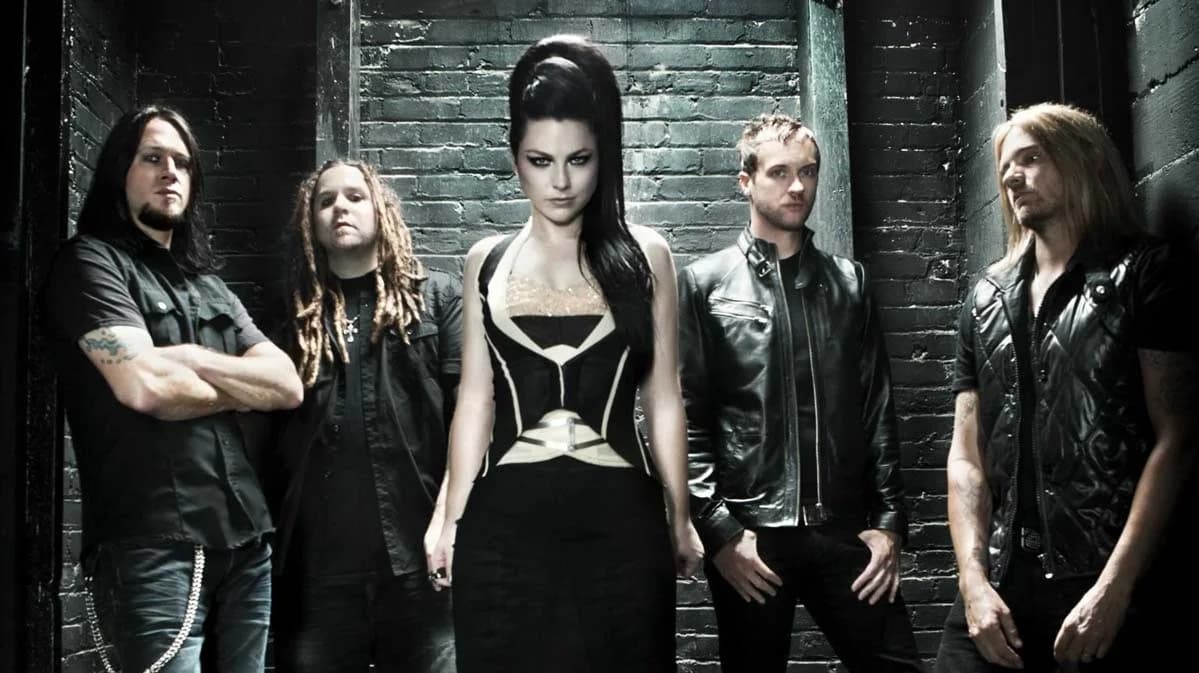
A serious reading of Evanescence has to go beyond “gothic rock with a female singer.” The story includes teenage songwriting, label pressure, internal conflict, lineup changes, creative control, long silences, rebirth and a fan relationship built around grief, guilt, isolation, broken faith and reconstruction. The band’s heaviness has never been only about distortion; it comes from the tension between vulnerability and scale.
Basic Facts
| Field | Information |
|---|---|
| Name | Evanescence |
| Origin | Little Rock, Arkansas, United States |
| Formed | 1995 |
| Founding core | Amy Lee and Ben Moody |
| Associated genres | Alternative rock, alternative metal, gothic metal, hard rock |
| Labels | Wind-up, Concord/Craft, BMG |
| Status | Active |
| Current lineup | Amy Lee, Tim McCord, Troy McLawhorn, Will Hunt, Emma Anzai |
| Essential albums | Fallen, The Open Door, Evanescence, Synthesis, The Bitter Truth |
Origin and Formation
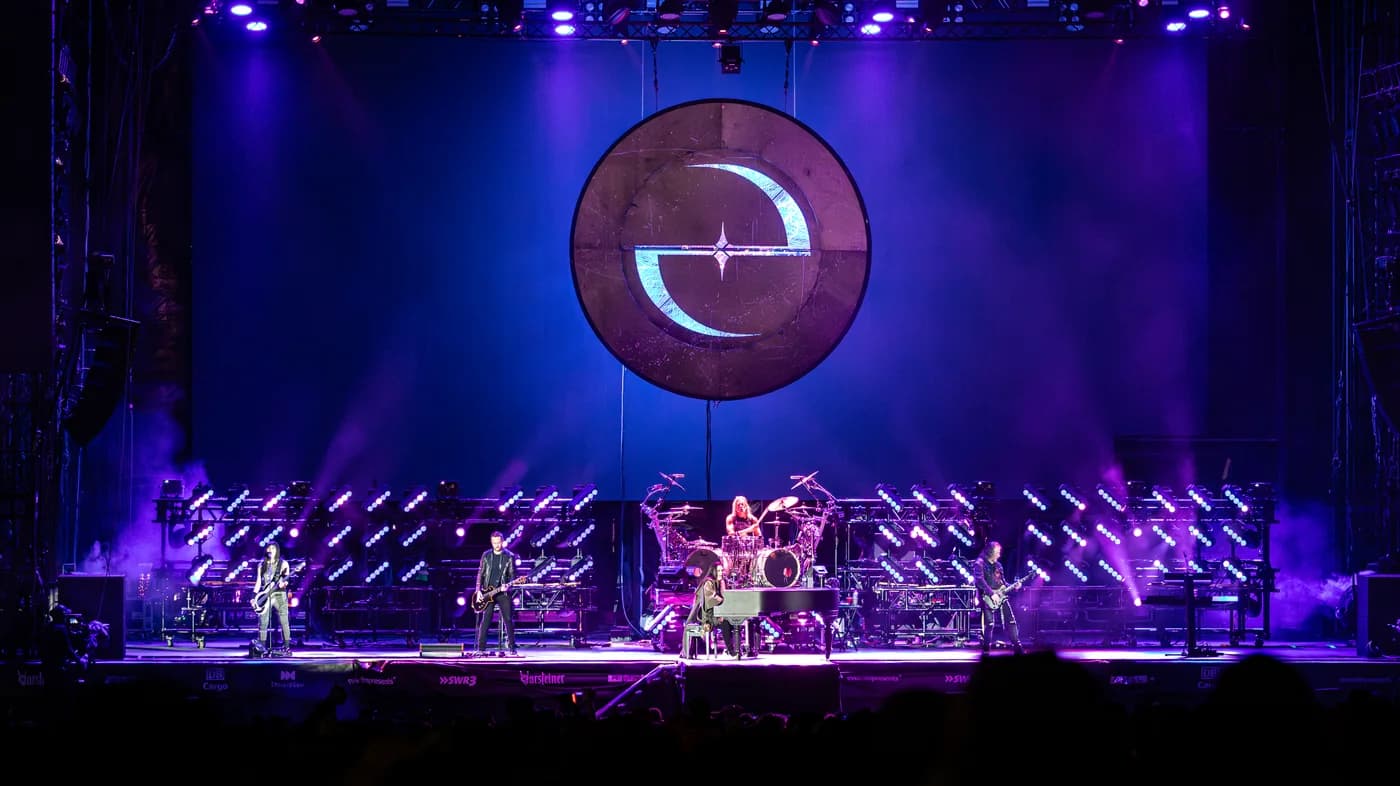
Evanescence began less as a product of a defined scene and more as the meeting point of two specific sensibilities. Amy Lee and Ben Moody met as teenagers in Little Rock and started writing music that combined piano, dark atmosphere, confessional melodies and dense guitars. Before becoming globally known, the project moved through independent recordings, demos and an identity still too unusual to fit neatly into one label.
Evanescence’s signature was born from that collision. It did not sound like European symphonic metal, because it was less epic and more intimate. It did not sound like standard nu metal either, because its emotional center was not masculine rage, but Amy Lee’s voice turning pain, introspection and catharsis into song.
Members and Lineups
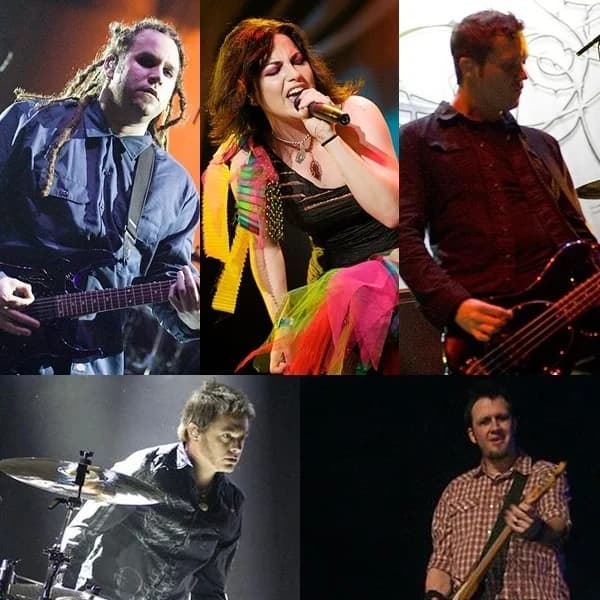
Evanescence’s history is shaped by lineup changes that affected the band’s sound, stage presence and creative balance. Amy Lee is the permanent axis, but reducing the band to her alone makes the story smaller. Each era brought musicians who changed the weight, texture and arrangement language.
| Member | Role | Period | Importance |
|---|---|---|---|
| Amy Lee | Vocals, piano, keyboards | 1995-present | Artistic core, lead voice and central aesthetic force |
| Ben Moody | Guitar, songwriting | 1995-2003 | Co-founder and key architect of the early Fallen language |
| David Hodges | Keyboards, backing vocals | 2000-2002 | Part of the pre-Fallen consolidation period |
| Will Boyd | Bass | 2003-2006 | Connected to the first major touring cycle |
| Rocky Gray | Drums | 2003-2007 | Added live power during the Fallen and The Open Door eras |
| John LeCompt | Guitar | 2003-2007 | Helped turn the project into a touring rock band |
| Terry Balsamo | Guitar | 2003-2015 | Crucial creative partner on The Open Door and the mature second phase |
| Tim McCord | Bass, later guitar | 2006-present | Long-term stability; moved to guitar in 2022 |
| Will Hunt | Drums | 2007-present | Modern, powerful and consistent live foundation |
| Troy McLawhorn | Guitar | 2007-present | Weight, stage presence and continuity |
| Jen Majura | Guitar, backing vocals | 2015-2022 | Expanded the band’s live harmonic and visual presence |
| Emma Anzai | Bass, backing vocals | 2022-present | Strengthened the current lineup after McCord moved to guitar |
The Fallen Breakthrough
The album arrived at a specific cultural moment. Heavy rock still had a strong presence on MTV, in film soundtracks and on radio, but there was room for a more emotionally theatrical language. Evanescence occupied that space with dark visuals, lyrics of inner collapse and a vocalist who did not fit either the decorative muse stereotype or the traditional aggressive frontman mold.
The male vocal part helped the single enter the radio landscape of its time, while Amy Lee later reinterpreted and reclaimed the song in live versions.
“My Immortal” reached listeners far beyond heavy rock and proved the band’s drama could work in a near-chamber-pop format.
Rupture, The Open Door and Creative Control
The songs depend less on the contained-verse/explosive-chorus formula and more on internal drama. “Call Me When You’re Sober” has a pop attack but emotional venom. “Lithium” deepens the melancholy with greater elegance. “Sweet Sacrifice” keeps the weight and theatricality. The album expands strings, choirs, piano layers and soundtrack-like atmosphere without abandoning guitar.
From Band to Collective: Evanescence, Synthesis and The Bitter Truth
The self-titled 2011 album marks another key point: Evanescence begins to sound more like a full band, not just a project led by an original core. The drums become more athletic, the guitars gain modern muscle and the songs carry a different urgency. “What You Want” opens the door to a more physical Evanescence, while “Lost in Paradise” preserves the band’s gift for dramatic ballads.
Essential Discography
Evanescence’s discography can be heard as a sequence of battles for identity. Each album answers a different pressure: early construction, the aftermath of success, band affirmation, orchestral reinterpretation and the return to heaviness after years of silence.
| Album | Year | Editorial reading |
|---|---|---|
| Fallen | 2003 | The founding impact: piano, riffs, huge choruses and global dark aesthetics |
| The Open Door | 2006 | Amy Lee’s creative emancipation and the band’s most dramatic phase |
| Evanescence | 2011 | A more physical, collaborative and band-oriented record |
| Synthesis | 2017 | Orchestral/electronic reinterpretation that exposes the songs’ harmonic DNA |
| The Bitter Truth | 2021 | A mature return to heaviness, grief and adult emotional critique |
Style, Guitars and Sonic Language
Evanescence’s sound is built on contrast. The piano is rarely decorative; it acts as an emotional narrator. The guitars are not usually virtuosic in the classic sense, but they are structurally essential: open chords, dense layers, low tunings, supporting riffs and chorus explosions. The drums, especially in the Will Hunt era, give the catalog the muscle that keeps the drama from becoming fragile.
For guitarists, Evanescence is a lesson in function. Guitar does not need to dominate an arrangement to be decisive. In many songs it works as a mass of sound pushing the voice upward. In others it creates rhythmic tension with simple picking patterns and compressed tones. The value is in dynamic control: knowing when to become a wall, when to step back for the piano and when to double the chorus’s emotional lift.
The harmony often uses minor keys, circular progressions and movements that reinforce suspension. The result is music that sounds large but rarely joyful. Evanescence created its own grammar for turning suffering into arena-scale impact.
Helps explain the piano’s role as an intimate voice, not merely accompaniment.
Illuminates the interest in dark layers, electronic pressure and industrial atmosphere.
Represents the context of bands combining metal, dark melody and strong female vocals.
Shows the dialogue with grand arrangements, although Evanescence is more direct and confessional.
Amy Lee, Image and Representation
Amy Lee became one of modern rock’s central figures because her presence did not depend on cartoon aggression. She built authority through voice, piano, songwriting and an image that refused the decorative role often assigned to women in heavy bands. In a period dominated by male singers, Evanescence opened space for a different kind of intensity.
Her importance is also about endurance. She crossed lineup disputes, label pressure, commercial expectations, hiatuses and market shifts without abandoning the band’s emotional center. Over time, she moved from unlikely breakout figure to an author increasingly in control of her own narrative.
That does not mean Evanescence is only “Amy Lee’s band.” It means the band found its compass in her. Lineups change, producers change, the market changes, but the combination of voice, piano, shadow and catharsis remains unmistakable.
Legacy and Current Era
For Luciano Bastos Guitar, Evanescence matters because it teaches a valuable musical lesson: identity does not come from technical complexity alone. It comes from coherence. The band built a sound where piano, guitar, voice, silence, image and emotion all point in the same direction. Few groups from the 2000s achieved that with such force and permanence.