
Basic Facts
| Field | Information |
|---|---|
| Name | AC/DC |
| Origin | Sydney, Australia |
| Formed | 1973 |
| Genre | Hard Rock, Blues Rock, Rock and Roll, Heavy Metal |
| Label | Albert Productions, Atlantic, Atco, Elektra, East West, Columbia/Sony |
| Status | Active |
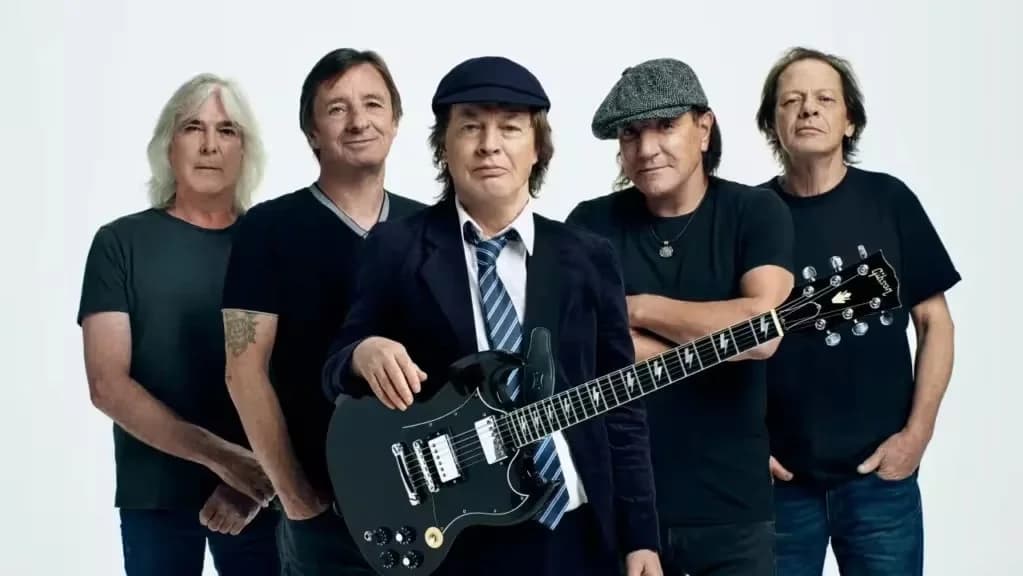
| Current members | Angus Young, Brian Johnson, Stevie Young, Chris Chaney, Matt Laug |
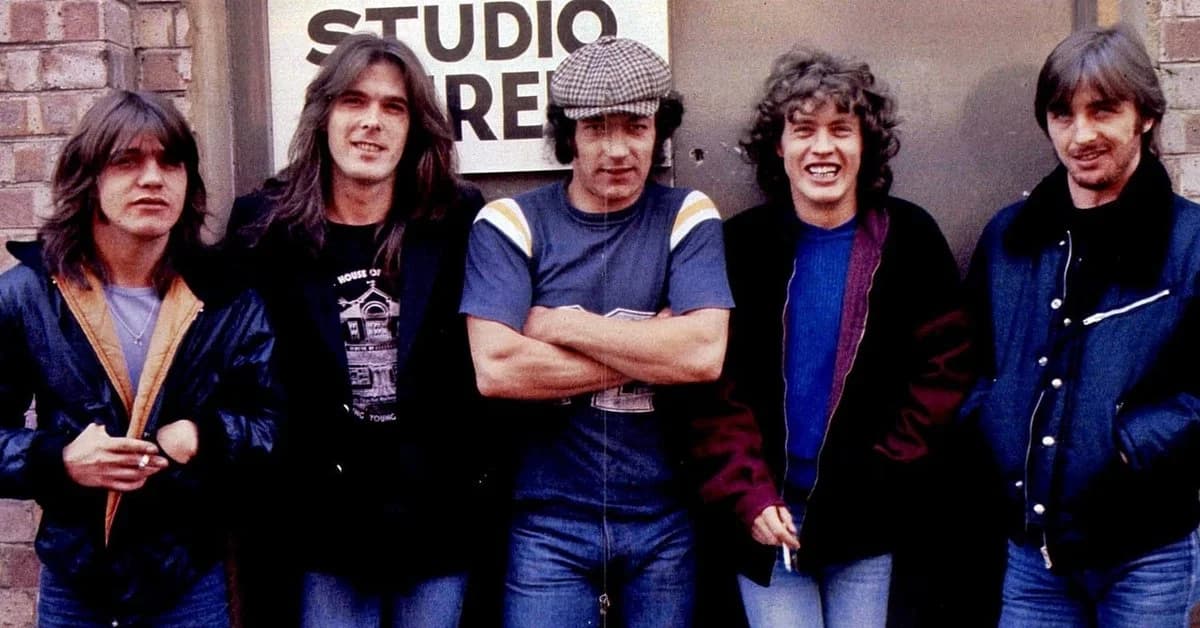
| Classic line-up | Angus Young, Malcolm Young, Bon Scott/Brian Johnson, Cliff Williams, Phil Rudd |
Origin and Formation
AC/DC formed in Sydney in November 1973 around a brutally clear idea: play rock with no decorative excess, no progressive labyrinths and no compromise with fashionable polish. Malcolm Young was the first architect of the band’s identity. With his younger brother Angus Young, he wanted a group that sounded like voltage made physical: hard riffs, straight drums, a locked bass line and choruses strong enough to travel from pubs to stadiums.
The name came from an electrical mark seen by the Young brothers’ sister Margaret on a sewing machine: AC/DC, alternating current/direct current. It was perfect branding before the band even had a global audience. The first line-up featured Angus Young on lead guitar, Malcolm Young on rhythm guitar, Dave Evans on vocals, Larry Van Kriedt on bass and Colin Burgess on drums. The personnel would change quickly, but the central mechanism was already there: Angus as visual detonation, Malcolm as the rhythmic engine.
The Young family had deep ties to Australian rock before AC/DC took shape. George Young, Angus and Malcolm’s older brother, had been a member of the Easybeats and later became, with Harry Vanda, a decisive producer for the band’s early records. That connection linked AC/DC to the 1960s beat scene, Australian pub rock and a more international hard rock ambition.
Bon Scott’s arrival in 1974 completed the first classic identity. Scott had already sung with groups such as the Valentines and Fraternity, and he brought a dangerous mix of wit, street charisma, irony and rasp. With him, AC/DC became more than a loud young band: it became a fully formed mythology of riffs, boogie, bad decisions, dirty jokes and disciplined musical force.
Members
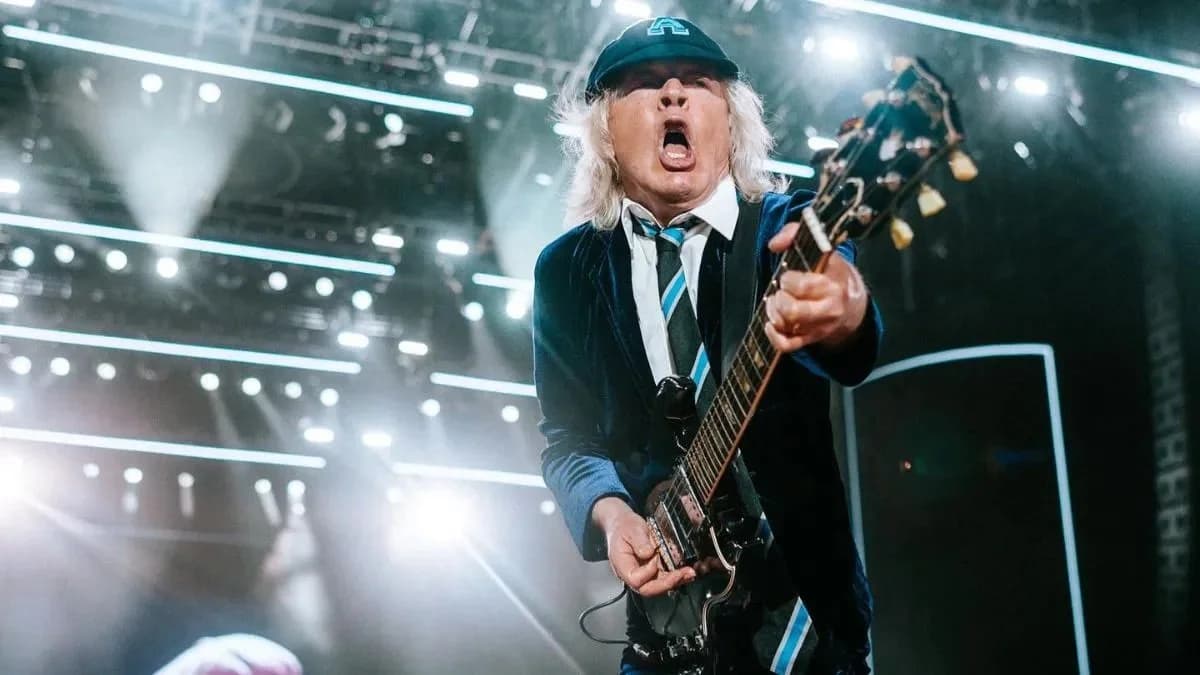
AC/DC’s story is inseparable from Angus and Malcolm Young. Angus became the visual icon: schoolboy uniform, Gibson SG, duckwalk, cutting solos and a stage presence that turns rock performance into controlled chaos. Malcolm, however, was the center of gravity. His rhythm guitar is one of the great schools of hard rock: tight, economical, percussive and absolutely essential to the band’s swing.
Bon Scott defined the first golden era. His voice was not merely rough; it was narrative. He sounded like a man laughing at disaster while turning lust, danger, travel and excess into characters. After his death in February 1980, Brian Johnson inherited an almost impossible role and answered with one of rock’s most dramatic rebirths. On Back in Black, his high, torn vocal attack turned grief into architecture.
Cliff Williams stabilized the low end from 1977 onward, playing directly and never crowding the guitars. Phil Rudd, during his key periods, gave the band a dry, heavy, unshowy pulse. That restraint matters: AC/DC’s power comes from musicians who know exactly how little to play to make the riff feel enormous.
From 2014, after Malcolm Young retired due to health issues, Stevie Young carried the rhythm guitar role with remarkable continuity. In recent touring line-ups, Chris Chaney has taken the bass position and Matt Laug has handled drums, keeping AC/DC active with Angus Young as the central guardian of the band’s sound and image.
| Member | Instrument/Role | Main period |
|---|---|---|
| Angus Young | Lead guitar | 1973-present |
| Malcolm Young | Rhythm guitar | 1973-2014 |
| Bon Scott | Vocals | 1974-1980 |
| Brian Johnson | Vocals | 1980-2016, 2018-present |
| Cliff Williams | Bass | 1977-2016, 2018-2024 |
| Phil Rudd | Drums | 1975-1983, 1994-2015, 2018-2023 |
| Stevie Young | Rhythm guitar | 1988, 2014-present |
| Chris Chaney | Bass | 2024-present |
| Matt Laug | Drums | 2023-present |
History
AC/DC’s early years moved fast. High Voltage, released in Australia in 1975, introduced the basic formula: accelerated blues, stripped riffs, crude humor and stage energy. The same year’s T.N.T. locked in the Bon Scott personality and supplied songs that would become permanent parts of the band’s identity. The 1976 international version of High Voltage gathered material from those Australian releases and opened the door to Europe.
Across Dirty Deeds Done Dirt Cheap, Let There Be Rock and Powerage, the band refined its language without softening it. Let There Be Rock pushed intensity toward something almost biblical: rock as voltage, sermon and volume ritual. Powerage, darker and more compact, remains a musician’s favorite because it reveals how much nuance AC/DC could place inside a seemingly simple frame.
Highway to Hell, released in 1979, was the decisive international breakthrough. Produced by Robert John “Mutt” Lange, it gave AC/DC a cleaner, more organized sound without removing its danger. The title track became an immediate anthem, and the band appeared ready to conquer the world. Then Bon Scott died in London in February 1980 at the age of 33.
The band could have ended there. Instead, AC/DC recorded Back in Black with Brian Johnson. Released in 1980, the album became a monumental response: black cover, surgical riffs, huge choruses and production that made every drum hit and guitar pause feel architectural. It was not just a new singer joining a band; it was a rebirth that preserved the DNA while pushing AC/DC to historic scale.
The 1980s brought both peaks and uneven stretches. For Those About to Rock We Salute You confirmed the stadium era, while Flick of the Switch, Fly on the Wall and Blow Up Your Video kept the band moving through changing production fashions. In 1990, The Razors Edge and Thunderstruck brought AC/DC back to global hard rock dominance for a new generation. Later albums such as Ballbreaker, Stiff Upper Lip, Black Ice, Rock or Bust and Power Up proved that AC/DC rarely changes language; it sharpens the same electric alphabet.
Recent decades also brought serious challenges: Malcolm Young’s retirement, Phil Rudd’s absences, Brian Johnson’s temporary withdrawal due to hearing issues and Axl Rose’s guest role on 2016 Rock or Bust dates. Even so, Power Up arrived in 2020 as a tribute to Malcolm, and the band returned to major touring with its reputation as one of rock’s most durable live machines intact.
The AC/DC mark was suggested after Margaret Young saw the electrical abbreviation on a sewing machine. Its association with power and voltage became inseparable from the band’s identity.
The 1980 album followed Bon Scott’s death and served as tribute, rebirth and declaration. Its black cover reinforced the memorial character of the record.
Angus was the visual explosion, but many musicians identify Malcolm as the band’s rhythmic center. His control of dynamics and silence is one of AC/DC’s secrets.
Discography
AC/DC’s discography is one of rock’s most coherent bodies of work. Rather than chasing trends, the band built a vocabulary and refined it for decades: standard-tuned riffs, boogie grooves, arena choruses, dry production and a near-philosophical refusal of excess. The evolution is less about radical change and more about precision.
The Bon Scott era smells of pubs, roads and danger. The Brian Johnson era begins with a world-scale explosion and turns AC/DC into the definition of stadium hard rock. Even on less celebrated records, the discipline is remarkable: the band knows exactly what it is, and that certainty is part of its greatness.
| Album | Year | Note |
|---|---|---|
| High Voltage | 1975 | Australian debut, raw and embryonic |
| T.N.T. | 1975 | The Bon Scott identity fully emerges |
| Dirty Deeds Done Dirt Cheap | 1976 | Acid humor, street attitude and direct riffs |
| Let There Be Rock | 1977 | One of the most explosive early albums |
| Powerage | 1978 | Darker, tighter and beloved by deep fans |
| Highway to Hell | 1979 | International breakthrough with Mutt Lange |
| Back in Black | 1980 | Brian Johnson’s debut and a hard rock monument |
| For Those About to Rock We Salute You | 1981 | Stadium scale fully established |
| Flick of the Switch | 1983 | Rawer attack after commercial polish |
| Fly on the Wall | 1985 | A rougher mid-eighties chapter |
| Blow Up Your Video | 1988 | Reunion with Vanda & Young production |
| The Razors Edge | 1990 | Global comeback powered by Thunderstruck |
| Ballbreaker | 1995 | Dry production and Phil Rudd’s return |
| Stiff Upper Lip | 2000 | More relaxed blues rock feel |
| Black Ice | 2008 | Large-scale return in the twenty-first century |
| Rock or Bust | 2014 | First album without Malcolm as an active member |
| Power Up | 2020 | Tribute to Malcolm and a late-career reaffirmation |
Style and Influence
AC/DC’s style is a lesson in economy. The band rarely relies on complex harmonies, excessive solos or sudden rhythmic detours. Its power comes from precision: open guitars, riffs with space, bass as foundation, drums without ornament and vocals that treat the chorus like a hammer blow. The music is simple in outline and sophisticated in collective execution.
Angus Young’s signature lies in sharp bends, nervous vibrato and blues-derived theatricality. Malcolm Young’s signature lies between the notes: muting, accents, pauses, pick attack and a near-architectural sense of groove. The result is hard rock that feels heavy not because of density, but because of pressure.
Across decades, AC/DC maintained continuity as an aesthetic principle. Production may shift from the rawness of the seventies to the polish of Highway to Hell and Back in Black, the metallic edges of parts of the eighties and the modern weight of Black Ice and Power Up, but the grammar remains instantly identifiable.
The stage energy, guitar-driven rhythm and direct vocabulary of early rock and roll run through AC/DC’s language, especially in Angus Young’s physical performance style.
Electric blues helps explain the expressive base of the riffs, bends and tension between repetition and variation that power many AC/DC songs.
The family connection through George Young tied AC/DC to an Australian tradition of direct, melodic, disciplined rock later transformed into high-voltage hard rock.
The vocal intensity, urgency and bodily celebration of rock help explain the band’s most explosive and performative qualities.
Although each band has its own identity, Motörhead’s rawness, speed and riff-centered force show how AC/DC helped define a direct, unornamented approach to heavy music.
Hard rock bands of the eighties absorbed AC/DC’s direct riffs, arena theatricality and belief that attitude can matter as much as virtuosity.
Legacy
AC/DC’s legacy is that of a band that turned repetition into a universal language. In a genre often seduced by virtuosity, conceptual grandeur or abrupt reinvention, the group built greatness by remaining faithful to a core sound: two guitars working as machinery, a brutally precise rhythm section and a singer able to turn simple phrases into communal shouts.
Back in Black holds a singular place in popular culture as one of the best-selling albums ever and one of hard rock’s defining mass statements. But AC/DC is larger than one record. The Bon Scott era created the mythology; Highway to Hell opened the road; For Those About to Rock confirmed the stadium scale; Thunderstruck renewed the band for the nineties; Power Up showed that the voltage could still burn in Malcolm Young’s memory.
The band’s 2003 induction into the Rock and Roll Hall of Fame formalized recognition fans had already granted decades earlier. AC/DC influenced hard rock, heavy metal, punk, glam metal, alternative rock and countless garage bands that learned an essential truth from Angus and Malcolm: a great riff does not need to be complicated; it needs to be inevitable.
Culturally, AC/DC remains shorthand for energy. The logo, the lightning bolt, Angus’s uniform, the cannons of For Those About to Rock and the opening of Thunderstruck belong to an imagination that crosses generations. AC/DC is one of the rare bands that can sound primitive and monumental at the same time — as if every show were five musicians plugged directly into the wall.