Basic Facts
| Field | Information |
|---|---|
| Full name | Angus McKinnon Young |
| Stage name | Angus Young |
| Born | March 31, 1955 |
| Birthplace | Glasgow, Scotland |
| Nationality | Scottish-Australian |
| Main instrument | Electric guitar |
| Genres | Hard rock, blues rock, rock and roll |
| Bands and projects | AC/DC, Marcus Hook Roll Band, Kantuckee/Tantrum |
| Career start | Early 1970s |
| Signature guitar | Gibson SG |
| Nicknames | “Schoolboy”, rock’s school-uniform guitarist |
Introduction
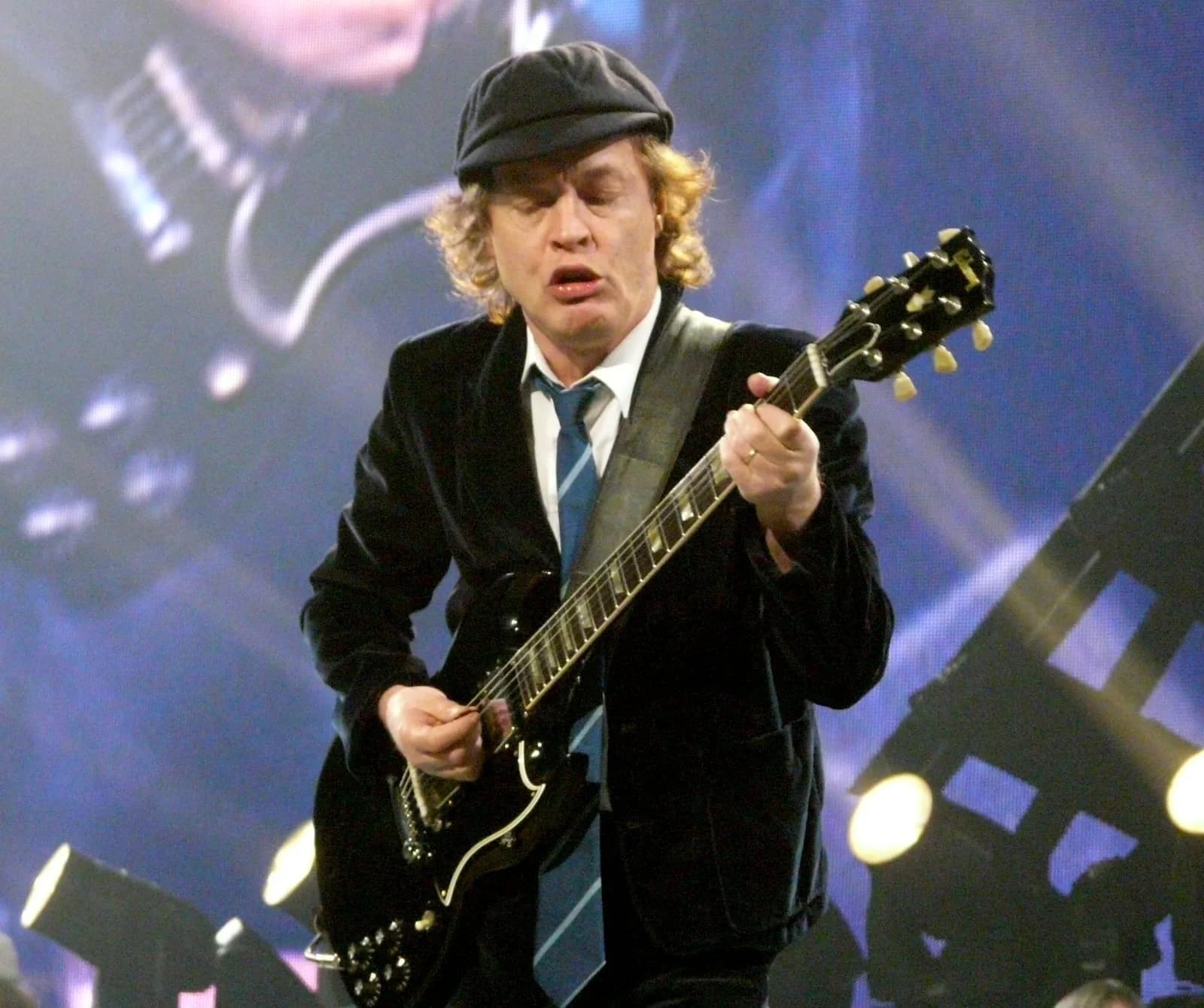
Angus Young is one of the most instantly recognizable guitarists in rock history. Within seconds, the image tells the story: a Gibson SG hanging from his small frame, the schoolboy uniform, the restless movement across the stage, the head shaking as if the riff itself were driving his body. Behind that brilliant caricature, however, is an extremely precise, economical and disciplined musician, able to turn simple ideas into definitive riffs.
As co-founder, lead guitarist and the constant force inside AC/DC, Angus helped define a hard rock language built on three pillars: direct riffs, raw tone and physical energy. He never needed to sound sophisticated to sound huge. His greatness lies in control: knowing when to repeat, when to attack, when to let the band breathe and when to release a solo that feels like blues amplified to stadium volume.
Angus is not a guitarist associated with complex effects, exotic tunings or long technical demonstrations. His signature comes from a firm picking hand, nervous vibrato, vocal bends and the ability to make a simple progression sound inevitable. At a time when many guitarists chased more speed and more equipment, he stayed loyal to a brutally efficient formula: SG, Marshall, high volume and no-frills rock and roll.
Early Steps
Angus McKinnon Young was born in Glasgow, Scotland, into a large family deeply connected to music. As a child, he moved with his family to Australia, where the Young brothers would find the environment that gave birth to one of rock’s most important bands. The house was full of musical references: George Young found success with the Easybeats, Malcolm Young developed a powerful rhythm-guitar language, and Angus absorbed early the idea that music was work, instinct and presence.
Before AC/DC, Angus played in local groups such as Kantuckee, later connected to the formation known as Tantrum, and he also moved around the family circle that surrounded Marcus Hook Roll Band. These experiences shaped his understanding of bands, stages and guitar sound, but the decisive moment came in 1973, when Malcolm Young decided to form a direct, loud, no-nonsense rock band. Angus became the lead guitarist.
AC/DC was born in Sydney with a simple and powerful mission: rock built on riffs, electric blues, barroom energy and arena volume. In the early years, the lineup changed, but the chemistry between Angus, Malcolm and Bon Scott quickly established the group’s identity. Malcolm was the rhythmic wall; Angus was the spark. One pushed the music forward, the other exploded above it.
The schoolboy uniform, suggested within the family environment and tied to Angus’s electric youthfulness, became a permanent visual trademark. What might have seemed like a stage gimmick became part of AC/DC’s language: a collision of humor, rebellion and musical seriousness. Angus looked like a mischievous kid, but he played with the conviction of someone who knew exactly where he was going.
Musical Influences
The most visible influence on Angus sits in Chuck Berry’s rock and roll DNA: short phrases, double-stops, stage energy and the famous duckwalk. Angus did not simply borrow the gestures; he absorbed the idea that guitar can be rhythm, melody, humor and attitude at the same time.
From Muddy Waters’s electric blues, Angus inherited a taste for emotionally charged phrases built from few elements. Instead of relying on many notes, he creates tension through repetition, attack and response, keeping the guitar connected to the band’s pulse.
B.B. King’s shadow appears in the way Angus treats bends and vibrato as a kind of voice. Even in a much heavier context, Angus preserves the logic of blues: one well-chosen note, held with intent, can be worth more than a fast run.
Little Richard’s explosive energy helps explain AC/DC’s physical dimension. Angus shares that urgency: the stage is not merely a place to play songs, but a place to push them to the limit with humor, sweat and intensity.
Malcolm was more than Angus’s brother and bandmate: he was Angus’s musical center of gravity. His dry, precise and powerful rhythm guitar created the perfect space for Angus to sound free without losing focus. Much of Angus’s solo impact is born from that relentless rhythmic foundation.
Bands and Projects
Angus Young’s story is almost completely tied to AC/DC, and that is essential to his artistic strength. Unlike many guitarists who split their careers across several side projects, Angus built his identity inside one language, refined over decades until it became instantly recognizable.
AC/DC was formed in 1973 by Malcolm and Angus Young. The first era, with Bon Scott on vocals, established the band’s rawest and most mischievous essence. Albums such as High Voltage, T.N.T., Dirty Deeds Done Dirt Cheap, Let There Be Rock, Powerage and Highway to Hell show Angus in his early fire: aggressive riffs, accelerated blues solos and an increasingly theatrical sense of the stage.
After Bon Scott’s death in 1980, AC/DC returned with Brian Johnson and released Back in Black, one of hard rock’s most important albums. Angus played a central role in that transition: the band needed to remain faithful to its past while becoming strong enough to survive an irreparable loss. The result was a dry, monumental album full of riffs that crossed generations.
Beyond AC/DC, Angus was connected to the Marcus Hook Roll Band environment, a project tied to his brothers George and Malcolm Young and to Harry Vanda. The importance of that chapter lies less in an extensive discography and more in family apprenticeship: production, arrangement, studio discipline and the idea that simple rock can demand enormous precision.
Over time, Angus became the only founding member continuously present in AC/DC. Even through lineup changes, losses and pauses, his presence kept the band’s thread intact: direct guitar, memorable riffs and absolute loyalty to rock and roll.
Instruments and Gear
Core Techniques
Angus does not play riffs merely as blocks of chords; he articulates them with rhythmic intent. In songs like “Back in Black” and “Highway to Hell”, the force comes from pauses, space between attacks and the way the guitar talks to the drums. To study Angus, the first step is to play fewer notes with greater conviction.
Much of Angus’s soloing comes from minor pentatonic, major pentatonic and blues phrases. The difference is in the phrasing: in-tune bends, expressive vibrato and short answers between ideas. “Whole Lotta Rosie” and “Let There Be Rock” show this vocabulary at high speed while remaining tied to the blues.
Angus’s vibrato is fast, intense and full of personality. He often holds notes as if forcing the guitar to scream, creating tension before resolving the phrase. This technique is clear in the solos of “You Shook Me All Night Long” and “Highway to Hell”.
Angus’s sound depends heavily on the right hand. He alternates dry attacks, strong accents, light muting and open strums. Because he uses few effects, every change in picking strength changes the amplifier’s response, making dynamics essential to the tone.
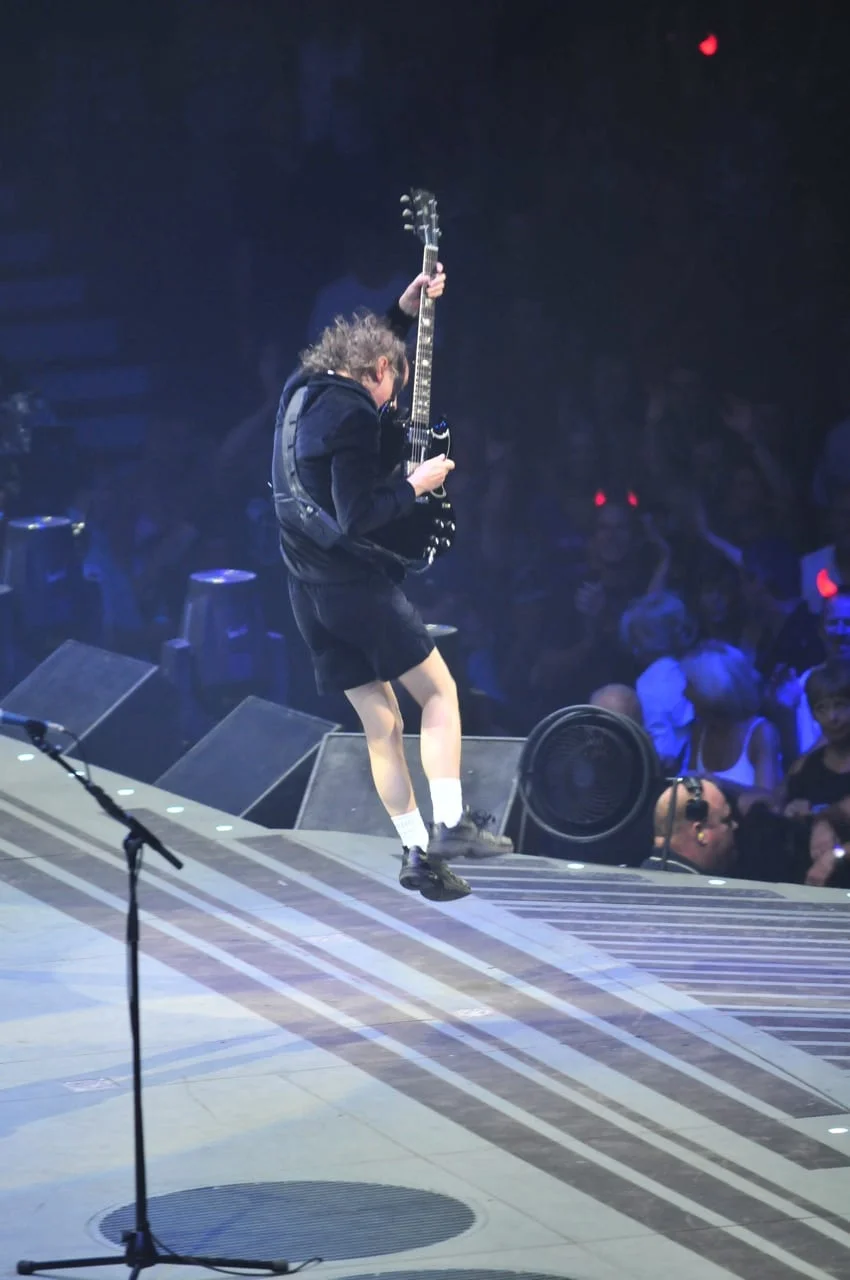
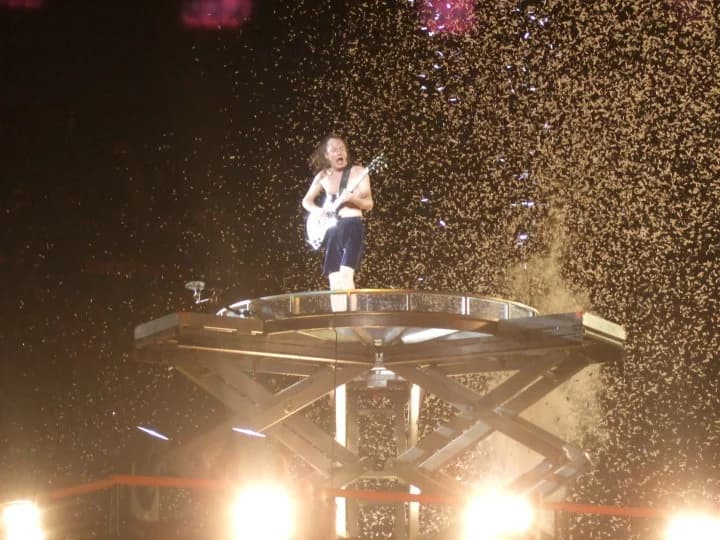
The duckwalk, the stage runs and the exaggerated movements are not just visual spectacle. They reinforce the music’s urgency. Angus plays as if his whole body is marking time, which helps explain why his live solos sound so intense even when they are built from simple language.
Essential Songs
Curiosities
The schoolboy outfit was not just a costume. It created the perfect contrast between youthful appearance and devastating volume, making Angus visually recognizable even to people who do not play guitar.
Angus favored the SG because it was light, comfortable and aggressive. Its thin body allowed extreme mobility onstage, while the humbuckers delivered the attack needed to cut through a wall of Marshall amplifiers.
Much of Angus’s tone comes from the interaction between guitar, amplifier and picking. He is a classic example of a guitarist whose sound depends less on pedals and more on dynamics, volume and consistency.
The duckwalk immortalized by Chuck Berry became part of Angus’s stage vocabulary. The gesture reinforces the direct connection between AC/DC and rock and roll’s most physical tradition.
After Bon Scott’s death, AC/DC could have ended. Instead, Angus, Malcolm and the band recorded an album that became a symbol of mourning, resilience and rebirth within hard rock.
Across the decades, lineups changed, members left and others returned. Angus remained the constant presence that preserves the group’s sonic and visual identity.
Legacy and Influence
Angus Young’s legacy does not rest on harmonic complexity, extreme speed or constant reinvention. It rests on something harder to copy: the ability to make the basics sound definitive. His riffs feel inevitable, as if they had always existed. That is one of the greatest achievements any rock guitarist can claim.
Angus influenced generations of musicians who learned through AC/DC that heaviness does not necessarily depend on excess. Hard rock, heavy metal, punk and arena rock bands absorbed his lesson: a strong riff, played with precision and conviction, can move an entire crowd. His style remains a reference for guitarists who value organic tone, stage presence and a direct connection to the blues.
His partnership with Malcolm Young is also essential. AC/DC’s sound was never only Angus’s lead guitar; it was the friction between two guitars. Malcolm built an almost architectural rhythmic foundation, while Angus filled the spaces with solos, replies and explosions. That relationship defined one of the greatest two-guitar models in rock history.
For guitar students, Angus Young is a permanent lesson in focus. He shows that you do not need to master everything to have your own voice. You need to deeply master what matters to the music. In his case, that means riff, time, attack, vibrato, tone and presence. Few guitarists have done so much with a formula that appears so simple. And few have proved so powerfully that rock and roll can still be pure electricity.