Basic Facts
| Field | Information |
|---|---|
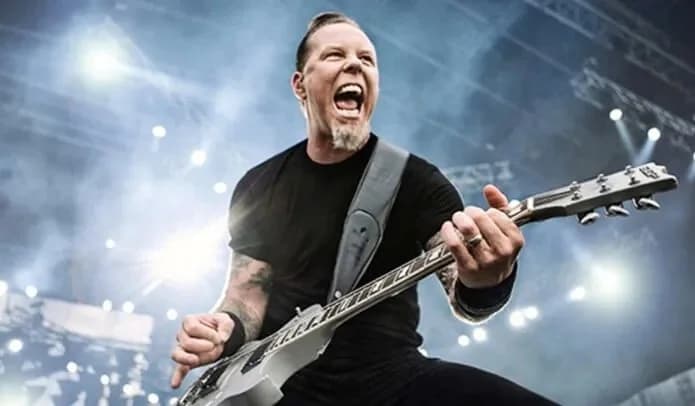
| Full name | James Alan Hetfield |
| Born | August 3, 1963 |
| Birthplace | Downey, California, United States |
| Nationality | American |
| Instruments | Guitar, vocals |
| Main band | Metallica |
| Active years | 1978–present |
| Genres | Thrash metal, heavy metal, hard rock, speed metal |
| Musical role | Vocalist, rhythm guitarist, songwriter and co-founder |
| Nicknames | Papa Het |
Introduction
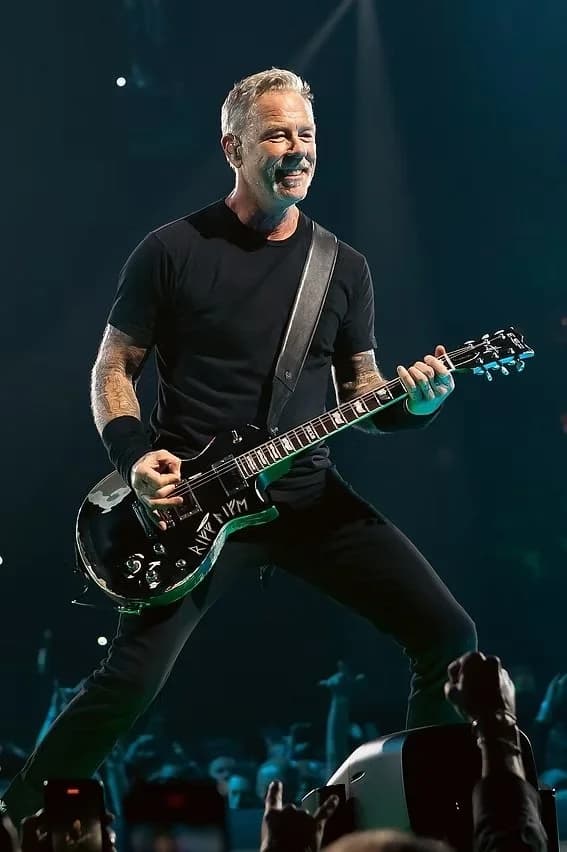
James Hetfield is one of metal's defining figures not simply because he sings in Metallica, but because he turned rhythm guitar into a lead force. His right hand, attack and ability to compress tension, weight and melody into direct riffs gave Metallica an identity that can be recognized within seconds. At his best, Hetfield sounds like a human engine: steady, aggressive, precise and emotionally exposed.
What makes his style endure is the union of discipline and instinct. He is not remembered as a guitarist of decorative excess, but as a riff architect who knows exactly where a song is going. In "Master of Puppets", "Battery", "One" and "Enter Sandman", the guitar does not merely support the song: it builds the whole structure. Every rest, muted stroke, accent and dynamic shift has dramatic purpose.
As a vocalist, Hetfield also created a signature of his own. His voice evolved from the raw urgency of the early records into a deeper, more controlled and theatrical instrument, able to cut through heavy guitars without losing clarity. As a lyricist, he has written about control, fear, religion, war, addiction, family, anger and survival — themes that gave Metallica an emotional depth far beyond the stereotype of aggressive metal.
Early Years
James Alan Hetfield was born in Downey, California, on August 3, 1963. His musical training began before the guitar: as a child he took piano lessons, later played his half-brother's drums and eventually found the guitar as a teenager. That early contact with rhythm instruments helps explain why his approach to guitar became so percussive, physical and driven by accent.
Hetfield's childhood was marked by family and religious tensions that would later surface in his lyrics. The death of his mother, Cynthia, while he was still a teenager left a deep mark and reappeared in songs such as "The God That Failed". Before Metallica, he played in bands including Obsession and Leather Charm, experiences that brought him closer to the Los Angeles hard rock and heavy metal scene.
The turning point came in 1981, when Hetfield answered Lars Ulrich's advertisement in The Recycler. The chemistry between the Danish drummer and the American guitarist led to Metallica, a band that was initially still searching for its lineup, sound and identity. With Ron McGovney on bass and Dave Mustaine on lead guitar in the earliest period, the group began to accelerate traditional heavy metal, absorbing the New Wave of British Heavy Metal and punk urgency.
Musical Influences
Hetfield has identified Aerosmith as a decisive childhood influence. Their mix of riffs, stage attitude and direct rock songwriting helped spark his desire to play guitar and form a heavy rock band.
Tony Iommi's dark heaviness and monumental riff construction are part of Metallica's DNA. Hetfield pushed that logic forward with more speed, precision and rhythmic aggression.
Diamond Head was a structural reference for young Metallica: long riffs, section changes, British energy and epic scope. Metallica's later covers make that admiration explicit.
Motörhead's dirty speed, frontal attack and uncompromising stance helped create the bridge between punk, rock and roll and extreme metal that Metallica explored in its first records.
Judas Priest's precise rhythm work, twin-guitar aesthetic and sharp metal language contributed to the vocabulary Hetfield transformed into drier, more muted and violently synchronized riffs.
Bands and Projects
Before Metallica, Hetfield played in teenage bands such as Obsession and Leather Charm. Those projects leaned toward hard rock and traditional metal, but did not yet reveal the full identity that would emerge when he met Lars Ulrich. In Leather Charm, some songwriting and performance experience helped prepare the transition toward a faster, drier and more aggressive sound.
With Metallica, Hetfield became one of the pillars of thrash metal. The debut album, "Kill 'Em All", introduced a fast, raw and explosive band. "Ride the Lightning" expanded the harmonic and dramatic range. "Master of Puppets" consolidated a monumental form of writing, where intricate riffs function like movements in a heavy cinematic piece. On "...And Justice for All", the architecture became even more angular and progressive.
The commercial breakthrough came with "Metallica", widely known as the Black Album, in 1991. Hetfield preserved the heaviness but refined the writing into more direct structures and massive choruses. Later came aesthetic expansion on "Load" and "Reload", a raw and controversial approach on "St. Anger", the return to thrash vocabulary on "Death Magnetic", the modern synthesis of "Hardwired... to Self-Destruct" and the heavy reflection of "72 Seasons".
Outside the studio discography, Hetfield appears in documentaries and projects tied to Metallica's history, including "Some Kind of Monster", which exposed the band's internal conflicts, and initiatives such as All Within My Hands, Metallica's foundation. Although his work is almost entirely tied to the band, his musical personality is so strong that many Metallica riffs are instantly perceived as Hetfield language.
Instruments and Gear
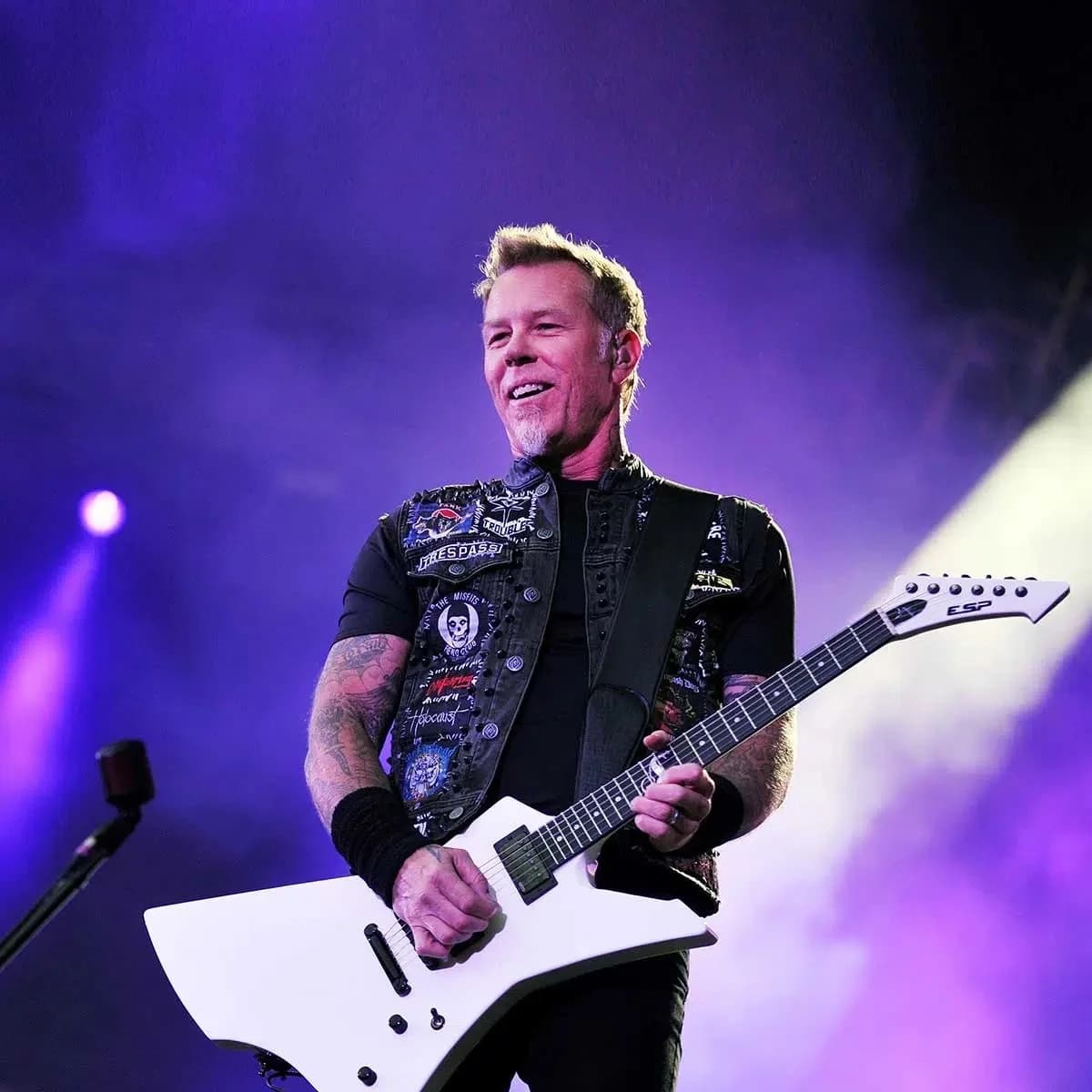
James Hetfield's sound came from a combination of hard-attacking guitars, active pickups, high-gain amplifiers and an exceptionally controlled right hand. In the early years, he was associated with Flying V and Explorer-style guitars, including the famous Electra OGV and white Explorers that became part of Metallica iconography. Over time, his relationship with ESP became one of the most important partnerships between a guitarist and a manufacturer in metal.
Main Techniques
The technique most associated with Hetfield is extreme downpicking: rapid, consistent downward strokes. On "Master of Puppets" and "Creeping Death", this approach gives the riffs a marching authority that alternate picking rarely reproduces in the same way.
Hetfield uses right-hand muting as a compositional element. Palm muting is not only about reducing sustain; it creates pulse, tension and contrast. On "Battery" and "Disposable Heroes", the riffs feel like controlled blows, alternating between open notes and muted attacks.
Many Hetfield riffs seem simple until they are played with the right timing. He explores off-center accents, short rests and entrances that converse directly with Lars Ulrich's drums. "Sad But True" is an example of heaviness built more through space and accent than speed.
Singing while playing complex riffs is one of Hetfield's most impressive trademarks. The rhythmic independence required to perform parts such as "Blackened" or "Master of Puppets" while singing demands deep internalization of groove and structure.
Hetfield knows how to make a riff evolve inside a song. He alternates clean introductions, muted passages, open explosions and tempo shifts to create narrative. "One" demonstrates this ability by moving from dark arpeggios to a machine-gun rhythmic finale.
Essential Songs
Curiosities
Among metal guitarists, speaking of "Hetfield's right hand" has almost become a technical category. The fascination is not only speed, but the regularity of the attack, the cleanliness of the muting and the way each stroke seems to push the whole band forward.
Before becoming a symbol of heavy rhythm guitar, Hetfield began with piano lessons. That early foundation does not appear as classical virtuosity, but it helps explain his view of music as structure, repetition and harmonic tension.
Hetfield became one of the most important names in ESP history. Signature models such as the Truckster, Iron Cross, Snakebyte and Vulture represent different visual and sonic phases of his career.
In "Messengers: The Guitars of James Hetfield", Hetfield himself presents instruments from his collection, telling the stories and meanings behind guitars that accompanied his life and career.
During a joint show with Guns N' Roses in Montreal, Hetfield suffered burns in a pyrotechnic accident. The episode became one of the most remembered live moments in Metallica history.
On the first records, Hetfield sang with youthful urgency and rawness. From the Black Album onward, his expressive range grew: the voice became deeper, more controlled and more narrative, matching increasingly personal lyrics.
Legacy and Influence
James Hetfield's legacy sits at the center of modern heavy guitar. Before him, rhythm guitar was already essential in rock and metal; after him, it was also measured by the ability to sustain an entire song with precision, weight and identity. Hetfield helped establish the idea that the riff can be the absolute protagonist: not merely a base for the solo, but the element that defines narrative, atmosphere and physical impact.
His influence appears across generations of thrash, groove metal, alternative metal, metalcore and heavy hard rock bands. Guitarists learned from him that playing hard does not mean playing messy, that speed needs articulation and that simplicity can be devastating when the accent is in the right place. The Hetfield school is a school of discipline: firm right hand, controlled tone, memorable riffs and respect for the space between notes.
As a songwriter, he also helped Metallica cross borders. Few bands have moved from the extreme underground to global mainstream status while keeping a catalog respected by technical musicians. Hetfield was crucial in that transition because he always wrote from the riff, but never only for guitar players. His best songs work both as metal studies and as complete songs.
More than four decades after Metallica's formation, James Hetfield remains a symbol of creative endurance. His work proves that rhythm guitar can be brutal and sophisticated, simple and complex, physical and emotional. For anyone interested in heavy rock, understanding Hetfield means understanding a fundamental part of metal grammar.