
Basic Facts
| Field | Information |
|---|---|
| Full name | Robert Leroy Johnson |
| Stage name | Robert Johnson |
| Date of birth | May 8, 1911, generally accepted date |
| Date of death | August 16, 1938 |
| Birthplace | Hazlehurst, Mississippi, USA |
| Nationality | American |
| Genres | Delta Blues, Country Blues, Acoustic Blues |
| Instrument | Guitar, voice |
| Nicknames | King of the Delta Blues Singers, The Crossroads Bluesman |
Introduction
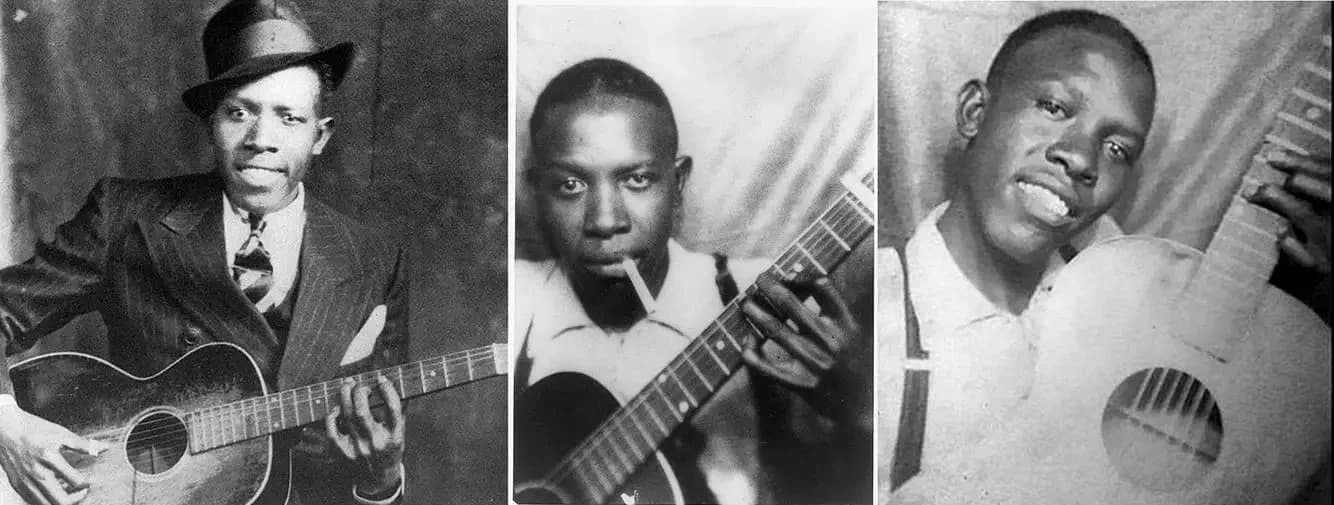
Few artists in guitar history carry as much symbolic weight as Robert Johnson. He lived briefly, recorded little, and left very few visual records. Even so, his work became a foundation stone for modern blues, rock, and the romantic idea of the traveling musician who turns suffering, desire, and mystery into sound.
Robert Johnson was not only a character surrounded by legend. Before the crossroads myth, before the stories about a deal with the devil, and before his image became a pop icon, there was a real musician: a singer with a sharp and expressive voice, a technically sophisticated guitarist, a songwriter alert to the record market of his time, and an artist capable of compressing drama, groove, and storytelling into songs under three minutes long.
For guitar players, studying Robert Johnson is almost mandatory. He teaches how to create motion with alternating bass, how to make one acoustic guitar sound larger than it is, how to use slide in a vocal way, how to build phrases with tension and response, and above all how to turn technique into atmosphere. His music does not merely sound played: it seems to haunt the space around it.
Early Years
Robert Leroy Johnson was born in Mississippi, in the heart of a region where rural blues took shape through agricultural labor, churches, parties, travel, racial violence, and oral tradition. His youth was marked by family changes, poverty, and movement between small Delta communities. That environment explains part of the force of his music: it did not come from a conservatory, but from roads, observation, survival, and direct contact with popular musicians.
At first, Johnson was not seen as a prodigy. Accounts from older musicians such as Son House describe a young man still immature on the instrument. The story that fed the myth grew from that gap: he supposedly disappeared for a period and returned playing much better. Popular imagination turned that technical leap into a supernatural pact. The musical reading is more concrete: Johnson most likely studied intensely, absorbed repertoire from several musicians, learned to accompany singers, dancers, and noisy audiences, and developed an extremely functional way to perform alone.
His life was that of an itinerant musician. He played in juke joints, parties, street corners, informal gatherings, and small events. That routine required versatility. Robert Johnson had to play blues, popular songs, dance numbers, and anything that could hold an audience's attention. That is why, although he is now remembered as a symbol of Delta blues, his vocabulary was wider than the stereotype of the haunted bluesman suggests.
Musical Influences
One of the essential Delta blues references. His vocal intensity, dramatic slide work, and almost spiritual approach to the blues helped shape the musical world in which Robert Johnson developed.
A central figure in Mississippi blues, Patton influenced generations through stage presence, aggressive rhythm, broad repertoire, and a percussive way of playing guitar. His music reveals the raw, physical side of Delta blues.
Often cited by oral tradition as Johnson's mentor during his period of technical growth. The Zimmerman connection helps explain Robert's leap from promising musician to guitarist with a highly refined language.
The modal sound, open tunings, and dark atmosphere of Skip James help explain part of the psychological mood present in recordings such as “Hellhound on My Trail” and “Come On in My Kitchen”.
An urban blues singer and pianist whose melodic and lyrical sophistication echoes in songs such as “Kind Hearted Woman Blues”. Johnson was not only a rural bluesman: he also absorbed urban blues and popular songwriting of the period.
An elegant and advanced guitarist, important for showing how blues could connect with jazz, melody, and more refined lines. The clarity of Robert Johnson's phrasing speaks to that more sophisticated school.
Robert Johnson was an artist of synthesis. He combined the raw weight of the Delta, the melodic sense of urban blues, the rhythmic drive of popular dances, and rare compositional intelligence. The magic lies in how those influences appear compressed into short recordings, with voice and guitar occupying every space.
Career and Recordings
Robert Johnson's recording career is small in quantity and enormous in impact. Between 1936 and 1937, he recorded 29 songs, with several alternate takes, in sessions held in San Antonio and Dallas, Texas. That body of work became the basis of his legend and, decades later, would be gathered in compilations that changed how rock, blues, and folk musicians heard acoustic guitar.
The San Antonio recordings, made in November 1936, included songs such as “Kind Hearted Woman Blues,” “I Believe I'll Dust My Broom,” “Sweet Home Chicago,” and “Cross Road Blues.” The Dallas sessions, in June 1937, revealed some of his darkest and most mature performances, including “Hellhound on My Trail,” “Love in Vain,” and “Me and the Devil Blues.”
The striking detail is that these songs were captured under simple conditions, far from the modern logic of studio production. There were no layers of production, endless corrections, or sophisticated equipment. It was performance almost bare: voice, guitar, room, and intention. For that reason, the rough edges, noise, and variations became part of the magic. The listener feels a presence, not a polished product.
Instruments and Gear
For anyone trying to approach Robert Johnson's world today, the path does not run through expensive pedals. A comfortable steel-string acoustic, proper setup, a slide, open-tuning study, and right-hand control will bring you much closer to the right spirit than sophisticated equipment.
Core Techniques
One of Robert Johnson's most important traits is his ability to create the impression of two instruments at once. The thumb keeps a steady bass line while the fingers or pick articulate chords, responses, and phrases in the upper register. This is essential to understanding why his recordings sound so complete with only voice and guitar.
Johnson used the slide as if he were extending the voice. Notes glide, rise, fall, and seem to carry human tension. To study this resource, the guitarist should think less about speed and more about intonation, pressure, vibrato, and intention.
Open tunings allow full chords with barres, drones, and simple slide movements. They also help create that old, deep, slightly unstable sound we associate with Delta blues.
Johnson's music talks to itself. He sings a line and the guitar answers; he plays an idea and the voice seems to complete the thought. This question-and-answer logic is one of the foundations of the blues and remains essential for any guitarist who wants to solo musically.
Johnson does not play like a rigid metronome. He pushes, holds back, drives, and delays phrases according to the emotion of the lyric. This flexible time is hard to imitate because it depends on inner listening, not just counting.
The songs had to fit the limit of a 78-rpm record, yet they seem to tell entire worlds. Johnson mastered the art of entering the conflict immediately, repeating strong images, and ending before the tension fades.
Essential Songs
Curiosities
The legend says Robert Johnson sold his soul to the devil in exchange for talent. The story is powerful, but it should not erase the real musician: a disciplined, observant artist deeply connected to the repertoire of his time.
The official discography is small, but nearly every track became an object of study. Few musicians have created such lasting impact with such a limited catalog.
Johnson died in 1938 at age 27. Decades later, that coincidence helped connect him symbolically to the so-called “27 Club,” although his story belongs to a much earlier context than rock.
During his lifetime, Johnson's circulation was limited. His explosion of influence came mainly through later reissues, when blues, folk, and rock musicians discovered his recordings.
Eric Clapton, Keith Richards, Jimmy Page, and other British musicians treated Johnson as an essential reference. That introduced his work to a generation that might never have found the original records.
There are theories involving poisoning, disease, and health complications, but the records are incomplete. As with almost everything in Johnson's life, historical fact and oral tradition overlap.
Legacy and Influence
Robert Johnson is a rare case: an artist who did not leave a large body of work, did not live to become a celebrity, and still ended up shaping the imagination of modern guitar. His impact is not only in the songs people covered, but in the idea that one musician alone, with voice and guitar, can sound complete, threatening, elegant, and deeply human.
His legacy runs through Muddy Waters, Elmore James, Howlin' Wolf, B.B. King, Eric Clapton, Keith Richards, Jimmy Page, Bob Dylan, the Rolling Stones, Led Zeppelin, and countless artists who saw him as a primary source. “Sweet Home Chicago,” “Cross Road Blues,” “Love in Vain,” and “Dust My Broom” are not just old songs: they are language templates.
For beginner guitarists, Robert Johnson teaches a decisive lesson: technique is not separate from storytelling. Alternating bass, slide, open tunings, and elastic rhythm only work because they serve a story. Learning Robert Johnson means learning that the blues does not live in the number of notes, but in the way each note seems to carry an entire life.