Basic Facts
| Field | Information |
|---|---|
| Full name | Kirk Lee Hammett |
| Born | November 18, 1962 |
| Birthplace | San Francisco, California, United States |
| Nationality | American |
| Main instrument | Electric guitar |
| Main genres | Thrash metal, heavy metal, hard rock |
| Years active | 1979–present |
| Main bands | Exodus, Metallica |
| Solo project | Portals |
| Nicknames | The Ripper, wah-wah master |

Introduction
What makes Hammett special is not only speed. His style is born from a very particular blend: blues and hard-rock pentatonics, minor scales, modal phrasing, dramatic bends, nervous vibrato, intense wah-wah and a sense of climax that works perfectly in large arenas. Rather than sounding like a technician isolated from the music, Kirk tends to build solos that work like characters within the narrative: the lament of "Fade to Black," the fire of "Creeping Death," the despair of "One" and the almost vocal hook of "Enter Sandman."
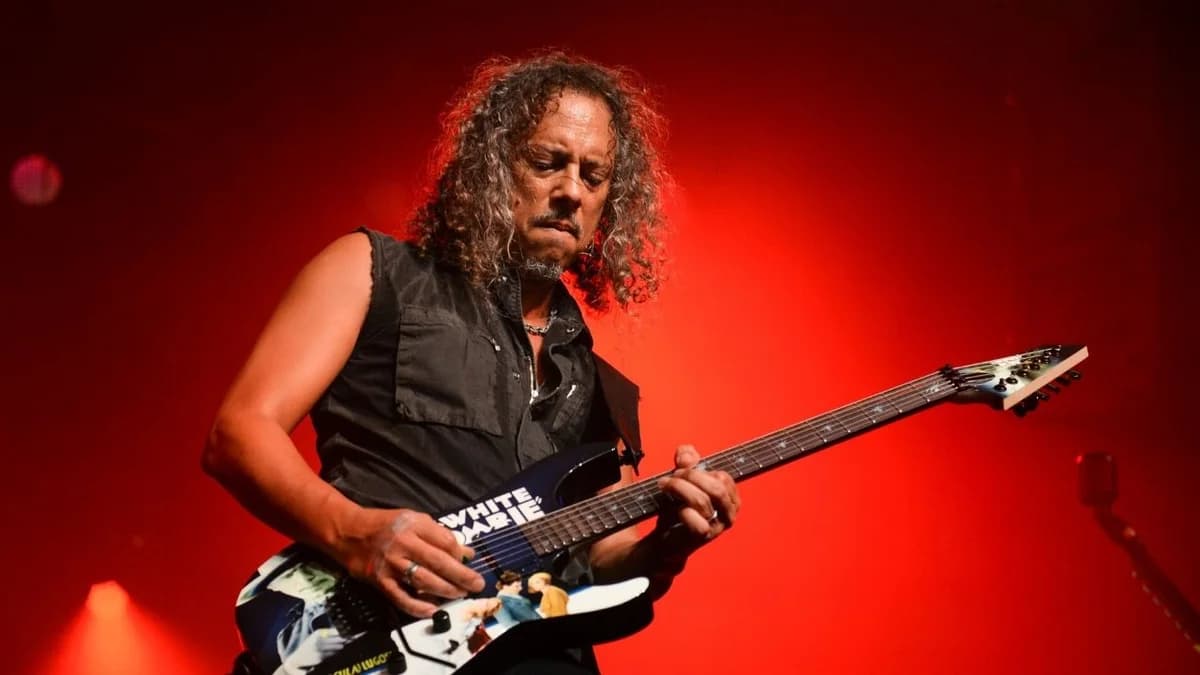
Over the decades, he has also become a visual and cultural icon: ESP guitars with skulls, classic movie monsters, a picking hand protected by tape, and a passion for horror, surf and historic instruments. Hammett is, at the same time, an extreme-metal guitarist, an obsessive collector and a musician who found in the electric guitar a bridge between fear, energy and dark beauty.
First Steps
Kirk was born in San Francisco and grew up in the Bay Area, the setting that would become essential to the rise of American thrash metal. Before the guitar, his imagination was already fed by horror films, comic books and objects tied to macabre pop culture. That fascination would never be separate from his music: years later, monsters, posters and horror imagery would appear on his guitars, in his books and in his artistic identity.
His first major musical contact came through his older brother's record collection, with names like Jimi Hendrix, Led Zeppelin, UFO, Black Sabbath and other pillars of heavy rock. Hammett started playing guitar as a teenager and quickly understood that the instrument could unite aggression, drama and improvisation. While still young, he helped form Exodus, a crucial band of the early Bay Area thrash scene.
His life changed in April 1983, when he received the invitation to join Metallica. The band had just fired Dave Mustaine and needed a guitarist capable of recording, touring and sustaining the technical brutality of the repertoire. Kirk flew to New York, auditioned and was brought in almost immediately. From then on, his path became tied to the rise of one of the most important bands in the history of heavy metal.
Musical Influences
Hendrix sits at the base of Hammett's expressive vocabulary: long bends, tones in combustion, dramatic use of effects and the idea that the guitar can sound almost like a living entity. Even within thrash, Kirk preserved that impulse to make the solo sing, scream and warp.
Schenker was a direct reference for the melodic construction of many 1980s metal guitarists. In Hammett, that influence appears in leads with a sense of arc, in minor phrases with European tension and in the search for solos that are memorable, not just fast.
Iommi's shadow lives in the weight, the dark atmosphere and the fascination with riffs that sound threatening. Although Hammett is more associated with solos, his taste for dark intervals and horror-like moods speaks directly to the tradition founded by Black Sabbath.
Hammett studied with Joe Satriani before Metallica's global explosion. The influence appears in his technical organization, his control of scales, his legato fluency and his awareness that speed must serve the musical phrase.
Blackmore helped consolidate the idea of the hard-rock guitarist as a dramatic soloist, with classically inspired phrases and ferocious attitude. In Kirk, that spirit appears in the moments when the solo grows like a theatrical piece within the song.
Bands and Projects
Hammett's first relevant phase was with Exodus, the group that helped define the language of Bay Area thrash metal even before the genre gained international reach. Exodus was the laboratory where Kirk developed stamina, rhythmic aggression and familiarity with a scene that valued speed, live energy and cutting riffs.
Instruments and Gear
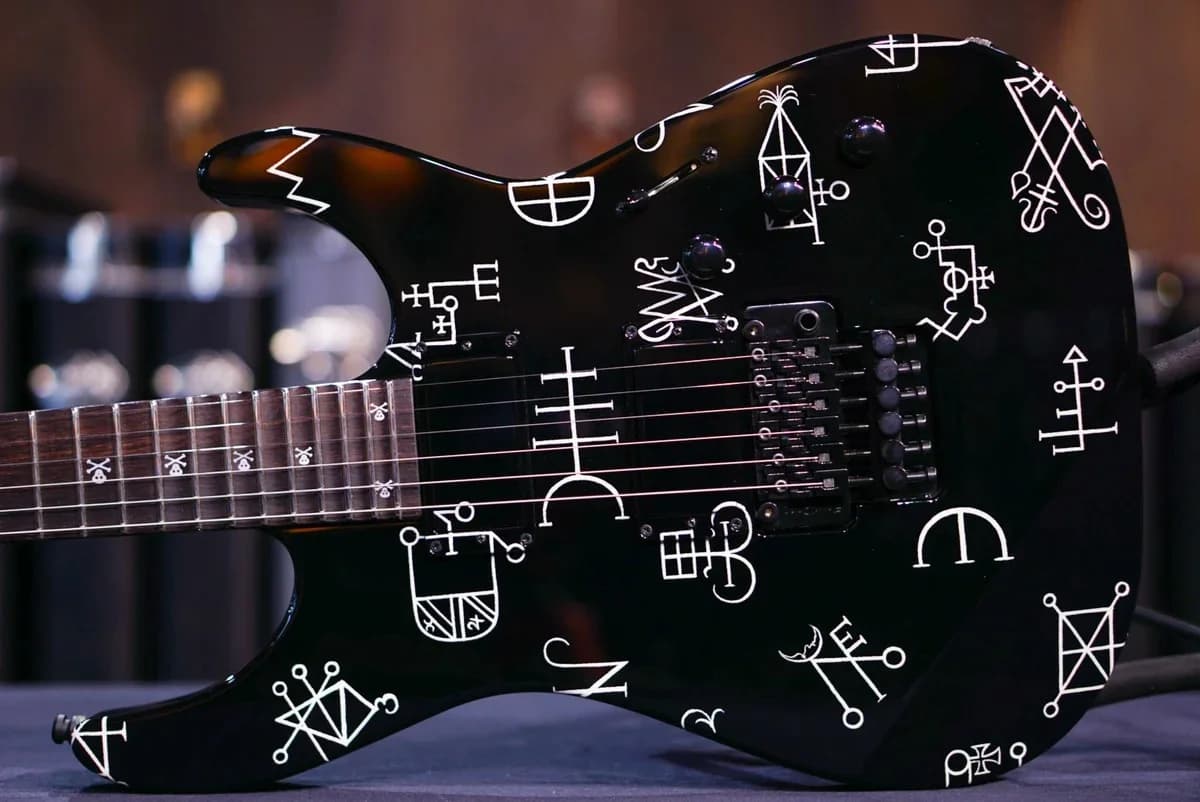
Kirk Hammett is one of the guitarists most closely associated with ESP. His signature guitars, especially the KH lineage, translate much of his aesthetic: an aggressive body, a fast neck, Floyd Rose, active EMG pickups and the famous "skull and bones" fingerboard markers. At the same time, his collection includes historic instruments, like the legendary 1959 Gibson Les Paul Standard "Greeny," previously owned by Peter Green and Gary Moore.
Core Techniques
The wah-wah is practically a signature for Kirk Hammett. He uses it to turn bends and pentatonic licks into vocal phrases, with a sense of call and response. On songs like "Enter Sandman" and "Wherever I May Roam," the pedal is not just an effect: it shapes the articulation of the solo.
Within thrash metal, picking precision is essential. Kirk combines alternate picking with minor and pentatonic scales to create fast passages that cut through Metallica's wall of rhythm. This resource appears strongly in "Master of Puppets," "Battery" and "Damage, Inc."
His training with Joe Satriani helped Hammett develop fluidity. Hammer-ons, pull-offs and connected sequences appear in solos where speed needs to sound continuous, not mechanical. This technique lets him alternate aggressive attacks with more liquid lines.
Kirk often uses long bends as climax points. His vibrato is fast, intense and emotional, creating a recognizable signature even in just a few seconds. "Fade to Black" is one of the best examples of his ability to turn a sustained note into narrative tension.
Although he is remembered for his solos, Hammett also masters the rhythmic language of thrash. Palm muting helps create weight, control and definition in fast passages. The tape on his right hand became a recurring image precisely because of the abrasion caused by intense picking on long tours.
Essential Songs
Curiosities
Before becoming world famous, Kirk took lessons with Joe Satriani. That training helped structure his technique and his understanding of scales, even though his final style remained deeply tied to metal and the blues.
The 1959 Les Paul known as "Greeny" belonged to Peter Green, then Gary Moore and, currently, Kirk Hammett. Few instruments carry such a symbolic lineage within the history of the electric guitar.
The tape used on his picking hand helps protect the skin during long shows, intense palm muting and constant contact with the strings. Over time, it became a recognizable part of his live image.
Legacy and Influence
Kirk Hammett's legacy lies in having carried the lead guitar of thrash metal to a popular scale without completely diluting its essence. In a band dominated by monumental riffs, aggressive drumming and dense arrangements, he created spaces for melody, panic and catharsis. His solos helped millions of listeners realize that extreme metal could be as memorable as it was violent.
His influence appears in guitarists who associate metal with wah-wah, accelerated pentatonics, high-gain tones and ESP guitars with a dark look. More than a "shredder," Hammett became an archetype: the soloist who steps into the middle of the storm to give the chaos a voice. He is remembered not just for fast notes, but for phrases that became part of the collective memory of heavy metal.
Alongside Metallica, Kirk went through phases of underground, global acclaim, experimentation, criticism and renewal. His sound remains immediately identifiable, and that may be the greatest possible compliment to a guitarist: a few bends, a wah opening the frequency and a sustained note are enough for the listener to know who is playing.