Basic Facts
| Field | Information |
|---|---|
| Full name | Saul Hudson |
| Nickname | Slash |
| Date of birth | July 23, 1965 |
| Birthplace | Stoke-on-Trent, England |
| Nationality | British-American |
| Genres | Hard Rock, Heavy Metal, Blues Rock |
| Instrument | Electric guitar |
| Years active | 1979 – present |
Introduction
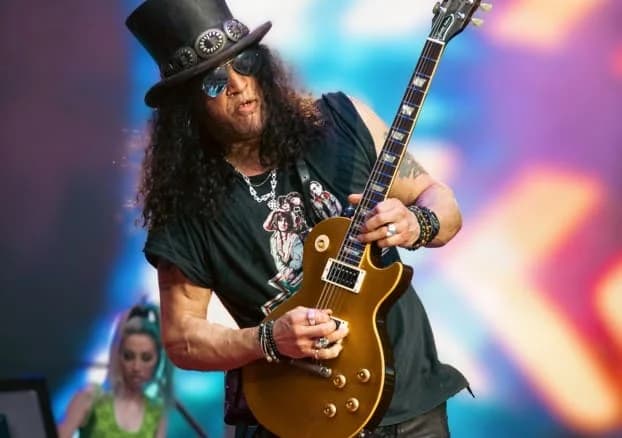
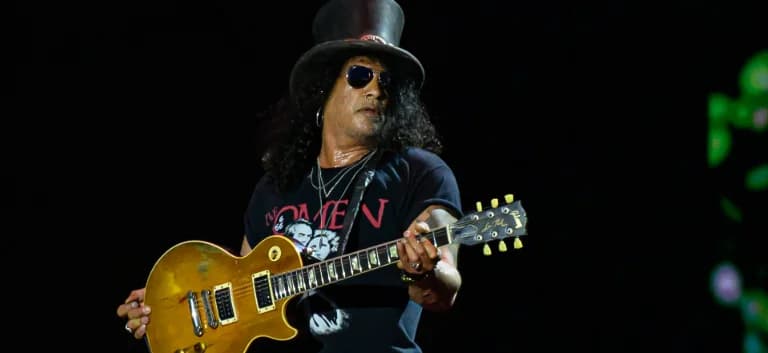
There is a type of guitarist you recognize before you even hear a note. Slash's silhouette — the top hat, the wild black curls, the cigarette dangling from his lips, the ever-present Les Paul — is one of the most iconic images in rock. But the image would be nothing without the sound that comes with it.
Born Saul Hudson in Stoke-on-Trent, England, and raised in Los Angeles, Slash became the symbol of everything hard rock in the 1980s promised and, for one glorious period, delivered. Four decades later, he's still there — top hat in place, Les Paul in hand, playing like his life depends on it.
Early Steps
Slash's childhood in Los Angeles was eclectic. His mother, Ola Hudson, was a costume designer for celebrities; his father, Anthony Hudson, designed album covers. The Hudson home attracted artists, musicians, and creators. David Bowie was a frequent guest. It's a background that explains a lot about how naturally Slash embraced life in rock.
By 15, Slash was playing in local Hollywood bands. It was in this circuit that he crossed paths with Axl Rose and Steven Adler, and the embryo of Guns N' Roses began to take shape.
Musical Influences
The reference Slash always cites as his biggest. Taylor had a fluid blues style, round-toned and vocal in its phrasing, which Slash absorbed directly. It's from Taylor that Slash's guitar gets its sense of breathing.
The ferocity and drama. Page showed that the guitar could be simultaneously primitive and cinematic. The Slash of the big solos owes much to Page.
The swagger of American rock. Perry taught Slash that rock can be dirty and elegant at the same time.
Economy of notes; the idea that each note carries weight. Clapton is the reason Slash never plays more than necessary.
Freedom. Hendrix proved the guitar has no limits and that technique serves expression, never the other way around.
Vibrato control and the ability to make the guitar sound like the human voice.
Bands and Projects
| Band / Project | Period | Notable Albums |
|---|---|---|
| Guns N' Roses | 1985–1996 | Appetite for Destruction (1987), Use Your Illusion I & II (1991) |
| Slash's Snakepit | 1994–1995, 2000–2002 | It's Five O'Clock Somewhere (1995), Ain't Life Grand (2000) |
| Velvet Revolver | 2002–2008 | Contraband (2004), Libertad (2007) |
| Slash (solo) | 2010–present | Slash (2010), Apocalyptic Love (2012), World on Fire (2014), Living the Dream (2018), 4 (2022), Orgy of the Damned (2024) |
| Guns N' Roses (reunion) | 2016–present | Hard Skool EP (2021) |
Instruments and Gear
Core Techniques
Essential Songs
Trivia
In 1985, Slash walked past the window of Retail Slut on Melrose Avenue, Los Angeles, saw the top hat, and didn't have the money to pay for it. He took it anyway. The ornaments on the hat were cut from a concho belt he lifted from a different store. What became a rock icon started as an opportunistic theft.
Slash raised a domestic puma named Curtis and accumulated a snake collection that included an anaconda and a boa constrictor named Pandora. The snakes appeared in music videos and photoshoots until 2002, when the birth of his first son prompted Slash to rehome his collection.
In 2001, Slash was diagnosed with cardiomyopathy — congestive heart failure caused by years of alcohol and substance abuse. A doctor gave him between six days and six weeks to live. He survived through surgery, physical therapy, and the surgical implantation of a cardiac defibrillator.
It's Mick Taylor, the Rolling Stones' guitarist between 1969 and 1974. Slash frequently cites Taylor as the most direct influence on his tone and phrasing — a fact that surprises those expecting a hard rock name.
Slash was running the arpeggio pattern as a finger exercise with no intention of using it in a song. Axl Rose heard it, asked him to keep playing, and started singing over it. The world's number-one riff was born as a warm-up.
Legacy and Influence
Slash's impact extends beyond sales and awards. He arrived at a moment when hard rock was being swallowed by plastic glam metal and synth-pop, and brought back something that had seemed forgotten: the guitar as an instrument of raw emotion and attitude, rooted in the blues.
The Guns N' Roses reunion in 2016 — with Slash returning alongside Axl Rose after two decades of silence — was one of the most anticipated events in rock history. That arenas sold out instantly worldwide proves the appetite has never been destroyed by time.