
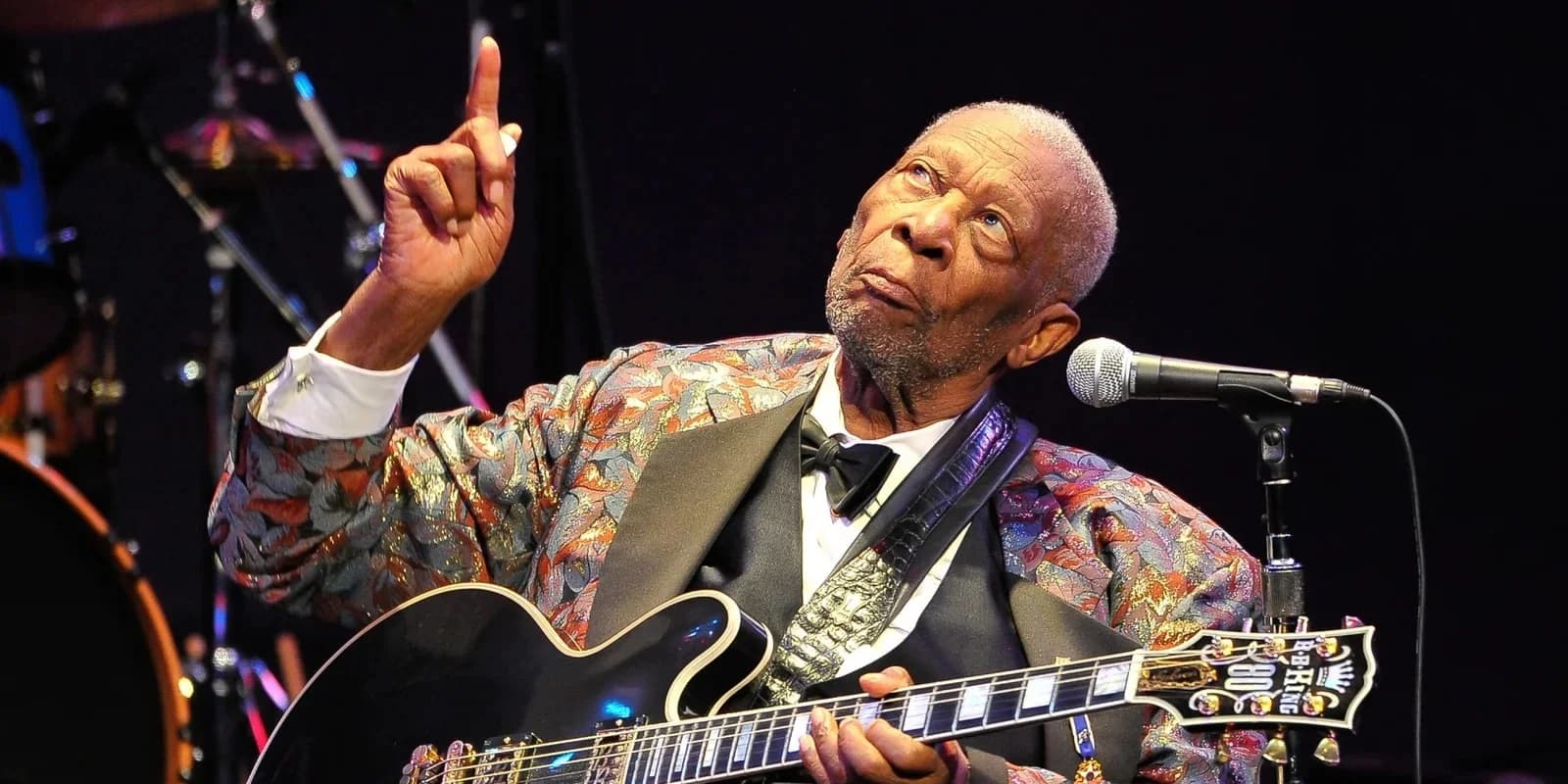
Basic Data
| Field | Information |
|---|---|
| Full name | Riley B. King |
| Stage name | B.B. King |
| Birth date | September 16, 1925 |
| Death date | May 14, 2015 |
| Birthplace | Itta Bena, Mississippi, USA |
| Nationality | American |
| Genres | Blues, Electric Blues, Rhythm and Blues, Soul Blues |
| Instrument | Guitar, vocals |
| Nicknames | B.B., The King of the Blues |
Introduction
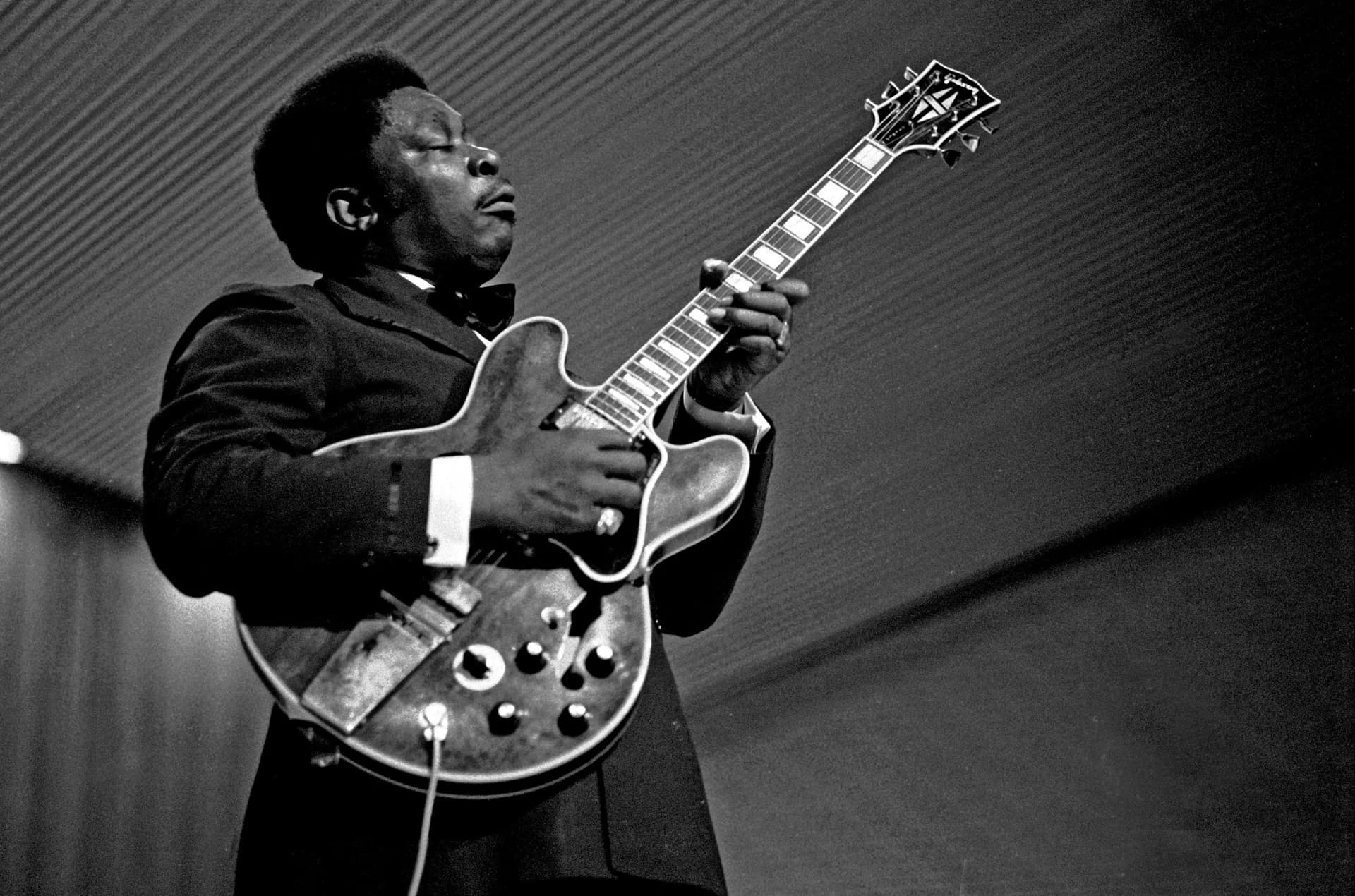
There is an invisible line separating great guitarists from the musicians who permanently reshape the instrument’s vocabulary. B.B. King lives on the rarer side of that line. He did not simply play the blues at the highest level; he redefined how electric guitar could speak. His wide vibrato, economical phrasing and the way he answered his own voice with Lucille created a language so powerful that it became foundational not only to blues, but to rock and modern guitar phrasing as a whole.
Across decades, B.B. King carried the blues from juke joints and the segregated southern circuit to theaters, international festivals, universities, prisons, historic clubs and major arena tours. When the blues needed an ambassador capable of crossing generations, racial barriers and commercial markets, he arrived in a sharp suit with a black Gibson on his lap and a smile that could disarm any room. The Rock & Roll Hall of Fame calling him the King of the Blues is not branding fluff; it is a concise statement of scale.
B.B. King proves a truth every serious guitarist eventually learns: sounding huge is not about playing more. It is about intention, dynamics, attack, silence and inner singing. Anyone trying to understand his style eventually arrives at the same lesson: make every note matter.
Early Steps
Riley B. King was born in the Mississippi Delta and grew up surrounded by hard work, church music, vocal tradition and hardship. Gospel, work songs and the emotional directness of the blues formed the soil of his musical identity long before the world knew his name.
His move to Memphis was the real launch point. The city offered radio, audiences and access to a broader musical network. At WDIA, a groundbreaking Black radio station, he found space as a singer, guitarist and on-air personality. It was there that “Beale Street Blues Boy” became “Blues Boy” and then simply B.B. King. The B.B. King Museum biography documents how central that radio era was to his rise.
His national breakthrough came with “Three O’Clock Blues,” the hit that pushed him beyond regional promise into the front rank of modern blues. By 1956 he was playing an astonishing 342 one-nighters in a single year. That roadwork explains why his timing, stagecraft and control seemed so natural: they were forged under real conditions, night after night.
Musical Influences
The decisive influence on B.B.’s shift toward elegant single-note lead guitar. From T-Bone came sophistication, articulation and the idea that blues guitar could lead without losing warmth.
King drew from Jefferson’s emotional gravity and the ability to make melody carry pain, memory and atmosphere all at once.
Part of B.B.’s refined melodic sense and jazz-adjacent phrasing can be traced to Lonnie Johnson’s cleaner, more lyrical school.
The precision of single-note lines and the singing quality of electric lead guitar placed Christian firmly in B.B.’s broader musical DNA.
One of B.B.’s deepest gifts was blending the emotional force of gospel with the directness of the blues. He famously said that when he sang, he played in his mind, and when he stopped singing, Lucille continued the song.
Bands and Projects
| Band / Project | Period | Notable Albums |
|---|---|---|
| B.B. King Review | 1950s–1970s | Live at the Regal (1965), Live in Cook County Jail (1971), Indianola Mississippi Seeds (1970) |
| B.B. King solo career | 1949–2015 | Singin' the Blues (1957), Completely Well (1969), Lucille (1968), Blues on the Bayou (1998) |
| B.B. King & Eric Clapton | 2000 | Riding with the King (2000) |
| Late-career collaborations | 1980s–2010s | There Must Be a Better World Somewhere (1981), Deuces Wild (1997), 80 (2005), One Kind Favor (2008) |
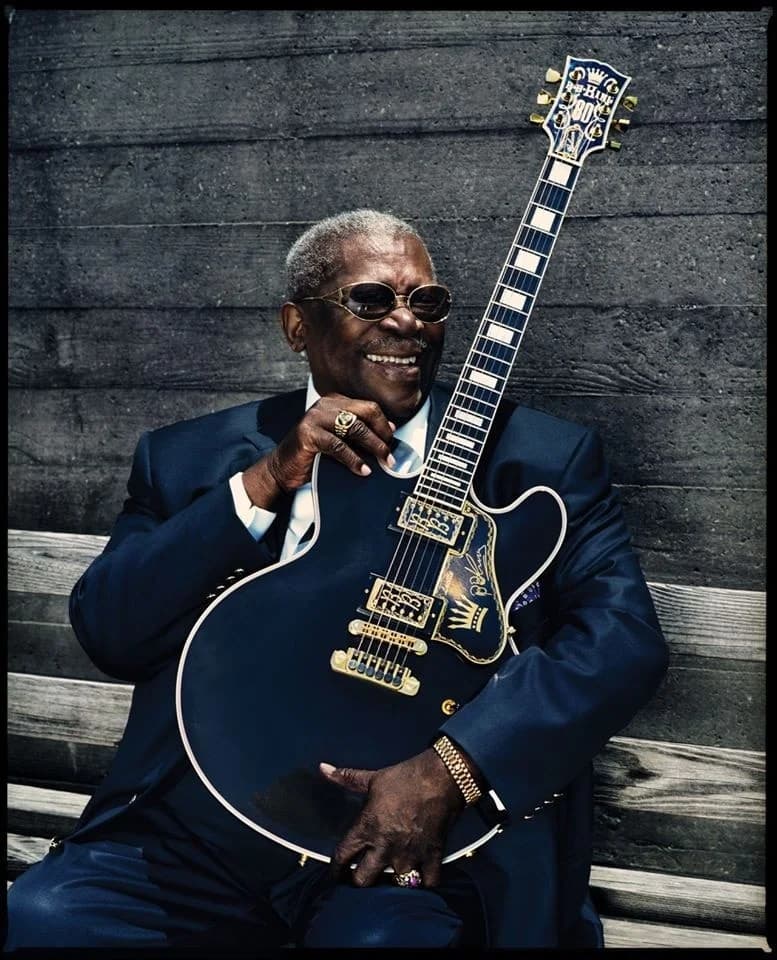
B.B. King did not build his legend around a single permanently branded band in the rock sense. His name was the banner, and the musicians around him changed across eras. What remained constant was the authority of the voice, the guitar and the show itself. The B.B. King Review was crucial in shaping the broad, road-tested sound that made him a giant on the Black touring circuit.
Instruments and Equipment
Lucille is the emotional and commercial centerpiece. The guitar’s name comes from the famous fire incident in Twist, Arkansas, when King ran back into a burning building to rescue his instrument. After learning the fight that started the fire involved a woman named Lucille, he gave that name to the guitar—and then to every guitar that followed.
Main Techniques
B.B. King's vibrato is one of the defining sounds of electric guitar. He did not simply shake a note; he made it breathe. The width, control and emotional timing of that vibrato are a major reason his playing remains instantly recognizable. The B.B. King Museum biography specifically highlights his vocal-like bends and left-hand vibrato as core parts of his style.
King was the enemy of excess. He chose fewer notes and gave each one melodic, rhythmic and emotional weight. That discipline is one of the biggest reasons his solos feel permanent rather than flashy.
One of his greatest gifts was the way he let the guitar answer the vocal line. He rarely interrupted a song with a solo; instead, Lucille completed the sentence after his voice stopped.
A large part of B.B.’s language comes from his fluid movement between major and minor pentatonic colors, with carefully placed blue notes. The result is deeply bluesy but never predictable.
Even with a full band, B.B. preserved note definition. His attack was firm but elegant, helping every phrase land with clarity rather than clutter.
Essential Songs
Trivia
B.B. came from “Beale Street Blues Boy,” shortened over time during his Memphis radio days at WDIA.
The name came after he ran back into a burning building to save his guitar and later learned the fight that caused the fire involved a woman named Lucille.
In 1956 alone, he played 342 one-night stands, a staggering number that helps explain his total command of the stage.
In 1969, the Rolling Stones selected him to open 18 American tour dates, helping expose him to a younger white rock audience.
Along with 15 competitive Grammys, he received the Recording Academy Lifetime Achievement Award in 1987.
From Clapton and Beck to Page and Harrison, his phrasing became part of rock guitar grammar itself.
Legacy and Influence
B.B. King is not merely one of blues guitar’s greatest masters; he is one of the architects of modern electric guitar phrasing. His influence can be heard in any player who values vocal expression over empty display. Eric Clapton, Jeff Beck, George Harrison, Jimmy Page, Gary Moore, Bonnie Raitt, Joe Bonamassa, Derek Trucks and many others drew directly from the way he made melody, timing and tone feel human.
His broader cultural legacy is just as significant. B.B. helped bring the blues to new audiences without stripping it of dignity or truth. He carried a Black American art form across decades of change and did so with elegance, generosity and immense authority. When the Rock & Roll Hall of Fame says he united people through music in a time of racial division, it is not institutional exaggeration—it is a fair summary of what he represented.
For guitarists, his legacy is almost a method. Technique is not contortion; it is emotional control. Tone is not gadget accumulation; it is the agreement between your hands, your ears and your intention. And a guitar can sing—if the player understands that the solo is simply the voice continuing by other means.