
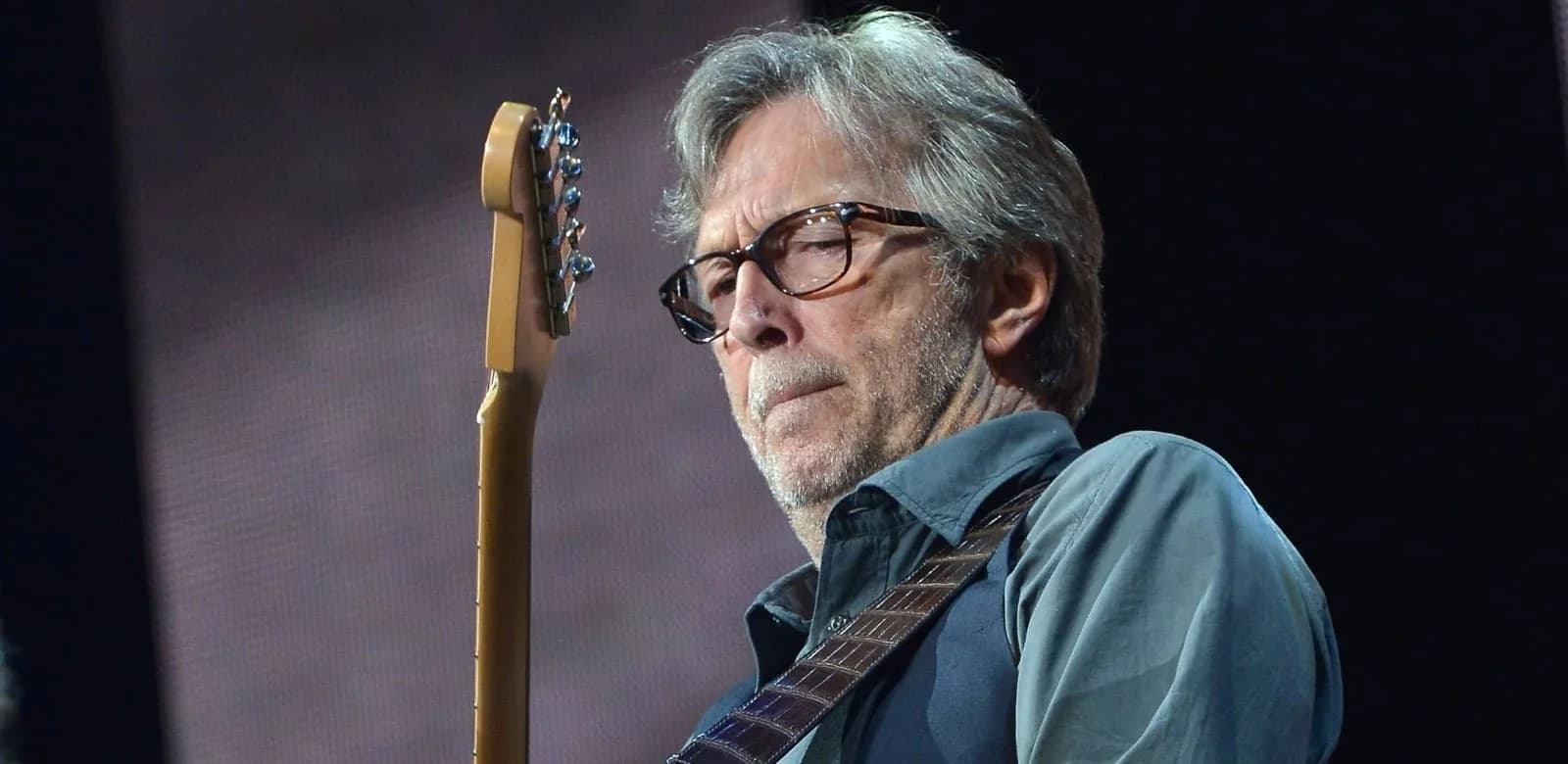
Basic Data
| Field | Information |
|---|---|
| Full Name | Eric Patrick Clapton |
| Stage name | Eric Clapton |
| Date of Birth | March 30, 1945 |
| Birthplace | Ripley, Surrey, England |
| Nationality | British |
| Music Genres | Blues, blues-rock, classic rock, soft rock |
| Primary Instrument | Electric guitar, acoustic guitar, vocals |
| Nicknames | Slowhand, God |
Introduction
There are technically superior guitarists. There are faster, more prolific, and more avant-garde guitarists. But there are few — perhaps none — quite as capable of making a single note ache as much as Eric Clapton. The nickname "Slowhand" didn't arise from laziness; it emerged from the conviction that every note needs space to breathe, that the silence between two phrases carries as much weight as the notes themselves. Clapton transformed the vocabulary of the American blues into something universally human.
At 16, he was already catching attention in the pubs of Surrey. By 20, fans were grafitti-ing "Clapton is God" on the walls of the London underground. Over his six-decade career, he has traversed the raw blues of the Yardbirds, the psychedelic explosion of Cream, the personal tragedy that yielded "Layla", the acoustic turn of MTV Unplugged, and still found breath for new albums well into his 70s. No other trajectory better illustrates the endurance of the blues as a living language.
He is the only musician to be inducted three times into the Rock and Roll Hall of Fame — as a Yardbird (1992), as a member of Cream (1993), and as a solo artist (2000). It's not a marketing record; it is the recognition that each phase of Clapton's career deserved its own line in the history of music.
First Steps
Eric Patrick Clapton was born on March 30, 1945, in Ripley, Surrey, the product of a brief relationship between his teenage mother Patricia Molly Clapton and a Canadian soldier who had already returned to Canada before his birth. Raised by his grandparents as if they were his parents, Eric only discovered the truth at age nine, when his mother returned to England for a visit accompanied by his six-year-old half-brother. The shock of this revelation would follow him forever, shaping the emotional intensity that overflows in every solo he ever played.
At 13, he received his first instrument, a German-made Hoyer acoustic guitar. The steel strings hurt his fingers and the tuning was torturous — he kept the guitar under his bed for months. The turning point came when he discovered blues records: Robert Johnson, Big Bill Broonzy, Muddy Waters. Those old recordings, smelling of the Mississippi and authentic suffering, made sense in a way nothing else had. He picked the guitar back up and never let it go.
At 16, he went to study at the Kingston College of Art, but visual art lost out to the guitar. At the end of 1963, at 18, he joined the Yardbirds. The rest is history.
Musical Influences
Clapton described him as "the most important blues musician who ever lived." He absorbed the melodic intensity and the sense of fatality in his lyrics — the spiritual foundation of Clapton's entire approach.
The electrification of Delta blues was the revelation that transformed Clapton from an active listener into a guitarist. Muddy Waters' tour of England in 1958 was a historical milestone for an entire generation.
The aggressive attack and sharp licks of Freddie King defined Clapton's vocabulary in the Yardbirds and the Bluesbreakers phase. "Hideaway" was his technical bible.
King's surgical vibrato and ability to make a single note sing for seconds directly shaped Clapton's bending style.
The ferocity and unpredictability of Buddy Guy, whom Clapton called "the greatest living inspiration for me," pushed the bolder electric side of Cream.
Bands and Projects
| Band / Project | Period | Notable Albums |
|---|---|---|
| The Roosters | 1963 | R&B Covers (no album) |
| The Yardbirds | 1963–1965 | Five Live Yardbirds (1964) |
| John Mayall & the Bluesbreakers | 1965–1966 | Blues Breakers with Eric Clapton (1966) |
| Cream | 1966–1968 | Disraeli Gears (1967), Wheels of Fire (1968) |
| Blind Faith | 1969 | Blind Faith (1969) |
| Derek and the Dominos | 1970–1971 | Layla and Other Assorted Love Songs (1970) |
| Solo Career | 1970–present | 461 Ocean Boulevard (1974), Slowhand (1977), Unplugged (1992), From the Cradle (1994) |
Instruments and Equipment
Carregando post do Instagram...
Main Techniques
Clapton's vibrato is one of the most recognizable in guitar history. Unlike most guitarists, he completely removes his hand from the back of the neck, keeping only the finger applying the vibrato in contact with the string. The result is a slow, wide, and vocal vibrato that seems to mimic the movement of a blues singer holding a long note. Hear it clearly in "Bell Bottom Blues" and the slow solos of "Wonderful Tonight".
The way Clapton performs bends distinguishes someone who simply plays the blues from someone who genuinely feels the blues. His bends arrive exactly at the right note — never above, never below — and often end with the floating vibrato, creating the illusion of a wind instrument. A specific characteristic is the use of microtonal bends, adding an expressive and hesitant character that amplifies the emotion.
Particularly visible during the Cream era and the recordings with the Bluesbreakers, the use of double stops (playing two notes simultaneously) adds thickness and musculature to the solo. Clapton frequently combines a double stop with a bend on one of the strings, creating harmonic tension that resolves dramatically. In "Crossroads" live, this technique appears in all its brutality.
Clapton's vocabulary is founded on the minor pentatonic scale with the addition of the blue note (the flat fifth). More important than the scale itself is the note selection: Clapton rarely plays everything he could, preferring to build short, memorable phrases with space between them. The silence is very much a part of the phrase itself.
Essential Songs
Curiosities
During Yardbirds shows, Clapton frequently broke strings mid-song. While he replaced the string right there on stage, the audience would start a slow handclap. The band's manager called it a "slow handclap" — which ironically became "Slowhand", a nickname that never left him.
Clapton is the only artist in history to be inducted three times: in 1992 for the Yardbirds, in 1993 for Cream, and in 2000 as a solo artist. No other musician even comes close to this record.
Harvard University named the minor planet 4305 after him following its discovery in 1976. Clapton is literally a celestial body.
Upon buying six vintage Stratocasters in 1970, Clapton gave one to George Harrison as a gift. In exchange, Harrison asked Clapton to play the solo on "While My Guitar Gently Weeps" for the White Album — making Clapton the only outside guitarist to record a solo on a Beatles record.
Clapton auctioned his two most famous guitars to fund the Crossroads Centre, his rehabilitation center in the Cayman Islands. Brownie sold for $497,500 in 1999; and Blackie for $959,500 in 2004 — breaking his own record.
In 1988, Fender released the Eric Clapton Signature Stratocaster — the first signature artist model in the brand's history. A new era for the collector guitar market began right there.
Clapton is a dedicated fly fisherman, frequenting rivers in Ireland, Iceland, and New Zealand. For him, fly fishing has the exact same meditative quality as playing slow blues.
Legacy and Influence
In March 1967, someone wrote in chalk on the walls of the London underground: "Clapton is God." No other pop musician has ever received such religious devotion in their own era. And the most impressive thing isn't that this happened — it's that Clapton, instead of letting fame paralyze him, kept searching for where the blues could take him next.
His influence branches out in every direction of modern rock and blues. Guitarists from Stevie Ray Vaughan and Gary Moore, to John Mayer and Joe Bonamassa, frequently cite Clapton as the starting point — tangible proof that the raw American blues could be distilled into something globally accessible without losing its essence.
Clapton's legacy goes far beyond the notes. The Crossroads Centre, founded in 1998, has helped hundreds of people struggling with chemical dependency. The Crossroads Guitar Festival, which he organizes periodically, has gathered guitarists of all generations and styles on a single stage, functioning as a living museum of the blues world.
In an era where the electric guitar is often declared dead by the specialized press, Eric Clapton continues playing shows for tens of thousands of people, recording new albums, and casting lines into freezing rivers. There is no more eloquent example that the guitar, like the blues itself, never dies — it merely transforms.