
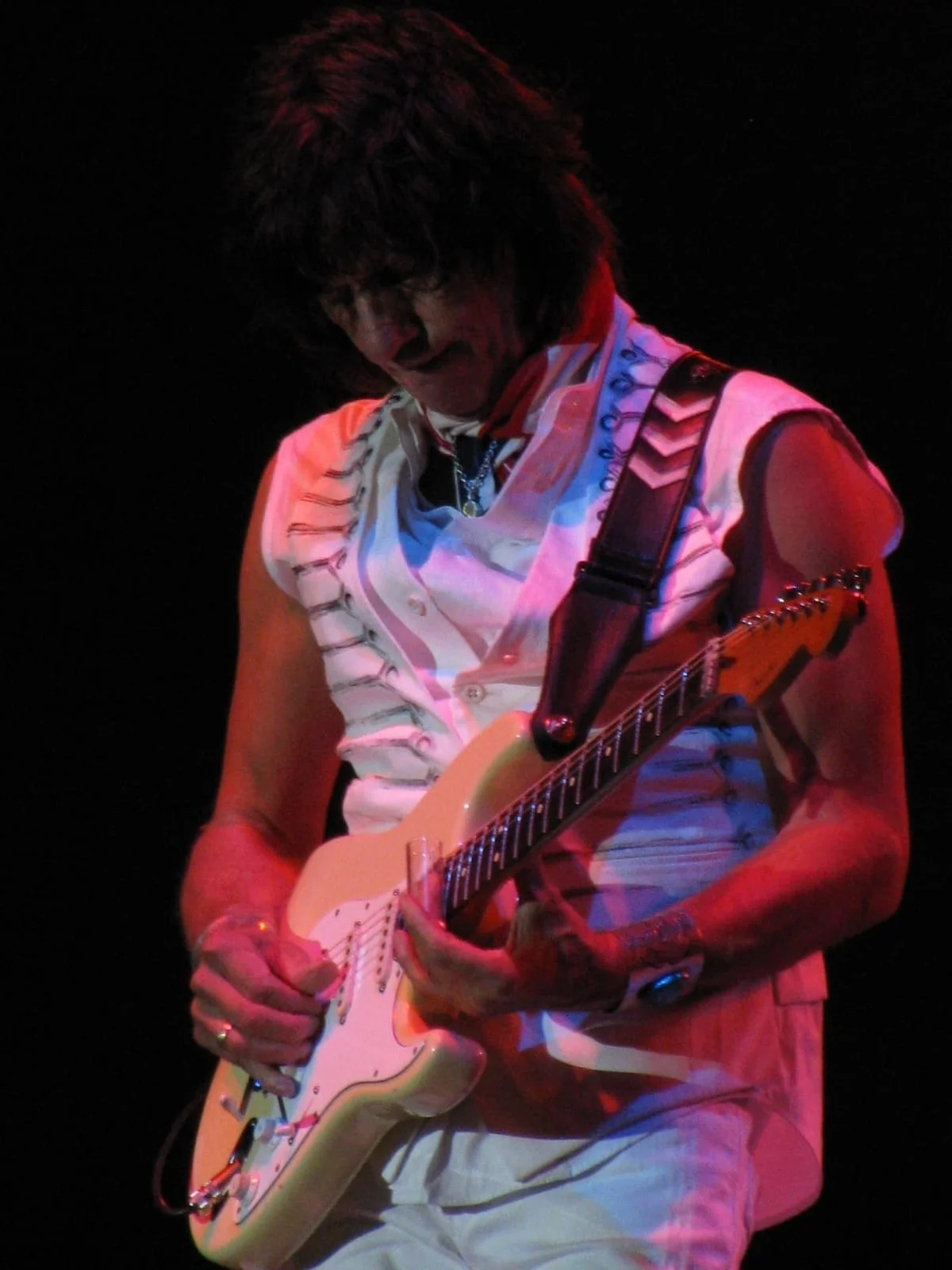
Basic Facts
| Field | Information |
|---|---|
| Full name | Geoffrey Arnold Beck |
| Stage name | Jeff Beck |
| Birth | June 24, 1944 |
| Place of birth | Wallington, Surrey, England |
| Death | January 10, 2023 |
| Place of death | East Sussex, England |
| Nationality | British |
| Career start | Early 1960s |
| Bands and projects | The Yardbirds, The Jeff Beck Group, Beck, Bogert & Appice, solo career |
| Main styles | Blues rock, hard rock, jazz fusion, instrumental rock |
Introduction
To talk about Jeff Beck is to talk about a guitarist who treated electricity like living matter. While many of his contemporaries became icons through riffs, monumental albums or stage persona, Beck built something even rarer: a language of his own. His touch always seemed to live on the edge of the unpredictable, yet it never lost control, intention or musicality.
From 1960s British blues to jazz fusion, from instrumental rock to the almost orchestral interpretations of his later decades, Jeff Beck proved that the guitar could sound human, aggressive, delicate and futuristic at the same time. That is why, for countless musicians, he became the “guitarist's guitarist”: an artist admired not only for what he played, but for how he reinvented the very act of playing.
Early Steps
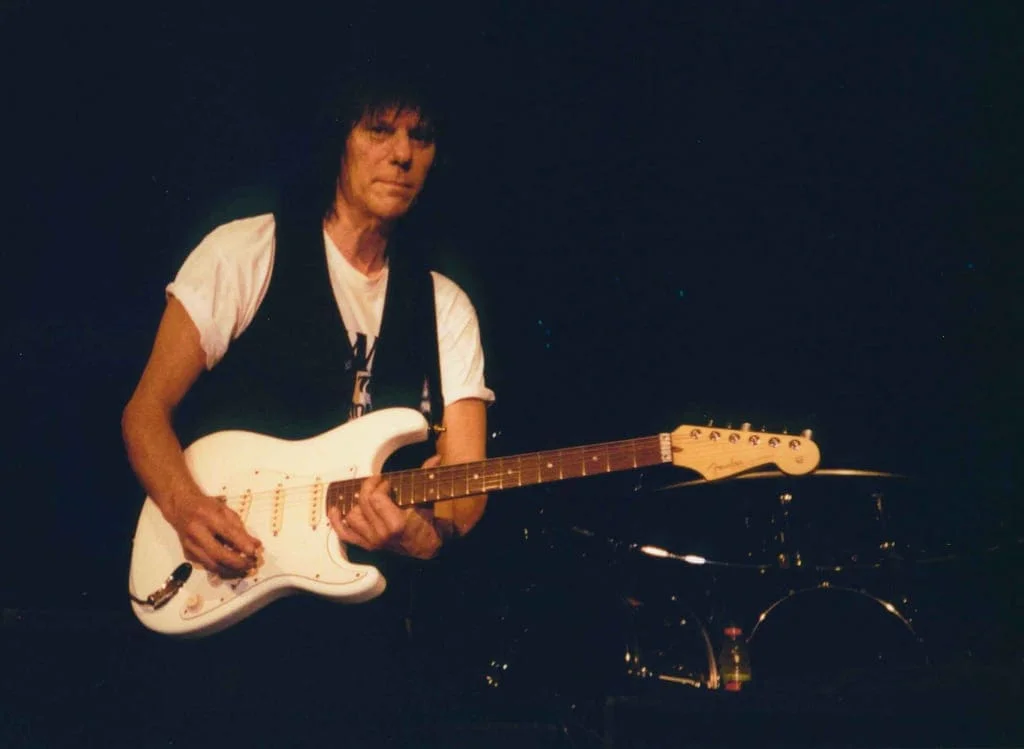
Jeff Beck grew up in southern England and developed an early fascination with the sound of the electric guitar. As a teenager, he built his own instrument, an experience that helped shape the almost craftsman-like relationship he would later have with tone, setup and dynamic response throughout his life. Before turning professional, he absorbed rockabilly, blues, instrumental music and the emerging vocabulary of British rock.
His breakthrough came in 1965, when he joined The Yardbirds in place of Eric Clapton. It was a decisive moment. Rather than simply keeping the band going, Beck pushed its sound into bolder territory, using distortion, feedback and rhythmic attack with a ferocity that helped shape the transition from blues rock to psychedelia and hard rock.
After leaving the Yardbirds, he formed the Jeff Beck Group, first with Rod Stewart and Ronnie Wood, and cemented a reputation as a restless musician with little interest in formulas. That impulse stayed with him throughout his career: Beck rarely repeated a successful phase; he preferred to open another door.
Musical Influences
Les Paul was central to Jeff Beck's sonic imagination. More than technique alone, Beck admired the ability to turn the guitar into a laboratory of tones, echoes and invention. Years later, that admiration would surface openly in recordings and performances tied to Les Paul's repertoire and spirit.
Cliff Gallup's fast, sharp and personality-driven phrasing left a deep mark on Beck in his youth. Part of Beck's attraction to lines that leap out of the track, bright, precise and slightly dangerous, can be traced back to that influence.
Chet Atkins helped Beck understand that technical refinement and popular appeal could coexist in the same performance. The clarity, touch and arranging instinct in Beck's playing owe a great deal to that school of guitarists who thought beyond sheer volume and speed.
Roy Buchanan mattered to the more vocal side of Beck's language. The expressive bends, subtle volume work and cries pulled from the strings connect directly with this emotionally raw, cliché-resistant approach to electric guitar.
Django's melodic freedom and improvisational instinct also echo in Beck, especially in his mature years. Even when he played heavy rock or fusion, there was a jazz-like fluidity in his phrasing, as if he were shaping the music in real time.
Bands and Projects
| Band / Project | Period | Key Albums and Highlights |
|---|---|---|
| The Yardbirds | 1965–1966 | Roger the Engineer (1966) — “Shapes of Things”, “Heart Full of Soul” |
| The Jeff Beck Group | 1967–1969 | Truth (1968), Beck-Ola (1969) — Rod Stewart and Ronnie Wood |
| Beck, Bogert & Appice | 1972–1974 | Beck, Bogert & Appice (1973) — high-impact power trio |
| Solo career | 1975–2022 | Blow by Blow (1975), Wired (1976), Guitar Shop (1989), Emotion & Commotion (2010) |
Instruments and Gear
Main Techniques
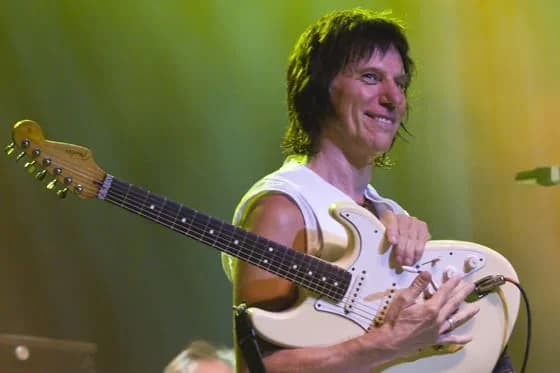
Jeff Beck turned the Stratocaster tremolo arm into a tool of subtle phrasing rather than a mere dramatic trick. Instead of cartoonish dives, he used it for microtonal bends, vocal inflections and emotional curves inside a single note. That approach is especially clear in his later instrumental performances.
Few guitarists worked the relationship between attack, sustain and volume as masterfully as Beck. He could clean the tone, swell it or make it nearly whisper without losing presence. The result was the feeling that each phrase had its own breathing pattern, especially in slow melodic pieces.
In many periods, Beck abandoned the pick and played with his fingers. That gave him a more organic articulation, with subtle tonal differences between strings, attacks and mutes. The result was phrasing that felt less mechanical and closer to voice, brass and orchestral strings.
Since the Yardbirds, Beck treated feedback as a compositional element. Rather than uncontrolled noise, he sought pitch, texture and intention. This approach was crucial to the expansion of psychedelic rock, hard rock and a more aggressive experimental guitar aesthetic.
Beck's vibrato had instant personality. Never too wide and never automatic, it arrived as a natural continuation of the phrase. His bends were not merely accurate; they told a story, creating tension and release with an almost vocal sense of timing.
Essential Songs
Curiosities
Before fame, Jeff Beck already had the technical curiosity of someone determined to understand the instrument from the inside out. Building a guitar at a young age helps explain his later intimacy with setup, response and tone.
Replacing an already respected guitarist would have been difficult for anyone, but Beck did more than fill the position: he changed the band's sonic direction and left an immediate mark.
Jeff Beck entered the Hall of Fame as a member of The Yardbirds and later again as a solo artist. Very few guitarists have that level of institutional recognition across two distinct chapters of their careers.
His career was honored across decades with eight Grammys, reflecting not only longevity but an ability to remain relevant and innovative in very different musical settings.
Members of Pink Floyd later admitted they considered inviting Beck in 1967 but felt too intimidated to ask. The story captures the extraordinary respect he inspired even among other legends.
Outside music, Beck had a serious passion for the automotive world, especially modified classic Fords. That fascination with mechanics matched his artisanal and obsessive attention to detail.
Legacy and Influence
Jeff Beck holds a singular place in guitar history. He does not fit perfectly into the story of the biggest record sellers, nor into that of the most publicly celebrated songwriters. His territory was different: permanent innovation. For generations of guitarists, he showed that virtuosity did not have to mean empty display, and that technique reaches full value only when it becomes a personal voice.
His importance crosses multiple chapters of popular music. In the Yardbirds, he pushed rock toward electric experimentation. In the Jeff Beck Group, he anticipated the weight and intensity that would soon explode in hard rock. In his instrumental years, he proved that the guitar could carry entire albums through imagination, dynamics and sophistication without losing emotional power. And even as a veteran, he kept defying expectations, refusing to play in a predictable way.
More than a guitar hero, Jeff Beck was an artist of rare listening. He played like someone chasing nuance down to the last detail, always searching for a sound that did not yet exist. His legacy lives in every musician trying to pull something more human, more expressive and less obvious from the instrument.