
Basic Facts
| Field | Information |
|---|---|
| Full name | James Patrick Page |
| Stage name | Jimmy Page |
| Date of birth | January 9, 1944 |
| Place of birth | Heston, Middlesex, England |
| Nationality | British |
| Occupations | Guitarist, songwriter, producer and arranger |
| Career start | Late 1950s |
| Bands and projects | The Yardbirds, Led Zeppelin, The Firm, Page and Plant, Coverdale/Page |
Introduction
Jimmy Page is not simply a great guitarist. He is an architect of atmosphere, a creator of riffs that feel carved in stone, and a producer who helped redefine the language of heavy rock without giving up subtlety, dynamics or mystery. His work with Led Zeppelin set a new standard for arena guitar, but his greatness goes beyond sheer volume: Page fused blues, British folk, rockabilly, psychedelia and studio experimentation into a musical signature that is instantly recognizable.
Before becoming a global icon, he was already one of the most in-demand session musicians in London. That experience shaped his discipline, his arranging instincts and his ability to find the right tone for each song. When he founded Led Zeppelin, he brought not only technique but a complete vision of sound, repertoire, production and impact. The result was a body of work that still serves as a map for hard rock, metal, blues-rock and alternative guitarists.
Early Steps
Jimmy Page grew up in post-war England and discovered the guitar at a young age, initially drawn to the impact of American rock and roll and the direct language of the blues. Like many British musicians of his generation, he learned largely by ear, absorbing licks, rhythms and inflections from records. That intuitive foundation remained visible throughout his career: Page always sounded less like a method player and more like a guitarist driven by imagination, instinct and dramatic instinct.
In the 1960s he became one of the leading names in the London studio scene. He played on pop, rock and soundtrack sessions, developing unusual versatility for someone later associated so strongly with such monumental music. This period was decisive because it gave him command over arrangements, layered guitars, textures and song structure as a whole. By the time he joined the Yardbirds, he had enough experience to turn that chapter into a direct bridge toward the creation of Led Zeppelin.
Musical Influences
Scotty Moore's clean phrasing, swing and rhythmic elegance helped shape the young Page's ear. The idea that the guitar could lead a song without losing lightness appears in many early moments of his playing and remains behind the groove that supports even his simplest-looking riffs.
James Burton was essential to Page's precision of attack, his short melodic figures and his sense of the guitar as a melodic voice within an arrangement. Even when Page moved into heavier territory, that rockabilly clarity stayed with him.
From electric blues came the expressive vibrato, the strength of sustained notes and the emotional economy. Page did not copy B.B. King's vocabulary literally, but he absorbed the central lesson: one note, played with conviction, can carry as much weight as a flood of phrases.
The aggression of slide guitar and the urgency of amplified blues in Elmore James helped draw Page toward a harsher, more physical sound. That kind of energy became crucial to the way he approached riffs and tone in Led Zeppelin.
On acoustic guitar and in open tunings, Page found a deep influence in Bert Jansch. The acoustic side of his style, full of drones, open strings, modal tension and almost medieval atmosphere, owes a great deal to that British folk lineage.
Bands and Projects
Jimmy Page's trajectory spans session work, the Yardbirds laboratory and the monumental body of work with Led Zeppelin, alongside relevant projects in the following decades.
| Band / Project | Period | Highlights |
|---|---|---|
| Studio sessions (London) | 1963–1968 | Recordings with Donovan, The Who, Them, Rolling Stones and many others |
| The Yardbirds | 1966–1968 | Psychedelic blues — direct transition to the formation of Led Zeppelin |
| Led Zeppelin | 1968–1980 | Led Zeppelin I (1969), II (1969), IV (1971), Physical Graffiti (1975) |
| The Firm (with Paul Rodgers) | 1984–1986 | The Firm (1985), Mean Business (1986) |
| Solo career — Outrider | 1988 | Only official solo album, featuring Robert Plant and Jason Bonham |
| Coverdale/Page | 1993 | Coverdale/Page (1993) |
| Page and Plant | 1994–1998 | No Quarter: Unledded (1994), Walking into Clarksdale (1998) |
Instruments and Gear
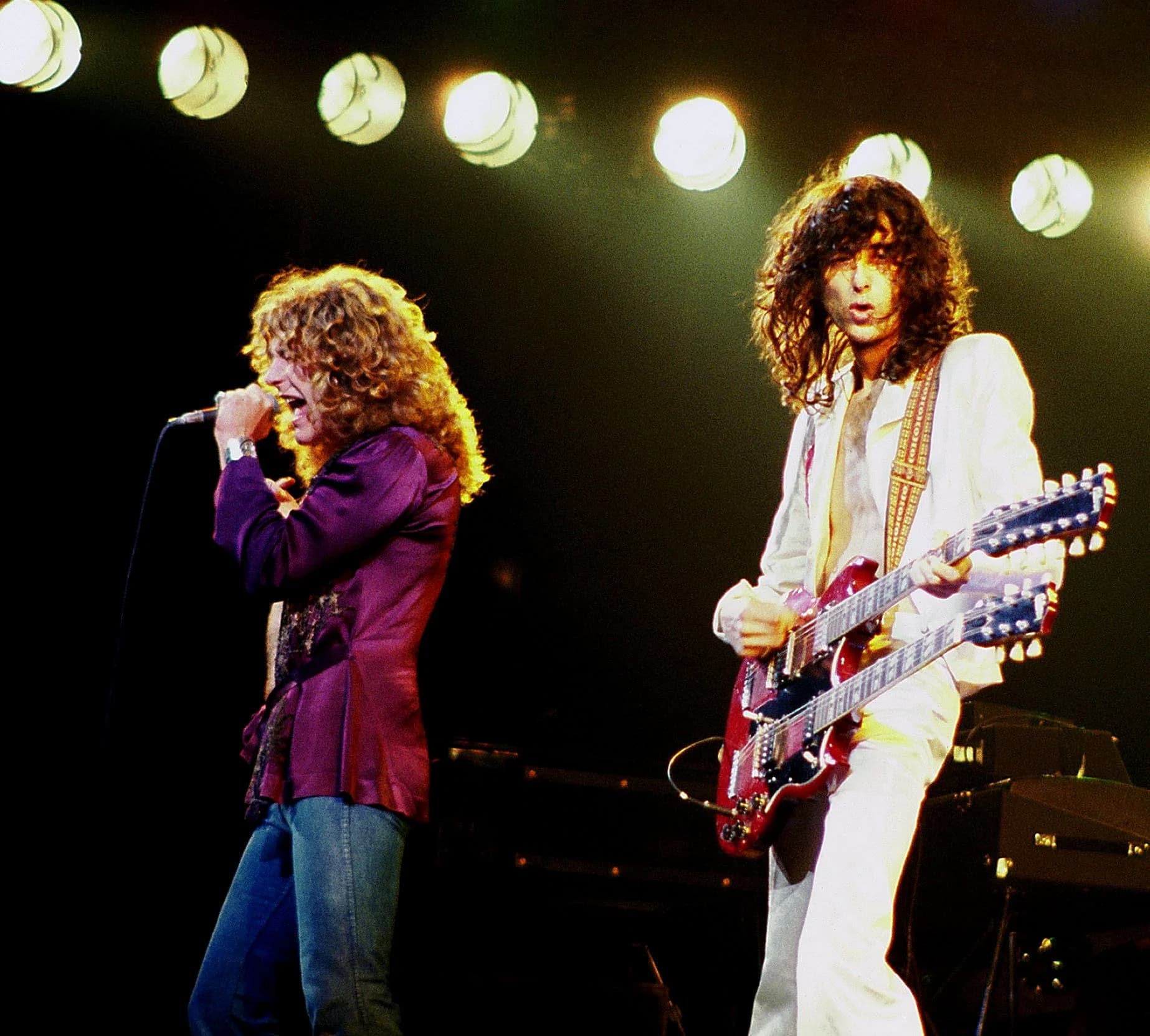
Jimmy Page built one of the most recognizable visual and sonic identities in guitar history. His tone came less from loyalty to a single setup and more from the strategic combination of instruments, tunings, amplifiers pushed to the edge and highly deliberate studio choices.
Main Techniques
Page understood that a memorable riff depends not only on the notes chosen but on how those notes breathe. He alternated violent attack, dramatic pauses and almost percussive accents, creating shapes that seem to drive the song forward. This approach is central to tracks like 'Whole Lotta Love', 'Black Dog' and 'The Ocean'.
Few classic-rock guitarists thought about recording as intelligently as Page. He stacked acoustics, electrics, doubled lines and complementary textures so an arrangement could grow in depth without losing identity. 'Achilles Last Stand' and 'Ten Years Gone' are clear examples of this almost orchestral mindset.
On acoustic guitar, Page immersed himself in alternate tunings, drones and modal movement that brought rock closer to British folk and traditional music. This gave his compositions an old, expansive and cinematic feeling, heard in 'Bron-Yr-Aur', 'The Rain Song' and passages of 'Kashmir'.
Rather than soloing only to display speed, Page often told a story. His solos build tension, change density and sometimes sound as if they are on the edge of falling apart, yet they almost always preserve emotional direction. 'Since I've Been Loving You' is a definitive example of that instrumental storytelling.
His experimental side turned performance into a sensory spectacle. The violin bow across the strings and the theremin were not mere stage tricks: they created noise, suspense, drones and unease, expanding the theatrical dimension of songs like 'Dazed and Confused'.
Essential Songs
Curiosities
Long before Led Zeppelin, Jimmy Page was recording professionally in London, which helps explain his confidence in arrangement, capture and tone-building when superstardom arrived.
Page was also a central force as producer and sonic director. Much of Led Zeppelin's album impact comes from his decisions about ambience, mic placement and layer organization.
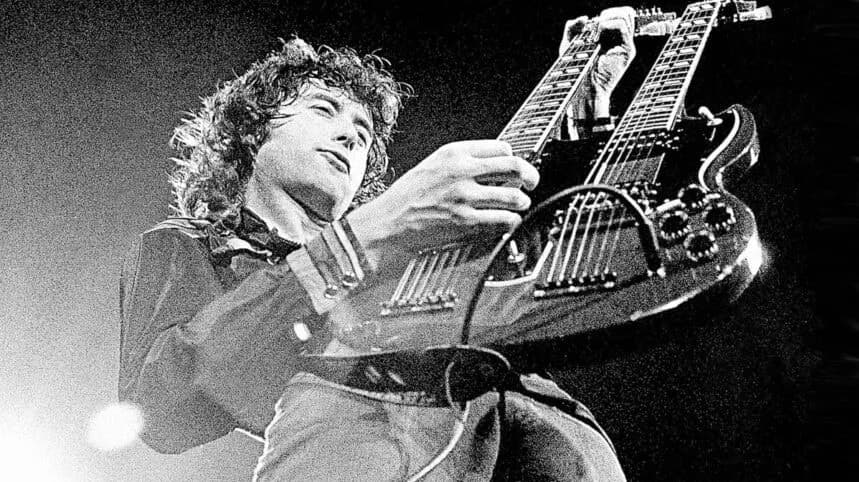
The Gibson EDS-1275 became a rock icon because Page turned it into both a practical musical solution and a dramatic stage symbol.
Although many listeners associate him only with volume and riffs, a decisive part of his legacy lives in acoustic guitar, folk textures and compositions of striking delicacy.
Very few guitarists can say that. Page was inducted with the Yardbirds and again with Led Zeppelin, clear evidence that he shaped more than one era of rock history.
Decades after Led Zeppelin's peak, Page still took an active role in remasters and reissues, showing how deeply he sees his body of work as something to preserve sonically.
Legacy and Influence
Jimmy Page holds a singular place in guitar history because he united the riff writer, the soloist, the arranger and the producer in one artistic identity. Many musicians wrote great phrases; few redefined the way guitars would be recorded, layered and turned into sonic architecture. Without him, the bridge between 1960s British blues and the monumental hard rock of the 1970s would look very different.
His legacy crosses generations because it does not depend on fashion. Metal, stoner, blues-rock, indie and alternative players keep returning to Page to understand how to combine weight and nuance, spontaneity and construction, tradition and risk. What endures is not only virtuosity but imagination: Jimmy Page showed that the electric guitar could be fierce, mysterious, sensual, acoustic, epic and experimental at the same time.