Basic Data
| Field | Information |
|---|---|
| Name | Guns N' Roses |
| Origin | Los Angeles, California, United States |
| Formed | March 1985 |
| Status | Active |
| Genre | Hard Rock, Sleaze Rock, Heavy Metal |
| Label | Geffen Records, UMG |
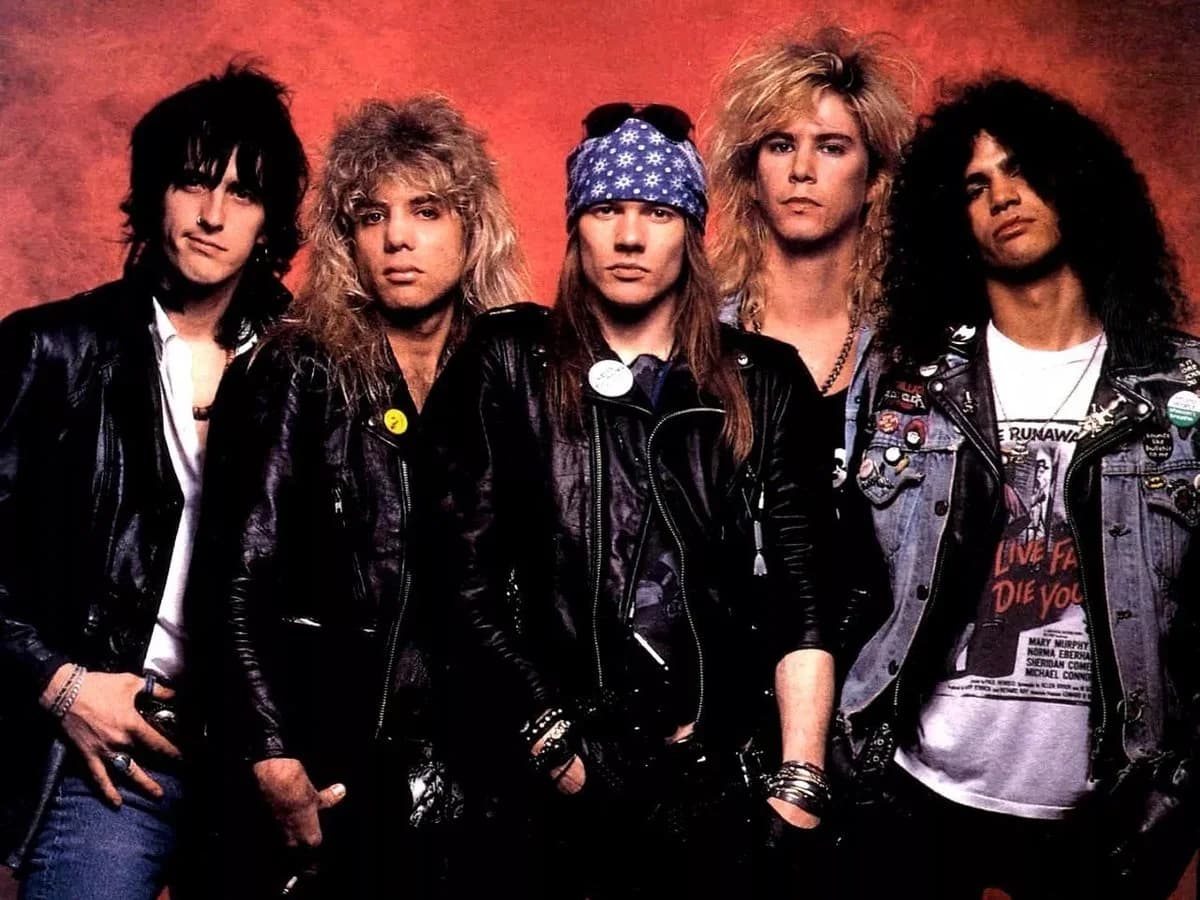
| Classic lineup | Axl Rose, Slash, Duff McKagan, Izzy Stradlin, Steven Adler |
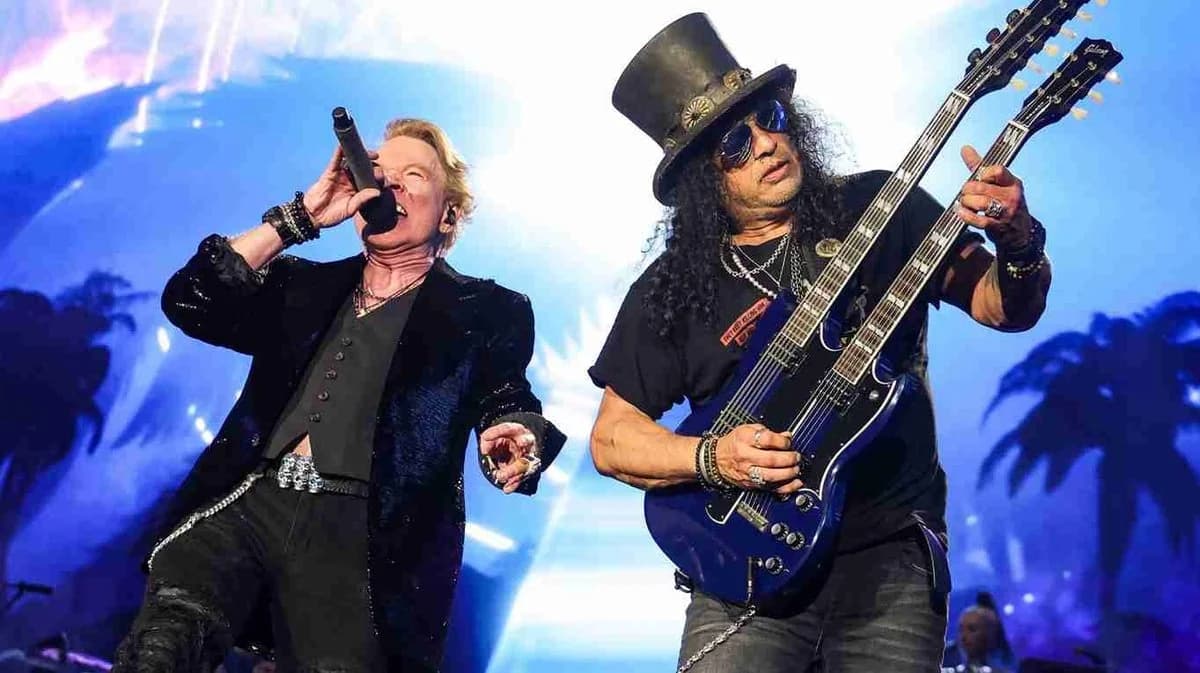
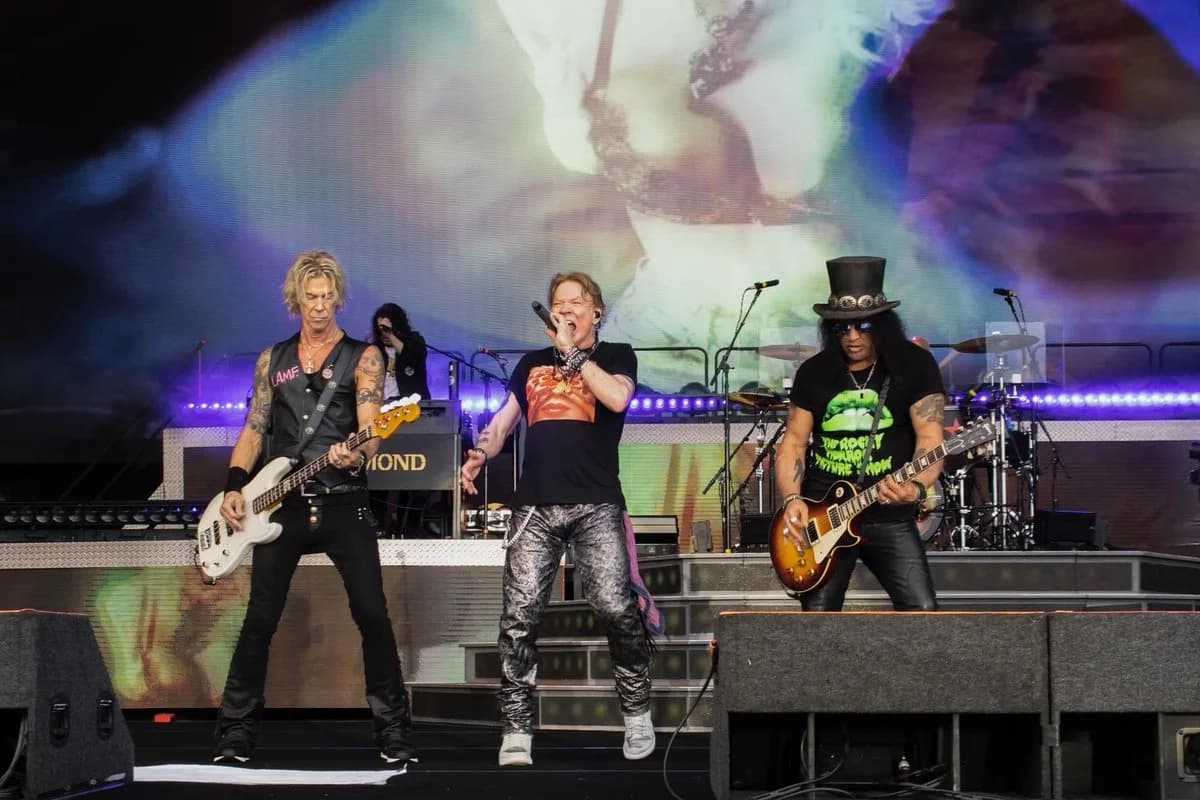
| Current lineup | Axl Rose, Slash, Duff McKagan, Dizzy Reed, Richard Fortus, Frank Ferrer, Melissa Reese |
| Official site | gunsnroses.com |
Origin and Formation
Guns N' Roses was born in March 1985 from the merger of two local bands in the Los Angeles underground scene: Hollywood Rose, featuring Axl Rose and Izzy Stradlin, and L.A. Guns, led by guitarist Tracii Guns. The name is a direct result of this dual origin — it literally combined "L.A. Guns" and "Hollywood Rose" into a single identity. The initial lineup brought together Axl Rose on vocals, Tracii Guns on lead guitar, Izzy Stradlin on rhythm guitar, Ole Beich on bass, and Rob Gardner on drums. This lineup lasted only a few weeks: Beich was replaced by Duff McKagan, coming from Seattle's punk scene, and soon Tracii Guns and Rob Gardner would also leave.
The classic lineup solidified in June 1985 with the arrival of Slash, coming from Hollywood Rose along with Stradlin, and Steven Adler, Slash's childhood friend. The five — Axl, Slash, Izzy, Duff, and Steven — set out that same month on the infamous "Hell Tour," a disastrous trip to Seattle in which the bus broke down on the way, forcing the band to hitchhike with truckers and strangers to reach their shows. The experience sealed the bond between them and defined the street, adventurous, dangerous band aesthetic that would become their trademark.
The Sunset Strip scene in 1985 was dominated by glam metal: Mötley Crüe, Ratt, Quiet Riot, and Poison dictated the look and the sound. Guns N' Roses fit aesthetically — leather, long hair, makeup — but the sound was different: bluesier, more Aerosmith, more Rolling Stones, dirtier. The band started playing the Troubadour, Whisky a Go Go, and Roxy clubs, and quickly built a reputation thanks to the rare combination between Axl's furious vocals and Slash's lyrical guitar. In March 1986, after a bidding war between several labels, the group signed with Geffen Records.
Members
Axl Rose, born William Bruce Rose Jr. in Lafayette, Indiana, is the leader, vocalist, and main lyricist. His voice covers an extraordinary range — from the deep growl to the piercing falsetto — and carries a rare emotional intensity, capable of turning rage, pain, and tenderness into theatrical performance. As a lyricist, he translated experiences of a violent childhood, drugs, fame, and paranoia into narratives that hold the catalog together. His turbulent relationship with the band, labels, and press made him one of the most unpredictable and studied figures in rock.
Duff McKagan came from Seattle's punk scene, where he played in bands like The Fastbacks and Ten Minute Warning before moving to Los Angeles. His pick-driven bass playing, influenced by Steve Jones and Paul Simonon, gave Guns N' Roses a foundation that was simultaneously melodic and aggressive. He survived a near-fatal episode of alcoholic pancreatitis in 1994 and reinvented himself as a musician, author, and entrepreneur before the 2016 reunion.
Izzy Stradlin, Axl's childhood friend in Indiana, was the band's silent architect. Composer of many of the most memorable riffs and lines — "Mr. Brownstone," "Patience," "You Could Be Mine," "14 Years" — he brought the most direct influence from the Rolling Stones, Aerosmith, and Hanoi Rocks. His departure in November 1991, at the peak of the Use Your Illusion Tour, is considered by many the moment when the original compositional balance broke.
Steven Adler completed the classic lineup with a swung, blues-based beat that gave Guns N' Roses a unique cadence, closer to Aerosmith and AC/DC than to the technical drummers typical of '80s hard rock. He was fired in 1990 because of heroin addiction, replaced by Matt Sorum, coming from The Cult, whose heavier, more direct feel shaped the sound of the Illusion-era recordings.
Dizzy Reed joined in 1990 as keyboardist and never left — he is, along with Axl, the only continuous member of the band since the original classic lineup. Robin Finck (from Nine Inch Nails), Buckethead, Bumblefoot, Richard Fortus, Frank Ferrer, and Melissa Reese form the group of musicians who navigated the long transition between Slash's departure in 1996 and his return in 2016.
| Member | Instrument/Role | Period |
|---|---|---|
| Axl Rose | Vocals, piano | 1985-present |
| Slash | Lead guitar | 1985-1996; 2016-present |
| Duff McKagan | Bass, backing vocals | 1985-1997; 2016-present |
| Izzy Stradlin | Rhythm guitar, backing vocals | 1985-1991 |
| Steven Adler | Drums | 1985-1990 |
| Matt Sorum | Drums | 1990-1997 |
| Dizzy Reed | Keyboards, percussion | 1990-present |
| Gilby Clarke | Rhythm guitar | 1991-1994 |
| Robin Finck | Guitar | 1997-1999; 2000-2008 |
| Buckethead | Lead guitar | 2000-2004 |
| Bumblefoot | Lead guitar | 2006-2014 |
| Richard Fortus | Rhythm guitar | 2002-present |
| Frank Ferrer | Drums | 2006-present |
| Melissa Reese | Keyboards, synths | 2016-present |
History
Appetite for Destruction, released on July 21, 1987 by Geffen, is the best-selling debut album in U.S. history — over 30 million copies worldwide. Mike Clink's production captured the band in a raw state: "Welcome to the Jungle," "Sweet Child O' Mine," "Paradise City," and "Mr. Brownstone" set a new standard of hard rock that was simultaneously raw and radio-ready. The original cover, with an illustration by Robert Williams depicting a scene of robotic sexual violence, was censored after pressure from retailers; the substitute edition brought the now-famous Celtic-cross skull drawing.
Success was not immediate. The album sold modestly in the first months until MTV began playing "Welcome to the Jungle" in off-peak hours, at the personal request of executive David Geffen. In August 1988, more than a year after release, "Sweet Child O' Mine" reached number one on the Billboard Hot 100. The band became, in a matter of months, the most talked-about cultural phenomenon in American rock. The EP-LP G N' R Lies, released in November 1988, combined live tracks from the pre-fame era with new acoustic recordings, including "Patience" and the controversial "One in a Million," whose explicit racism and homophobia generated intense debate and would permanently mark Axl's critical reception.
The turn of the decade found the band immersed in addiction, internal conflict, and cinematic ambition. Steven Adler was fired in July 1990 after repeated heroin problems, replaced by Matt Sorum. Dizzy Reed joined as keyboardist to accommodate the new orchestral ambitions. In September 1991, after two and a half years of work, Guns N' Roses simultaneously released Use Your Illusion I and II — two double albums totaling 30 tracks, including songs over nine minutes long like "November Rain," "Estranged," and "Coma." The scale was colossal: orchestrations, piano, horns, epic ballads, covers, and acoustic songs coexisted with direct hard rock.
The Use Your Illusion Tour, starting in January 1991 and extending through July 1993, is one of the longest and most turbulent in rock history — 192 shows in 27 countries over 28 months. It became synonymous with controlled catastrophe: the Riverport Riot in St. Louis in July 1991 began when Axl jumped off the stage to seize a camera and ended in a mass disturbance; in August 1992, in Montreal, on the joint tour with Metallica, Axl cut a show short due to vocal problems after the accident that burned James Hetfield, and the crowd destroyed the Olympic Stadium. Izzy Stradlin abandoned the band in November 1991, exhausted from the scale and chaos, replaced by Gilby Clarke. The Spaghetti Incident?, a covers album released in 1993, was the final studio record of that era.
The following years were ones of implosion. Slash announced his departure in October 1996, citing irreconcilable differences with Axl about musical direction. Duff McKagan left in 1997, Matt Sorum too. Axl retained the rights to the Guns N' Roses name and embarked on a nearly fifteen-year cycle working on a single album, Chinese Democracy, with rotating lineups that included Robin Finck, Buckethead, Bumblefoot, Tommy Stinson, and Brain Mantia. The album came out in November 2008 — estimates put more than $13 million spent on its production, possibly the most expensive album ever recorded.
Reconciliation happened in 2016. Slash and Duff McKagan returned to the band for the Not in This Lifetime... Tour, announced as improbable until the last moment. The tour, which extended from April 2016 to November 2019, grossed over $580 million, becoming one of the most lucrative in history. Steven Adler and Izzy Stradlin did not return to the official lineup, although Adler made occasional appearances. Since 2021, the band has been releasing new singles with the current lineup — "Absurd," "Hard Skool," and "Perhaps" — signaling that the modern Guns N' Roses chapter is still being written.
Guns N' Roses emerged from the union of two local bands: L.A. Guns, led by guitarist Tracii Guns, and Hollywood Rose, with Axl Rose and Izzy Stradlin. When the musicians combined in 1985, the name formed in the most direct way possible.
The first trip of the classic quintet — a disastrous tour to Seattle in June 1985 — included a broken-down bus, rides with strangers, and improvised shows. That shared trauma consolidated the bond between Axl, Slash, Izzy, Duff, and Steven.
The first cover of Appetite for Destruction featured a Robert Williams illustration with a scene of robotic sexual violence. Retailers refused to stock the record, and Geffen replaced it with an inner cover depicting skulls and the Celtic cross — today, one of the iconic graphics of rock.
Between 1994 and 2008, the album went through more than a dozen guitarists, several producers, and studios. Cost estimates exceed $13 million, making it a music industry case study on perfectionism, creative control, and production cost.
Discography
Guns N' Roses' discography is compact but decisive. In just six years — from 1987 to 1993 — the band produced four albums that redefined the scale of commercial hard rock: from the raw impact of Appetite for Destruction to the cinematic ambition of the Illusion recordings. After fifteen years of silence, Chinese Democracy closed Axl's cycle as sole leader. The later phase, with Slash and Duff back, still yields occasional releases and signals a new chapter under construction.
| Album | Year |
|---|---|
| Appetite for Destruction | 1987 |
| G N' R Lies | 1988 |
| Use Your Illusion I | 1991 |
| Use Your Illusion II | 1991 |
| The Spaghetti Incident? | 1993 |
| Chinese Democracy | 2008 |
Style and Influence
The Guns N' Roses sound is rooted in a specific combination: the blues-based hard rock of Aerosmith and Rolling Stones, the punk attack of the Sex Pistols and Stooges, the elegant violence of Hanoi Rocks, the weight of Black Sabbath and AC/DC, and the melodicism of Elton John, Queen, and Led Zeppelin. This synthesis materialized into a sound recognizable in just a few bars: Slash's guitar with a Les Paul and medium-gain Marshall, Axl's voice in a high, tense register, Duff and Steven Adler's swung rhythm section, and Izzy's rhythm guitar aligning purple, nervous textures.
Technically, the band never aligned with the virtuosity of Yngwie Malmsteen or Steve Vai. Slash prioritized pentatonic expressiveness, long bends, wide vibrato, and dynamics over pure speed. Izzy was even less concerned with technique — his role was creating grooves, voicings, and complementary textures. The aesthetic choice to favor feeling over flash, at a moment when shred dominated magazines, helped position Guns N' Roses as a direct heir of the '70s.
The band's persona was also a central part of their language. In a scene dominated by glam theatricality, Guns N' Roses seemed dangerously real — drugs, fights, paranoia, delays, riots. The slogan "the most dangerous band in the world" was not pure marketing: it reflected concrete events, documented controversies, and an internal instability that affected every record and every tour. This perceived authenticity was both their greatest strength and the source of their eventual breakdown.
The most direct influence in the Guns N' Roses DNA. From Steven Tyler's groove-driven vocals to the twin-guitar chemistry of Joe Perry and Brad Whitford, the band absorbed Boston's dirty blues as the foundation of its own language. Slash cited Joe Perry as a primary reference in several interviews.
The interaction between Izzy Stradlin and Slash mirrored the Richards-Wood partnership: one architect of rhythmic textures, another builder of melodies and solos. The street persona, blues as foundation, and the flirt with country and ballads come directly from the Stones.
Punk is the other half of the equation. Duff McKagan came from Seattle's punk scene, and Steve Jones was a constant reference. Iggy Pop, with his physical aggressiveness and theatricality, was a clear reference for Axl's stage presence.
The Finnish band directly influenced Guns N' Roses' visual and sonic aesthetic. The combination of leather, makeup, voluminous hair, and catchy choruses over aggressive bases came from Hanoi Rocks, whose tragic end (with drummer Razzle's death in 1984) deeply impacted the Los Angeles scene.
AC/DC's economy of riffs and direct aggressiveness informed the rawest phase of Guns N' Roses, especially on tracks like "Welcome to the Jungle" and "It's So Easy." Steven Adler cited Phil Rudd as a primary rhythmic reference.
After the breakup with Axl, Slash, Duff McKagan, and Matt Sorum formed Velvet Revolver with Scott Weiland (Stone Temple Pilots) and Dave Kushner. The band won a Grammy in 2005 for Contraband and showed that an essential part of the GNR sound lay in the classic rhythmic-melodic trio.
Legacy
Guns N' Roses occupies a singular place in rock history: it is simultaneously the last great pre-grunge arena rock phenomenon and the band that made it impossible to ignore the fragility of that model. When Appetite for Destruction exploded in 1988, commercial hard rock reached a peak of visibility that no guitar band would repeat without the mediation of hip-hop or pop reinvention. When Nirvana made Nevermind the dominant album of 1991 — the same year as the Use Your Illusion records — an era ended, and Guns N' Roses was marked as the band that lived on the exact frontier of that closure.
The technical and compositional impact remains. Slash is one of the central influences for blues rock and hard rock guitarists of subsequent generations — just listen to Myles Kennedy, Richie Kotzen, Orianthi, or the solos of the Stone Sour era. Duff McKagan became a reference for bassists who want to unite punk and arena rock. The band's compositions, especially "Sweet Child O' Mine" and "November Rain," appear on lists of the best rock songs and continue being discovered by teenagers decades after their original release.
The 2012 induction into the Rock and Roll Hall of Fame institutionally confirmed the band's historical status, even with Axl's refusal to attend the ceremony. The 2016 return, with Slash and Duff back after two decades of rupture, showed that part of the audience had been waiting for that reconciliation chapter for a long time. The Not in This Lifetime tour grossed more than many contemporary pop star tours, signaling that there is a massive, loyal audience for the specific type of spectacle that only this band offers.
For Luciano Bastos Guitar, Guns N' Roses is a school of several dimensions: composition with economy of elements, emotional weight without gratuitous virtuosity, building tone with Les Paul and Marshall, interaction between two guitarists with distinct functions, and above all, the lesson that persona, attitude, and song form an indivisible whole. When Slash starts the riff of "Sweet Child O' Mine," the listener recognizes it in three notes — that is the kind of signature few artists achieve, and the kind of goal worth pursuing for anyone who takes guitar seriously.