
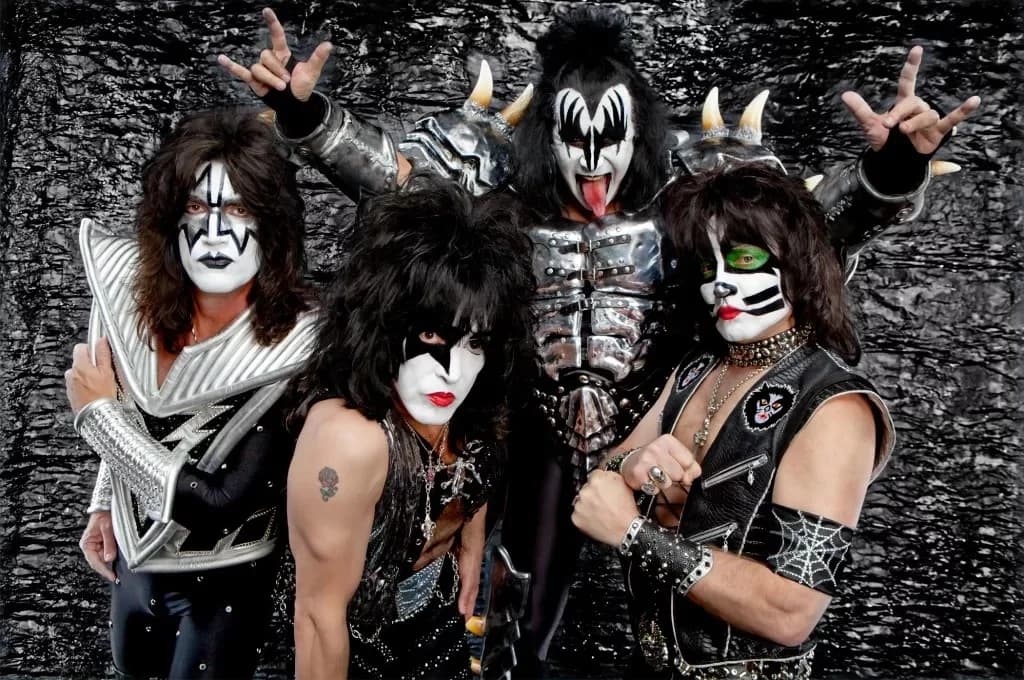
Basic Facts
| Field | Information |
|---|---|
| Name | KISS |
| Stylized name | KIϟϟ |
| Origin | New York, United States |
| Formation | 1973 |
| Current status | Active as a brand, catalog, audiovisual legacy and post-stage project; the regular touring era ended in 2023 |
| Genres | Hard Rock, Shock Rock, Glam Rock, Heavy Metal, Arena Rock |
| Classic lineup | Paul Stanley, Gene Simmons, Ace Frehley, Peter Criss |
| Final touring lineup | Paul Stanley, Gene Simmons, Tommy Thayer, Eric Singer |
| Classic personas | Starchild, Demon, Spaceman, Catman |
| Deceased members | Eric Carr, Mark St. John, Ace Frehley |
| Essential albums | KISS, Alive!, Destroyer, Rock and Roll Over, Love Gun, Creatures of the Night, Lick It Up, Revenge, MTV Unplugged |
| Essential songs | Strutter, Black Diamond, Rock and Roll All Nite, Detroit Rock City, Beth, Love Gun, Shock Me, I Was Made for Lovin' You, Lick It Up, Forever |
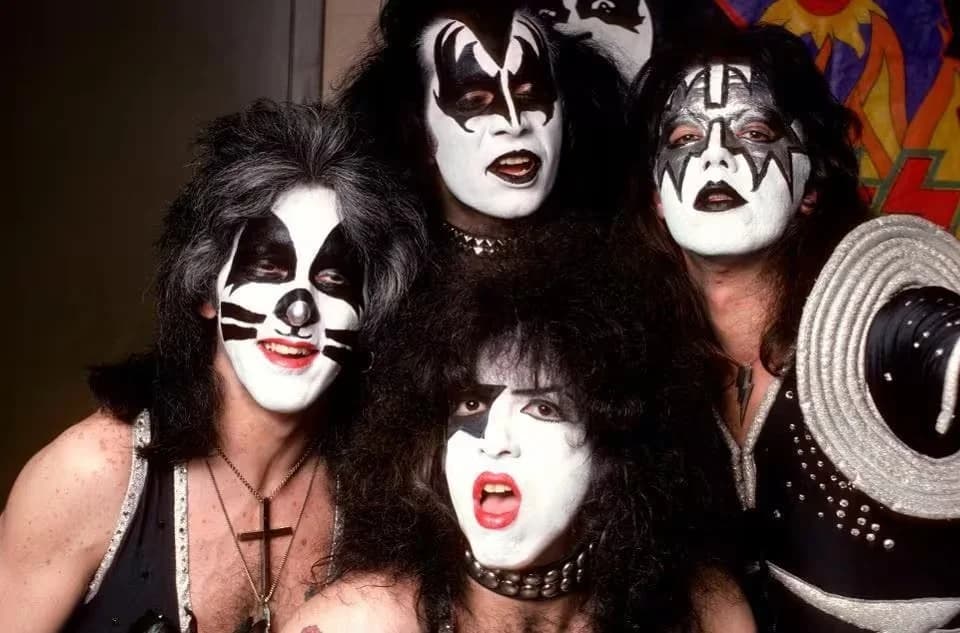
Origin and Formation
KISS was born in New York in 1973, but its real origin lies in Paul Stanley and Gene Simmons’ dissatisfaction with the direction of Wicked Lester. Their previous project contained elements of pop, psychedelia and studio rock, but it did not translate the ambition the two musicians were beginning to define: to create a band that was direct, physical, theatrical and immediately recognizable. They wanted the audience to understand the impact before the first note had even been played. The music had to be simple enough to stick, heavy enough to dominate a room and visually strong enough to become a symbol.
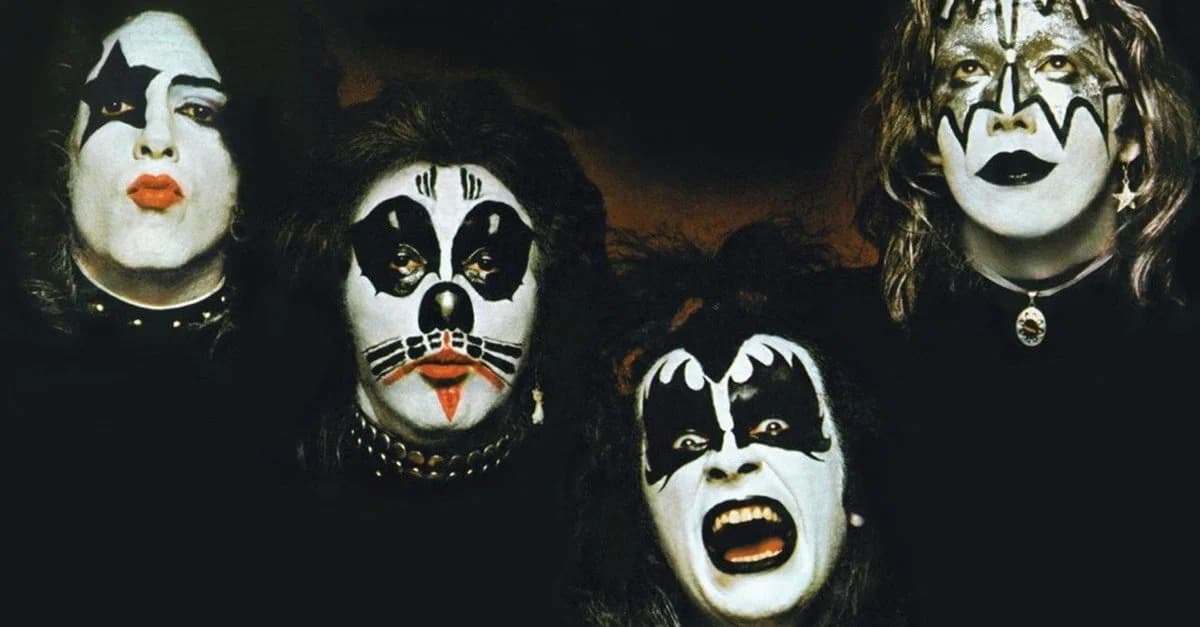
Peter Criss came in first, bringing a raspy voice, the swing of a drummer shaped by clubs and a connection to older rock and roll. Ace Frehley completed the core with a guitar style that was less academic and more instinctive: crooked bends, pentatonic phrases, wide vibratos and a personality that seemed to come from another planet. From that meeting onward, the band was no longer only Paul, Gene, Ace and Peter. It was Starchild, Demon, Spaceman and Catman.
That aesthetic decision was crucial. KISS did not use makeup as an ornament; it used makeup as language. Each character communicated a function inside the collective myth: Paul was the arena seducer, Gene was the demonic threat, Ace was the space outsider and Peter was the streetwise, romantic, feline heart. The visual identity allowed the band to be understood by children, teenagers, comic-book fans, radio listeners and people who simply wanted a heavy live show. Few rock bands built, so early, such an efficient bridge between music, character and cultural product.
Musically, the beginning of KISS was also smarter than many superficial readings suggest. The band blended Alice Cooper’s theatricality, the glam dirt of the New York Dolls, the Beatles’ sense of chorus and the urgency of seventies hard rock. The formula seemed simple: short riffs, repeatable choruses, memorable solos and drums that pushed everything forward. But the execution required discipline. Every song had to work as a song and as a scene.
Members and Personas
| Member | Persona / Function | Period | Historical role |
|---|---|---|---|
| Paul Stanley | Starchild / vocals and rhythm guitar | 1973-present | Main frontman, melodic architect, master of ceremonies and central live voice of the band’s identity |
| Gene Simmons | Demon / vocals and bass | 1973-present | Conceptual engine of the brand, extreme stage presence, direct bass lines and low-impact vocals |
| Ace Frehley | Spaceman / lead guitar | 1973-1982, 1996-2002 | Founding guitarist; defined riffs, solos, tone and an essential part of the visual imagination |
| Peter Criss | Catman / drums and vocals | 1973-1980, 1996-2001, 2002-2004 | Drummer with swing, voice of “Beth” and emotional link to the original lineup |
| Eric Carr | The Fox / drums | 1980-1991 | Renewed the band’s rhythmic power in the 1980s and became one of the most beloved members among fans |
| Vinnie Vincent | Ankh Warrior / lead guitar | 1982-1984 | Decisive figure in the transition toward the unmasked period and in the weight of Creatures of the Night/Lick It Up |
| Mark St. John | Lead guitar without a classic persona | 1984 | Played on Animalize and symbolizes a short, technical and turbulent passage |
| Bruce Kulick | Unmasked lead guitar | 1984-1996 | Stabilized the unmasked era, bringing technical phrasing, musicality and consistency |
| Eric Singer | Drums / Catman in the later era | 1991-1996, 2001-2002, 2004-present | Bridge between the Revenge era, the return of the characters and the final lineup |
| Tommy Thayer | Lead guitar / Spaceman in the later era | 2002-present | Represented the visual and operational continuity of KISS in the twenty-first century |
The history of KISS cannot be reduced to the original lineup, even though that lineup remains the emotional and symbolic center of the band. KISS is also the story of difficult replacements, identity conflicts and commercial survival. When Peter Criss left in 1980, Eric Carr had to take over the drums without destroying the myth. When Ace Frehley moved away, Vinnie Vincent and later Mark St. John and Bruce Kulick carried an almost impossible function: playing guitar in a band whose image of the guitarist was already a global character.
That tension runs through the whole catalog. For some fans, the true KISS is the classic lineup. For others, the unmasked phase of the 1980s and early 1990s contains some of the band’s best musical moments, especially in terms of weight, production and instrumental performance. The most honest view is to recognize that KISS survived because it managed to be two things at once: a band of characters and a machine of adaptation.
History
1973-1975: clubs, first records and the invention of the spectacle
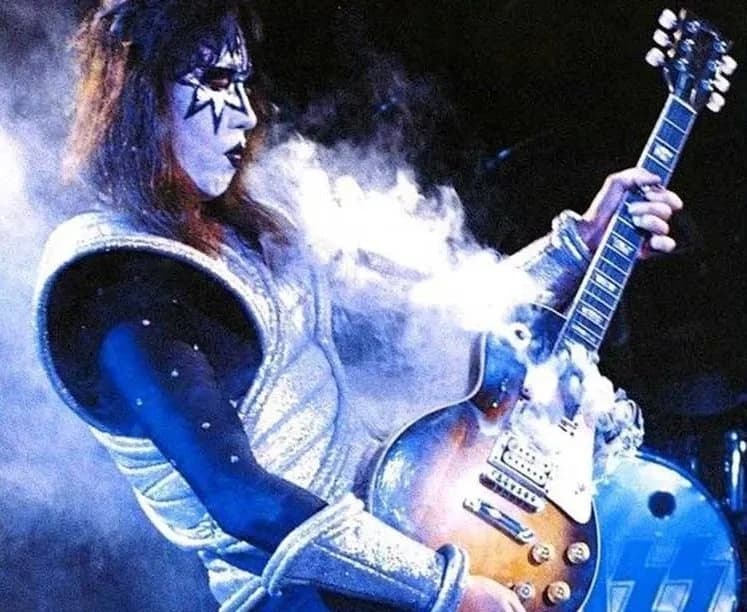
The first three studio albums — KISS, Hotter Than Hell and Dressed to Kill — presented the raw material: “Strutter”, “Deuce”, “Black Diamond”, “Hotter Than Hell”, “C’mon and Love Me” and “Rock and Roll All Nite”. In the studio, however, the band still did not sound as gigantic as it did onstage. KISS was, above all, a live experience: fire, fake blood, smoking guitars, platform boots, explosions, lights and an almost circus-like posture.
It was Alive!, in 1975, that transformed potential into phenomenon. The album did not merely capture the band’s energy; it sold the idea of belonging. Listening to Alive! was like entering an arena while still being in your bedroom. “Rock and Roll All Nite” became a manifesto because it condensed the band’s promise: party, catharsis, volume and collective identity.
1976-1979: commercial peak, mythology and excess
Destroyer lifted KISS to another level. Produced by Bob Ezrin, the record expanded the musical palette with more ambitious arrangements, urban narrative and drama. “Detroit Rock City” brought cinema into hard rock; “Beth” showed Peter Criss’ emotional force; “God of Thunder” consolidated Gene Simmons as an almost monstrous stage figure.
Rock and Roll Over and Love Gun returned the band to a more direct aesthetic, with dry riffs, strong choruses and guitars at the center. “Love Gun”, “I Stole Your Love”, “Christine Sixteen” and “Shock Me” reinforced the physical side of the band. “Shock Me”, Ace Frehley’s first major vocal showcase in KISS, also helped consolidate his persona as a charismatic, eccentric and indispensable guitarist.
By the end of the 1970s, KISS was more than a band. It was an empire: simultaneous solo records, comic books, licensed products, television, toys and an organized fan base. The problem was that excess also brought fatigue. The disco experiment of “I Was Made for Lovin’ You” showed adaptability, but it also divided part of the rock audience. Dynasty and Unmasked pointed to a band that was more pop, less threatening and internally fractured.
1980-1983: Peter’s exit, Eric Carr’s arrival and a crisis of direction
Peter Criss’ departure marked the first deep rupture in the myth. Eric Carr entered as The Fox and brought energy, precision and a clear desire to prove his value. He was not Peter, and that was exactly the challenge. The band had to convince the public that it could continue without one of the four original faces.
Music from “The Elder” was the riskiest bet of this period: a concept album far removed from the direct hard rock that had made the band famous. Over time, the record gained defenders, but at the time it deepened the crisis. Creatures of the Night, in 1982, corrected the route with huge drums, heavy guitars and a sound closer to heavy metal. Even so, Ace Frehley was already distancing himself from the creative dynamic, and KISS was moving toward a radical reinvention.
In 1983, the band removed the makeup on national television and released Lick It Up. The gesture was symbolic: KISS was abandoning the mask to try to survive in the age of MTV, visual metal and televised hard rock. Without makeup, Paul and Gene had to prove that there was still a band behind the mythology.
1984-1992: the unmasked era, Mark St. John, Bruce Kulick and reconstruction
Animalize, released in 1984, introduced Mark St. John on lead guitar. Technically fast and closer to the shred language of the 1980s, he participated in a moment of accelerated transition. His passage was brief, marked by health problems and difficulty fitting into the touring machine. Bruce Kulick took over the role and became the guitarist who gave stability to the unmasked phase.
With Asylum, Crazy Nights and Hot in the Shade, KISS entered a dialogue with the radio hard rock of the 1980s. Not everything from that period aged with the same strength, but it was essential to keep the band alive before a generation that consumed music through video clips. “Tears Are Falling”, “Crazy Crazy Nights”, “Hide Your Heart” and “Forever” show a band that was more polished, more melodic and less frightening, yet still capable of writing efficient choruses.
Revenge, from 1992, was a return to weight. With Eric Singer on drums after Eric Carr’s death, the record sounded harder, darker and more focused. For many fans, Revenge is the high point of the unmasked phase: less dependent on nostalgia, more consistent as a hard rock album and more aware of its own history.
1995-1996: MTV Unplugged, the acoustic set that changed everything and the return of the original lineup
MTV Unplugged was much more than an acoustic special. It was the moment when KISS realized, in front of the cameras and the audience, that the wound of the original lineup was still also its greatest commercial and emotional strength. Until then, the band had been defending its unmasked phase with Bruce Kulick and Eric Singer. There were good musicians, good records and a professional structure that worked. But when Ace Frehley and Peter Criss walked onstage to share songs with Paul Stanley, Gene Simmons, Bruce Kulick and Eric Singer, the energy changed category.
The acoustic format was decisive because it removed KISS’ armor. Without explosions, without blood, without platforms and without arena volume, what remained were songs, voices, glances and memory. “Beth”, “Nothin’ to Lose”, “2,000 Man” and “Rock and Roll All Nite” worked as a public reconciliation. The audience did not merely see former members playing together; it saw an interrupted story being given a chance to be retold.
That is the point that makes Unplugged so important. The reunion was not born only from commercial calculation, even though the market potential was obvious. It was born from an emotional realization: the imperfect chemistry between Paul, Gene, Ace and Peter still produced an electricity that no later lineup could fully replace. The acoustic set exposed that with a clarity that a pyrotechnic show might have hidden.
The fans’ response opened the path to the Alive/Worldwide Tour of 1996, with makeup, classic costumes and the original lineup reunited. It was one of the great nostalgia turns in modern rock. KISS understood before many others that memory could be a live experience, not merely an archival product. From that point on, the band operated again on a mythological scale: four characters, a gigantic stage, classic repertoire and a promise to return to the seventies dream.
1998-2004: Psycho Circus, internal tensions and the new replacement of characters
Psycho Circus was announced as the studio return of the original lineup, but the reality was more complex. Ace and Peter’s effective presence on the album was limited, and the project revealed that visual reunion did not necessarily mean a full reconstruction of the old internal democracy. Even so, the tour reinforced the strength of the classic imagination.
As the years passed, Ace and Peter left again. Eric Singer took over the drums using the Catman persona, and Tommy Thayer took over the guitar using the Spaceman persona. That decision became one of the most debated in the band’s history. For some, it preserved KISS’ iconography as theater of characters. For others, it diluted Ace and Peter’s authorship. The discussion is legitimate because it touches the center of the question: is KISS a band of people or a brand of characters?
The answer may be uncomfortable: it is both. KISS exists only because Paul, Gene, Ace and Peter gave humanity to the characters. But it also continued to exist because Paul and Gene understood the characters as symbolic property of the band. That tension is an inseparable part of the legacy.
2009-2023: final studio phase, final tours and physical farewell
Sonic Boom and Monster tried to present twenty-first-century KISS as a band still capable of recording new material inside its classic language. The albums did not redefine the story, but they showed a functional, professional lineup conscious of its own DNA: direct riffs, arena choruses, straight drums and solos built for the stage.
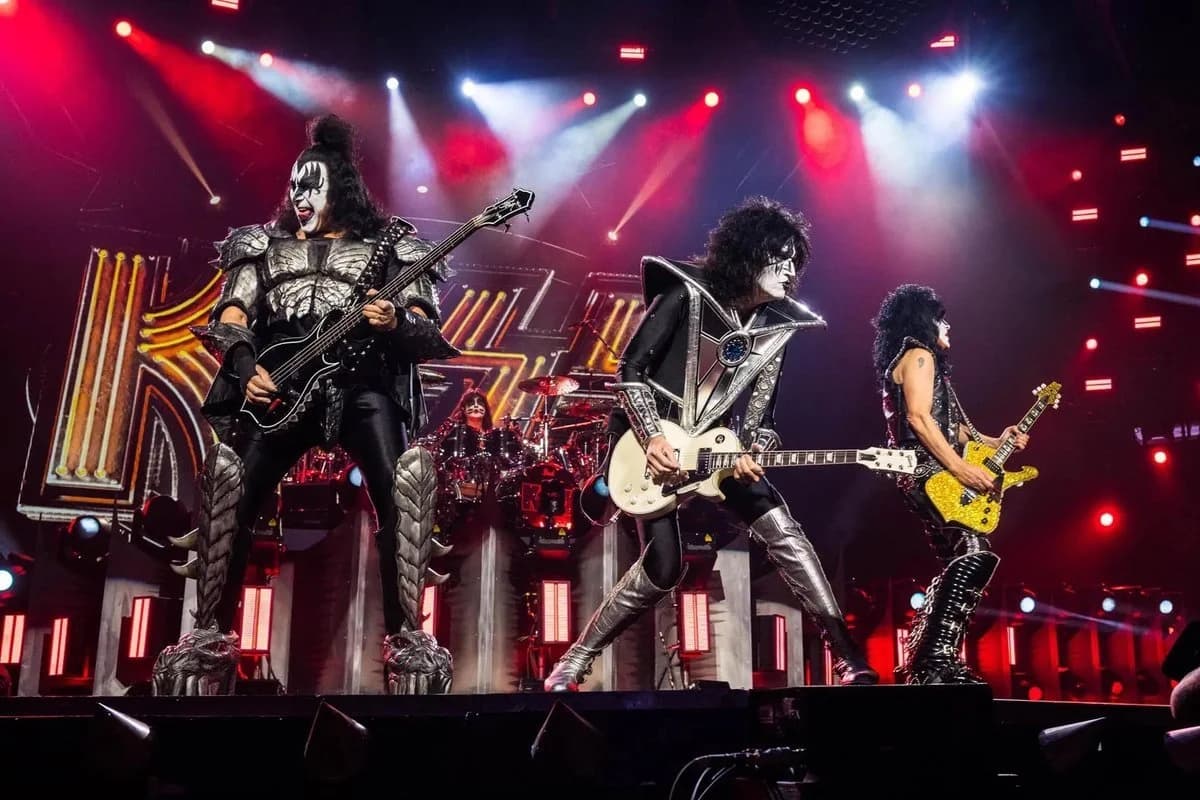
The End of the Road World Tour closed the era of regular touring with the Stanley, Simmons, Thayer and Singer lineup. The final show at Madison Square Garden in New York, in December 2023, carried obvious symbolic weight: the band ended its physical trajectory of major tours in the city where everything began. By revealing digital avatars as a possible continuation, KISS did something coherent with its own history. Since 1973, the band had never been only flesh and blood; it had always also been mask, character, drawing, product, spectacle and fantasy.
Deceased Members and Memory
To speak about KISS today requires treating its deceased members not as footnotes, but as fundamental parts of the narrative. The band always sold visual immortality, yet its real history is deeply human: illness, accidents, ruptures, reconciliations and losses. The contrast between the eternal image of the characters and the fragility of the musicians behind them is one of the most powerful elements of the KISS story.
Eric Carr was the first major loss. He entered under enormous pressure, because replacing Peter Criss meant touching the core of the original myth. Still, Eric did more than occupy a drum stool. He brought a heavier, more precise and more modern attack, especially on Creatures of the Night and in the 1980s tours. His death in 1991, at age 41, interrupted a trajectory of deep identification with the KISS Army. Revenge, released afterward, carries that shadow: it is a record of renewed force, but also of mourning.
Mark St. John represents a different story: that of a musician who passed through too quickly to be fully absorbed by the myth. His guitar on Animalize was in dialogue with the speed and technique of the time, but his live presence was limited. He died in 2007, at age 51, and his path often appears in fragmented form in narratives about the band. Even so, ignoring him impoverishes the story, because his brief passage helps explain how KISS tried to reposition itself within the hard rock of the 1980s.
Ace Frehley occupies another level. His death in 2025 definitively changed the way the band’s history is read. While Ace was alive, the tension between nostalgia, conflict and the possibility of reconciliation remained open in the imagination of fans. After his passing, the Spaceman stopped being only a charismatic former member: he became founding memory. His way of playing influenced guitarists precisely because it seemed reachable. He was not an academic virtuoso; he was a creator of phrases that sounded like songs inside the songs. For thousands of young players, Ace was proof that the guitar could be a character.
Essential Discography
| Album | Year | Why it matters |
|---|---|---|
| KISS | 1974 | Introduces the musical core: simple riffs, direct choruses and amplified club attitude |
| Hotter Than Hell | 1974 | Rawer, darker and dirtier; worshiped by fans for its heavy atmosphere |
| Dressed to Kill | 1975 | Brings “Rock and Roll All Nite” and consolidates the band as a factory of choruses |
| Alive! | 1975 | Turns KISS into a phenomenon and defines the live album as an arena experience |
| Destroyer | 1976 | Expands ambition, production and dramaturgy; includes “Detroit Rock City” and “Beth” |
| Rock and Roll Over | 1976 | Returns to direct hard rock with a more organic sound |
| Love Gun | 1977 | One of the definitive portraits of the classic lineup, with Ace highlighted on “Shock Me” |
| Creatures of the Night | 1982 | Repositions the band with weight, huge drums and a heavier language |
| Lick It Up | 1983 | Marks the unmasked era and the reinvention for MTV |
| Revenge | 1992 | High point of the unmasked phase, with weight, focus and more aggressive production |
| MTV Unplugged | 1996 | Document of the public reconciliation that opened the path to the classic reunion |
| Psycho Circus | 1998 | Ambiguous symbol of the visual return of the original lineup |
| Sonic Boom | 2009 | First studio album with the Stanley/Simmons/Thayer/Singer lineup |
| Monster | 2012 | Final studio album, reaffirming the direct hard rock of the final phase |
Sound, Guitars and Musical Language
KISS never depended on harmonic complexity to work. Its force lies in the architecture of impact: riffs that fit under the hand, choruses that fit inside the audience’s voice and arrangements that leave room for the stage to happen. Instead of sophisticated progressions, the band bet on movement, repetition and contrast.
Ace Frehley’s guitar was central to that formula. His solos rarely sound like technical exercises; they sound like melodic extensions of the song. Ace used pentatonics, bends, vibratos and phrases with a strong sense of identity. For a beginner guitarist, his solos are gateways. For an experienced guitarist, they teach a difficult lesson: memorability is worth more than an excess of notes.
Paul Stanley, in turn, is underrated as a rhythm guitarist. His function was to sustain the body of the songs with dry riffs, firm picking and stage sense. Gene Simmons played bass functionally, often prioritizing vocal and theatrical presence. Peter Criss brought swing and a certain elasticity that separated the classic lineup from a completely straight hard rock machine.
In the 1980s, the language changed. Vinnie Vincent brought more speed and tension; Mark St. John represented the shred aesthetic; Bruce Kulick offered technical balance, taste and versatility. On Revenge in particular, the band sounds heavier and less cartoonish, showing that there was musical substance beyond the makeup.
Aesthetics, Stage and Brand
KISS understood before almost everyone else that rock could be a multimedia experience. The band did not sell only albums; it sold a universe. The stage had fire, blood, smoke, platforms, explosions, guitars with effects, an elevated drum kit and a repertoire designed for collective participation. The audience was not an observer: it was part of the ritual.
The KISS Army was essential in that process. A KISS fan did not merely like the band; the fan belonged to a visually identifiable community. T-shirts, makeup, posters, action figures and album covers functioned as symbols of adhesion. That logic anticipated branding practices that today seem obvious in pop music, metal and franchise entertainment.
Critics frequently accused KISS of being more marketing than music. The accusation ignores that, in KISS, marketing and music are inseparable. The spectacle does not hide the song; it amplifies its function. “Detroit Rock City” is not only a track: it is an imaginary show opener. “God of Thunder” is not only a riff: it is the entrance of the Demon. “Rock and Roll All Nite” is not only a chorus: it is a collective oath.
Influences and Influenced Artists
Dark theatricality, stage horror and the idea of the show as staged performance helped open the path for the visual language that KISS would transform into a permanent system.
The glam dirt, New York attitude and visual provocation of the Dolls were important ingredients in KISS’ early aesthetic.
The influence appears in the idea of four recognizable identities, different voices, direct melodies and the construction of a collective universe.
Arena weight and the imagination of seventies rock dialogue with KISS’ ambition, even though the band preferred concision and choruses to long improvisations.
The glam metal of the 1980s directly absorbed the KISS lesson: visual identity, excess, theatrical danger and arena choruses could walk together.
Even within a much heavier aesthetic, later metal musicians recognized in KISS the importance of visual identity and the memorable riff.
Ace Frehley’s influence on guitarists who grew up in the 1970s and 1980s crossed styles and reached alternative rock.
Legacy
KISS’ legacy is paradoxical because the band was, at the same time, underestimated and impossible to ignore. Critics questioned its musical simplicity, but generations of fans learned guitar, stage presence and attitude through its songs. The band rarely sought progressive sophistication; it sought impact. And impact, in rock, is also a language.
The induction into the Rock and Roll Hall of Fame in 2014 recognized the original lineup as one of the most influential combinations of sound and image in rock culture. But KISS had already won before that: its iconography is recognized even by people who do not know the albums in depth. Few bands have such an immediate silhouette. Few transformed logo, makeup and characters into pop grammar.
MTV Unplugged remains one of the most revealing chapters because it showed that the band was not only explosion. When it unplugged the amplifiers and brought Ace and Peter back beside Paul and Gene, KISS found a rare form of vulnerability. The acoustic set did not diminish the band; it revealed its memory. From that moment on, the 1996 reunion did not feel merely like nostalgic spectacle, but like a symbolic repair for fans who had grown up waiting to see the four faces together again.
After the deaths of Eric Carr, Mark St. John and Ace Frehley, KISS also needs to be seen as a human archive. The brand can continue, the avatars can prolong the fantasy and the catalog can find new generations, but the real history remains tied to the musicians who gave body to the myth. Ace was not only the Spaceman; Eric Carr was not only Peter’s replacement; Mark St. John was not only a quick note in Animalize. All of them are part of a larger narrative about survival, reinvention and the emotional cost of keeping a legend alive.
MTV Unplugged in 1995 showed the emotional strength of the original lineup and helped pave the way for the makeup reunion in 1996.
Beyond being a founding guitarist, Ace is frequently associated with the creation of the classic logo and the construction of the Spaceman persona.
Even though he was not an original member, Eric Carr is remembered as one of the most beloved members in KISS history.
The physical farewell from major tours in 2023 was followed by the proposed digital continuity through avatars.