Basic Data
| Field | Information |
|---|---|
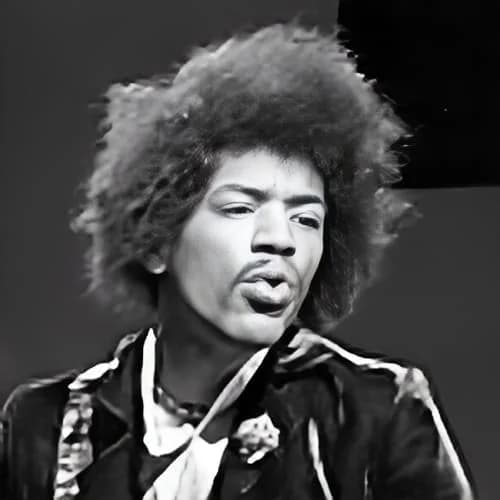
| Full Name | James Marshall Hendrix |
| Birth Name | Johnny Allen Hendrix |
| Stage name | Jimi Hendrix |
| Date of Birth | November 27, 1942 |
| Passed Away | September 18, 1970 (age 27) |
| Birthplace | Seattle, Washington, USA |
| Nationality | American |
| Genres | Psychedelic rock, electric blues, hard rock, R&B |
| Primary Instrument | Electric guitar |
| Nicknames | "The Voodoo Child", "The Electric Gypsy" |
Introduction
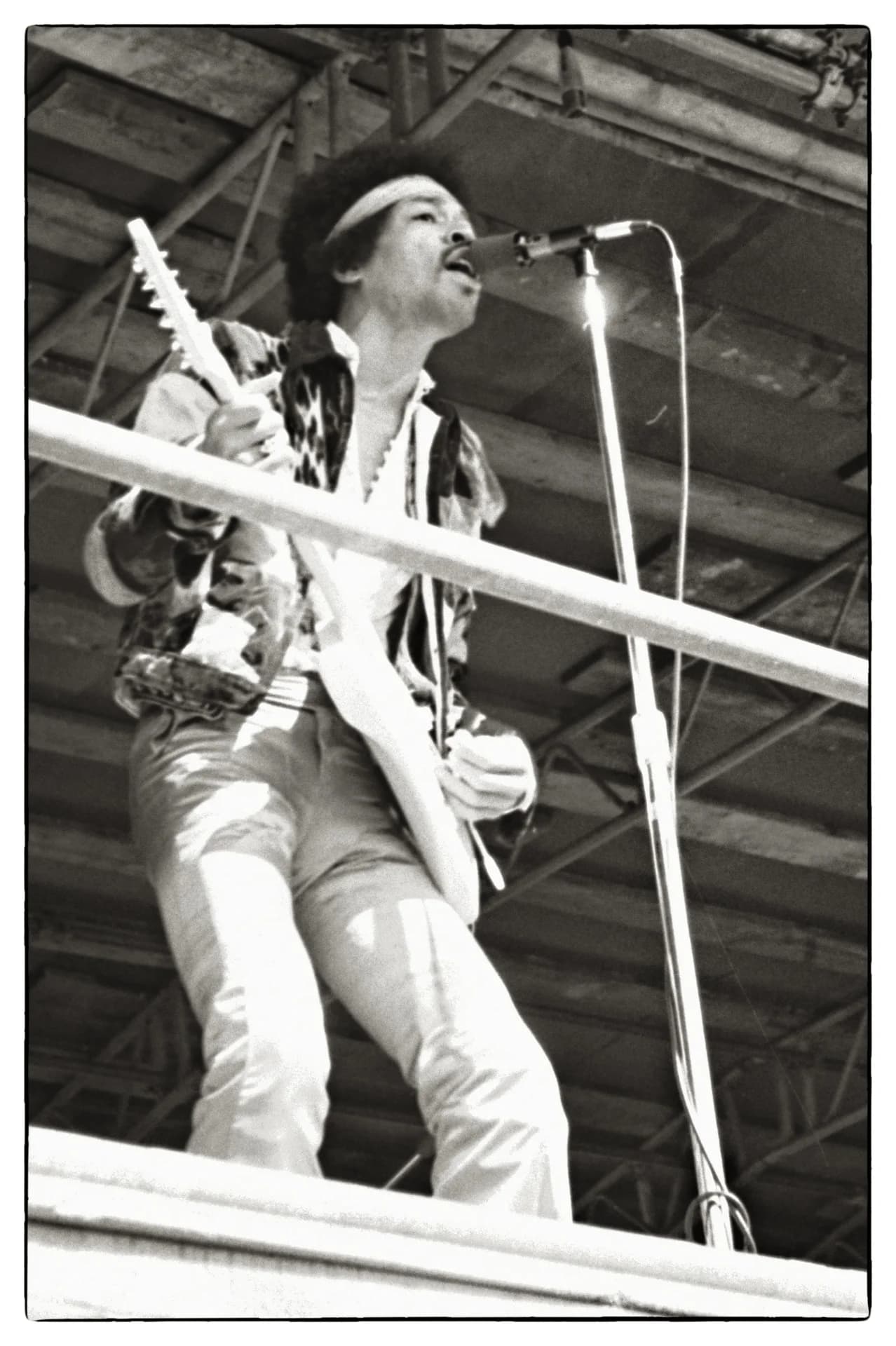
There are guitarists who play well. There are guitarists who play very well. And then there is Jimi Hendrix — a category entirely of his own, a phenomenon that happened exactly once in the history of music. In just four years of a mainstream career at the top (1966–1970), he transformed the electric guitar from a mere instrument into a visceral extension of the human body: capable of crying, screaming, whispering, and exploding with equal ferocity.
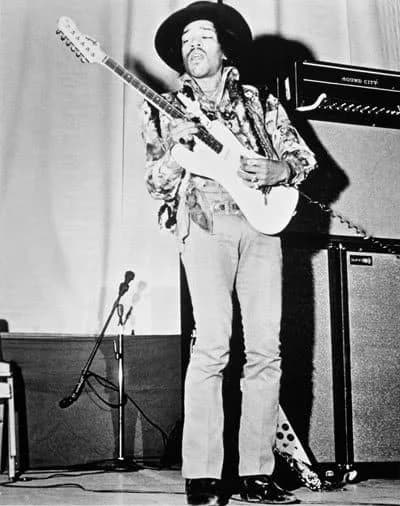
Hendrix did not invent the blues or rock. But he passed them through an unprecedented filter of psychedelia, feedback, and instinctive genius that no one has ever been able to replicate with the same natural ease. He played an inverted right-handed Stratocaster — a left-hander playing a right-handed guitar upside down without re-stringing it — extracting cosmic sounds that the sound engineers of his era could barely capture on tape. Eric Clapton, after watching him play for the first time in London, left the theater without saying a single word. There was simply nothing to say.
Hendrix's legacy goes far beyond mere notes. He redefined what was possible to achieve with distortion, wah-wah, and feedback — effects that other guitarists used with extreme caution, but which he transformed into an entirely new language. He died at 27, leaving only three studio albums. It was enough to change the course of music forever.
First Steps
James Marshall Hendrix was born in Seattle in 1942, the son of Al Hendrix and Lucille Jeter. His childhood was marked by instability: his mother passed away when he was only 15, and his father — who worked as a landscaper — raised the children with significant difficulty. It was Al himself who bought Jimi, still a teenager, his very first instrument: a one-string ukulele found among the belongings of an elderly neighbor who was clearing house.
At 15, Jimi got his first acoustic guitar for five dollars. Entirely self-taught — he never learned to read sheet music — he absorbed every single blues record he could possibly find. Muddy Waters was the earliest guitarist he became conscious of, listening to a record while still a small child. Then came B.B. King, Robert Johnson, and the first cutting sounds of rock and roll from Chuck Berry and Eddie Cochran.
In 1961, at 18 and with no great prospects, Hendrix enlisted in the US Army and served in the 101st Airborne Division — the legendary Screaming Eagles. It was there that he became a qualified paratrooper. But the guitar always spoke louder: he took it to the barracks and played relentlessly in his free moments. In 1962, he secured a discharge for inadequate conduct and went straight to pursuing music full-time on the highway.
The following years were ones of intense apprenticeship on the stages. Hendrix worked as a backing musician for names like Little Richard, Ike & Tina Turner, Sam Cooke, and The Isley Brothers — a tough school characterized by small stages and miserable pay. But it was exactly there that he developed the stage control and the wild interaction with the audience that would later define his own legendary shows.
Musical Influences
The very first guitarist Hendrix became conscious of. The Chicago blues and the raw power of the slide defined his relationship with the instrument starting from childhood.
The unmistakable vibrato of King and his highly vocal phrasing on the guitar lie at the deepest root of Hendrix's melodic approach in all his solos.
A blues giant who directly influenced Hendrix's bending techniques and deep emotional aggressiveness — especially his massive upward bends.
The mythology and mysticism of the Delta blues echo constantly in the lyrics and the dark atmosphere of tracks like "Voodoo Child".
Besides having worked with him directly as a sideman on the road, Hendrix heavily absorbed the theatricality and sheer show-business extravagance of the "Tutti Frutti" man.
The destruction of instruments physically on stage and the visceral energy of their shows directly influenced Hendrix's theatrical performance — ultimately culminating in the infamous burning of his guitar at the Monterey Pop Festival.
Bands and Projects
| Band / Project | Period | Notable Albums |
|---|---|---|
| Sideman (Little Richard, Isley Brothers etc.) | 1963–1966 | — |
| The Jimi Hendrix Experience | 1966–1969 | Are You Experienced (1967), Axis: Bold as Love (1967), Electric Ladyland (1968) |
| Gypsy Sun and Rainbows | 1969 | — (Woodstock, no studio album records) |
| Band of Gypsys | 1969–1970 | Band of Gypsys (live, 1970) |
Instruments and Equipment
Main Techniques
Hendrix was the first individual to transform feedback — the howling return sound looping between a guitar and an amplifier — from an audio problem into a highly expressive tool. By physically bringing his guitar closer to the amplifier at very specific angles, he controlled the precise pitch and duration of the feedback with surgical precision. In "Foxy Lady", the introductory feedback screech is a perfect example: it isn't an accident, it is deliberate composition.
Hendrix frequently wrapped his thumb entirely over the top edge of the guitar neck to press down the bass strings — especially the low E — thereby freeing up his other four fingers to play chords, melodies, and ornaments simultaneously. This allowed him to play the bassline, the rhythm harmony, and the lead melody all at the very same time, completely solo. Listen to "Little Wing" closely and you will immediately notice this impossible polyphony occurring on a conventional guitar.
While the vast majority of guitarists used the wah pedal merely as a rhythmic sweep effect, Hendrix utilized it directly as an extension of his vocal cords — making the guitar literally "speak". He actively synchronized the sweeping movement of the pedal with his melodic phrases, creating an almost vocal-like crying effect. "Voodoo Child (Slight Return)" famously opens with this melodic wah that immediately establishes the massive atmosphere of the entire track.
Hendrix's bending is extremely characteristic: typically pushed aggressively upwards (much like Albert King, his primary model), with a very wide and deeply expressive vibrato applied right at the very peak of the note. It is not the classic, refined vibrato of B.B. King — it is much wider, far more emotional, sometimes even successfully reaching an aggressive third interval within the bend. In "Red House" this is demonstrated with brutal, unrelenting clarity.
Hendrix used the Stratocaster's tremolo arm as a constant, indispensable tool of expression — abrupt dive bombs, subtle warbling vibratos, and deep descending glissandos. In "Star Spangled Banner" at Woodstock, he famously simulated dropping bombs, screaming sirens, and weeping individuals utilizing the tremolo arm combined heavily with feedback and wah. It remains an absolute masterclass in musical theater executed with just a single piece of wood and steel.
Essential Songs
Curiosities
Hendrix essentially began his journey with a ukulele possessing only a single string, discovered among the humble belongings of a recently deceased neighbor. With this incredibly primitive instrument, he slowly learned to reproduce complex melodies solely by ear — the undeniable foundation of his entire self-taught, instinctual musicality.
Before fully becoming a massive rock superstar, Hendrix was a fiercely trained paratrooper stationed in the 101st Airborne Division of the US military. He ultimately secured a discharge in 1962 — officially according to Army reports, for consistently inadequate behavior. However, according to Hendrix himself, it was actively because they quickly realized he was an absolutely terrible soldier.
Bob Dylan enthusiastically stated to the public that Hendrix's electric version of "All Along the Watchtower" was genuinely superior to his own acoustic foundation. "It's my song, but it's his now," Dylan remarked. It remains one of the absolute highest compliments that a legendary songwriter can possibly pay to a performing interpreter.
Eric Clapton saw Hendrix play for the very first time in London directly in 1966 and promptly left the club entirely silent and visibly troubled. In numerous later interviews, he openly admitted that he seriously considered aggressively quitting the guitar — utterly convinced he would never, ever be able to play at that celestial level. He eventually walked back on this a few days later.
The legendary defining performance was initially scheduled to close the massive festival on the prior evening, but massive delays caused Hendrix to finally step onto the muddy stage at 9 AM the next morning. Of the original 400,000 attendees, only a meager 30,000 to 40,000 had remained. The blistering performance of "Star Spangled Banner" under those thoroughly exhausted conditions remains one of the most incredibly iconic moments in recorded music history.
In an extensive television interview with host Dick Cavett in late 1969, Hendrix openly confirmed that he had never, ever learned to read formal sheet music. But he mentally processed music synesthetically — intimately associating individual musical notes and deep emotions with specific vibrant colors. "Jealousy is purple. Anger is purple. Envy is green," he eloquently explained.
Mere months prior to his tragic passing, Hendrix proudly inaugurated Electric Lady Studios squarely in Greenwich Village, New York — his very own personal studio, architecturally constructed inside an old, defunct nightclub. The legendary studio actively exists and operates to this day and has historically recorded icons like David Bowie, Led Zeppelin, The Clash, and Beyoncé.
Legacy and Influence
Jimi Hendrix tragically died on September 18, 1970, in London, of asphyxiation after fatally mixing aggressive barbiturates and hard alcohol. He was 27. He left merely three core studio albums, an absolute mountain of scattered posthumous recordings, and a massive, gaping hole in the universe of the electric guitar that absolutely no one has ever managed to fill since.
His colossal impact is actively measurable in deep layers. Technically speaking, Hendrix forcibly blew open the vocabulary of the electric guitar in ways that highly skilled guitarists of heavily subsequent generations are still thoroughly exploring today: his highly expressive use of untamed feedback, his seamless integration of chaotic effects as melodic language, treating the wah pedal as his primary vocal instrument, and effectively transporting the highly emotional, root-level blues bending straight into intense, heavy rock. There simply is no rock, blues, or metal guitarist trained after 1967 who does not actively pass, either directly or indirectly, right through the monumental influence of Hendrix.
But the legacy travels even further beyond the guitar itself. Hendrix was notably one of the very first prominent Black artists to utterly dominate the predominantly white rock scene of the era — and to actively do so entirely on his own uncompromising terms, without a single concession. His towering presence at Woodstock, his fiery destruction of his own instrument at the Monterey Pop Festival, and his fierce, politically-charged reinterpretation of the "Star Spangled Banner" were profound cultural gestures that widely transcend mere music. Above all else, he was an artist who fiercely refused to be neatly defined by any rigid category or limit.