Basic Info
| Field | Information |
|---|---|
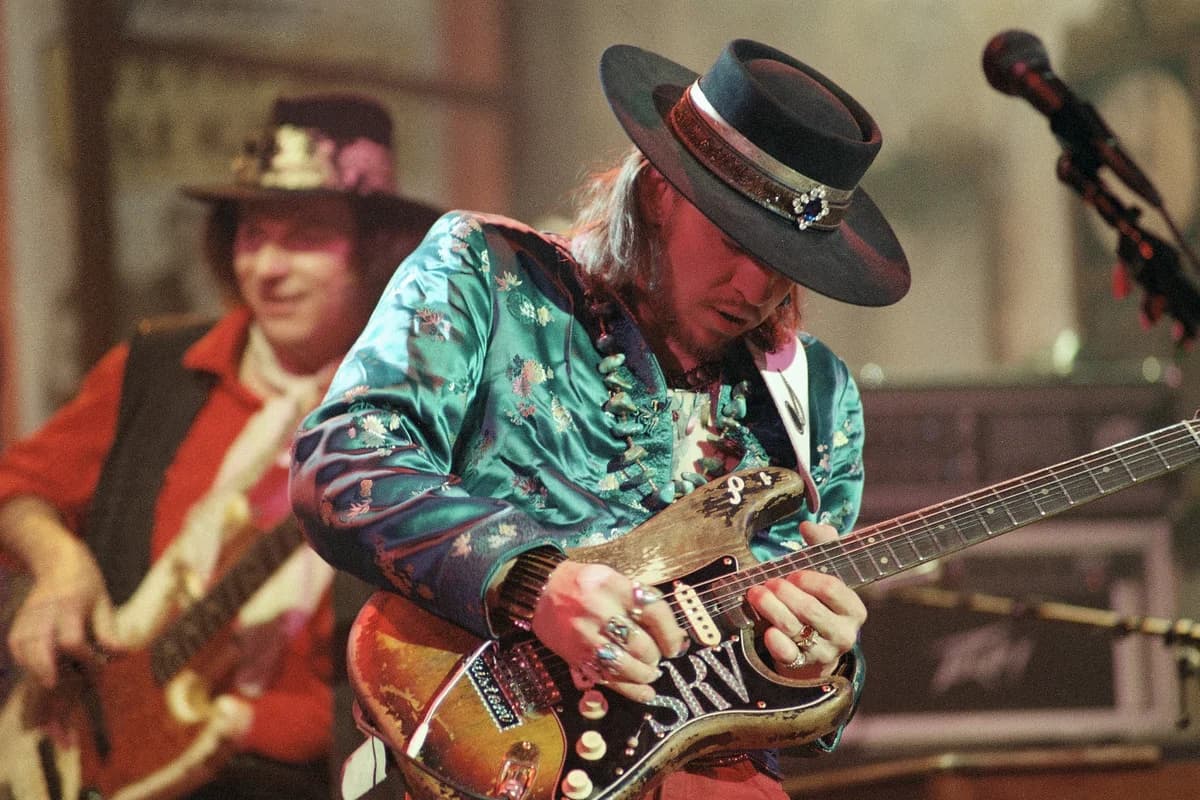
| Full name | Stephen Ray Vaughan |
| Nickname | SRV |
| Date of birth | October 3, 1954 |
| Passed away | August 27, 1990 |
| Birthplace | Dallas, Texas, USA |
| Nationality | American |
| Genres | Texas Blues, Blues Rock, Hard Rock |
| Instrument | Electric guitar |
Introduction
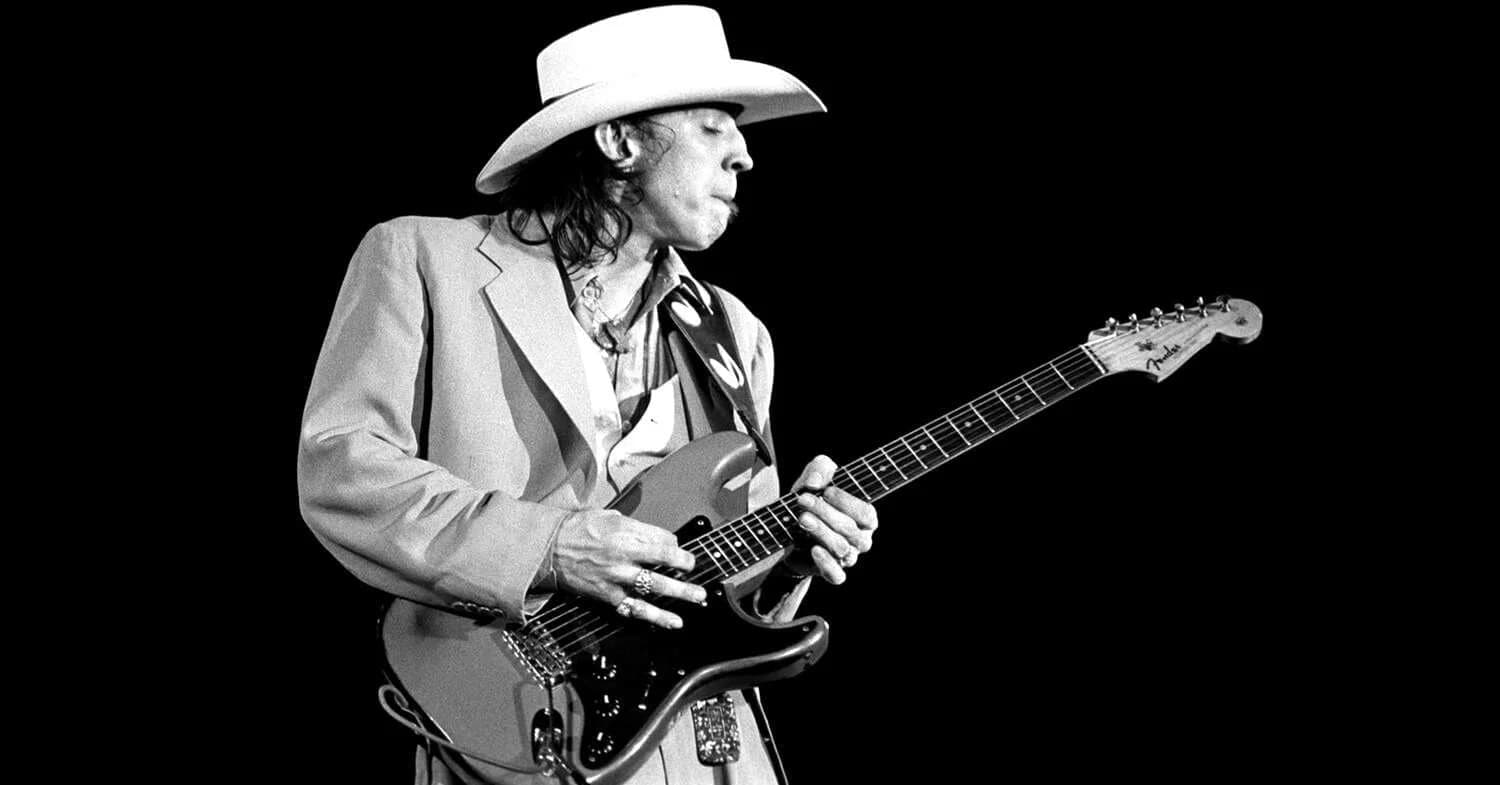
There are guitarists who play the blues. And then there was Stevie Ray Vaughan — a man who was the blues in human form. When he pressed his fingers onto the strings of his battered Stratocaster, something happened that music theory can never fully explain: the sound bled. In every note there was a confession, in every bend an ache transformed into joy, in every solo a story that anyone, in any language, could understand.
SRV emerged at a moment when blues had been pushed to the margins of popular culture. It was 1982, and the world was obsessed with synthesizers and polished production. Stevie Ray Vaughan stepped onto the stage at the Montreux Jazz Festival — the first unsigned act ever to perform at the event — and played with a ferocity that made the crowd rise to its feet and sent David Bowie racing backstage to introduce himself. Within months, blues had returned to center stage.
His mainstream career lasted just seven years. Seven years to record five studio albums, resurrect a genre, and leave a mark so deep that guitarists like John Mayer, Gary Clark Jr., and Kenny Wayne Shepherd have spent decades trying to capture a fraction of what he made look effortless. On August 27, 1990, a helicopter crash in Wisconsin took SRV at 35. The blues lost its greatest modern voice. The world still mourns.
Early Life
Stephen Ray Vaughan was born on October 3, 1954, in Dallas, Texas, the son of Martha Jean and Jimmie Lee Vaughan. He grew up in Oak Cliff, a working-class neighborhood in south Dallas, in a family that breathed music. His older brother, Jimmie Vaughan — who would go on to front the Fabulous Thunderbirds — was his first major influence. Stevie began imitating his brother as a small child, grabbing any instrument he could find around the house.
By age eight he was already playing guitar with obsessive dedication. Before that, he had even resorted to gripping a broom handle and pretending it was an instrument — such was his need to have something in his hands. While most kids his age were outside playing ball, Stevie was inside dismantling records one by one: Jimi Hendrix, Albert King, B.B. King, Lonnie Mack. He wasn't learning songs — he was absorbing entire worlds.
At 17, Stevie Ray dropped out of high school and moved to Austin, Texas, which at the time was the epicenter of the country's blues scene. Austin was a city that took live music seriously, with clubs open every night and an audience that understood what it was hearing. Stevie spent years playing in various lineups before finding the definitive band that would make him immortal.
Musical Influences
The number one influence, by SRV's own admission. From King came the bending approach — especially the technique of bending upward from low notes in the minor scale, creating that piercing tension known as the "Albert King sound." SRV absorbed it so completely that he made it entirely his own.
Absolute freedom and the conviction that the guitar can do anything. Hendrix showed Vaughan that expression has no technical limit — and SRV responded with a version of "Little Wing" that many consider deeper emotionally than the original. Both share the quality of making the guitar sound like a living thing.
The vocabulary of vibrato and the art of making a single note last an eternity. From B.B. King, SRV learned that in the blues less is more — but that "less" must carry a specific weight that only comes from decades of listening and experience.
Direct attack and brute force channeled with precision. Freddie King had a way of hitting the strings that entered the amplifier like a punch, and Vaughan developed his own full-arm attack — using the entire forearm, not just the wrist — directly from this reference.
Frenetic whammy bar tremolo and controlled speed. Mack was one of the fastest blues guitarists of the 1960s, and SRV absorbed his ability to accelerate and decelerate within a phrase as an expressive act, not merely a technical one.
The older brother was the first teacher, first inspiration, and the mirror against which Stevie measured his progress for years. Jimmie had a more economical, elegant style — and that influence surfaces in the moments when SRV chose the right note instead of ten.
Beyond the individual influences listed above, Stevie Ray also frequently cited Buddy Guy, Albert Collins, Guitar Slim, and the jazz of Wes Montgomery and Django Reinhardt as references that broadened his harmonic vocabulary.
Bands and Projects
| Band / Project | Period | Notable Albums |
|---|---|---|
| Cast of Thousands / Triple Threat Revue | 1972–1978 | — |
| Stevie Ray Vaughan and Double Trouble | 1978–1990 | Texas Flood (1983), Couldn't Stand the Weather (1984), Soul to Soul (1985), In Step (1989) |
| Sessions with David Bowie | 1982–1983 | Let's Dance (1983) |
| Family Style (with Jimmie Vaughan) | 1990 | Family Style (1990, posthumous) |
Instruments and Gear
Key Techniques
SRV inherited from Albert King a bending approach that sounds like a singer deliberately going off — and landing perfectly. He bends strings using three fingers together (index, middle, and ring) for maximum strength, reaching intervals of up to two and a half tones with absolute pitch accuracy. What sets his bending apart is the moment he attacks the note: usually slightly behind the beat, creating a feeling of contained urgency. Heard to perfection on "The Sky Is Crying" and "Riviera Paradise."
SRV's vibrato is instantly recognizable: wide, deep, and consistent. Executed primarily with the entire wrist rather than just the fingers, it produces a pitch oscillation that brings the guitar close to a blues vocalist's vibrato. Speed varies with emotional intensity — fast and frantic at peaks, slow and tearful at moments of resolution. It's the kind of vibrato that keeps a note sounding alive two seconds after it's played.
Unlike most guitarists who pivot from the wrist, SRV used his entire forearm to attack the strings. That larger-amplitude motion transferred far more energy to the amplifier — literally pushing the Vibroverb tubes into saturation with physical force. Combined with .013-gauge strings tuned a half-step down (to Eb), the result was a sound with a mass and presence that no pedal setup can replicate without that physical component.
SRV used double stops — two notes played simultaneously — with a frequency and creativity drawn directly from Robert Johnson and Chuck Berry, but transformed into a high-voltage context. In "Pride and Joy," the double stops in the rhythm groove create a texture that sounds like two guitarists playing at once. In solos, they appear as expressive punctuation between pentatonic scale phrases, adding harmony and texture where other guitarists would put single notes.
Essential Songs
Trivia
SRV used .013 to .058 gauge strings — virtually a slide guitar setup — and still tuned them a half-step down (to Eb). This created considerable physical tension and demanded unusual strength for bends. Many guitarists who try to replicate his tone in standard configuration quickly discover that the secret lies as much in the physics as in the technique.
John Mayer, one of the most successful guitarists of the next generation, considers SRV his absolute hero and has the initials "SRV" tattooed on his arm. Gary Clark Jr., Kenny Wayne Shepherd, and Jonny Lang are among others who cite Vaughan as the reason they picked up a guitar.
According to reports from band members and crew, in the week before his death, SRV shared that he had a disturbing dream in which he was at his own funeral watching thousands of people gathered around the casket. He was in exceptional form at that Alpine Valley show — the last he would ever play.
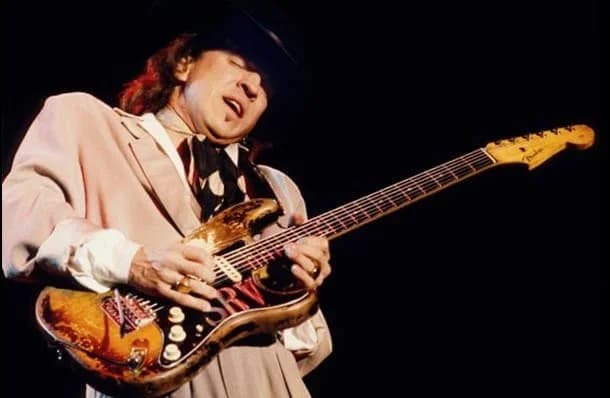
The legendary "Number One" Stratocaster was not on the aircraft that went down. It was being transported by road with the rest of the tour equipment. The guitar outlived its owner and is now in the possession of the Vaughan family — an object of near-religious devotion to the blues community.
Legacy and Influence
Stevie Ray Vaughan died at 35, but what he left behind is disproportionate to the time he had. In seven years of mainstream career, he didn't just resurrect the blues as a commercially viable genre — he established a new technical and expressive standard for the electric guitar that still serves as a reference today.
Guitarists like John Mayer, Gary Clark Jr., Kenny Wayne Shepherd, Jonny Lang, and Derek Trucks have built entire careers in a tradition that SRV helped redefine. Each of them cites Vaughan not just as a musical influence but as a reason for existing — the reason they decided the guitar was worth a lifetime of dedication.
In 2015, Stevie Ray Vaughan was posthumously inducted into the Rock and Roll Hall of Fame, alongside Double Trouble members Chris Layton, Tommy Shannon, and Reese Wynans. In 2003, Rolling Stone placed him at number 12 on its list of the 100 greatest guitarists of all time — a ranking that undersells the real impact he had.
But SRV's legacy doesn't live in lists or trophies. It lives in every guitarist who ever pressed pick to string and tried to make the instrument cry. It lives in the club nights in Austin, where musicians still play the same blues he played on those same streets forty years ago. It lives in the way music can be at once completely honest and completely transcendent.
Stevie Ray Vaughan proved that the electric guitar — when played with the whole heart — is capable of speaking directly to the human soul. That has no expiration date.